4 min read
Stay updated with the latest - Click here to follow us on Instagram

Journalism of Courage



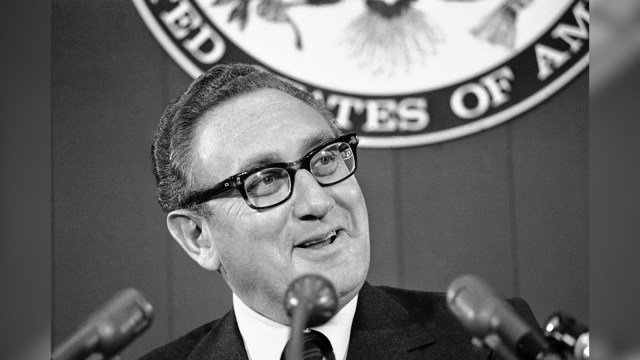 US Secretary of State Henry Kissinger briefs reporters, Oct. 12, 1973, at the State Department in Washington. (AP, file)
Henry Kissinger, a controversial Nobel Peace Prize winner and the top American diplomat who played a key role in shaping the US foreign policy under Presidents Richard Nixon and Gerald Ford, died in his home in Connecticut on Wednesday. He was 100.
His consulting firm, Kissinger Associates Inc, announced the death but did not give a cause.
Kissinger is the only American to serve as both White House Secretary of State and National Security Adviser at the same time. He played a pivotal role in several key world events including the Paris Peace Accords with North Vietnam, expanding Israel’s ties with its Arab neighbours, the US-Soviet arms control talks, and opening of diplomatic relations with China in the early 1970s.
Born as Heinz Alfred Kissinger to a Jewish family in Furth, Germany, the scholar moved to the US with his family in 1938 as the Nazi regime was gaining power in Europe. He became a naturalised citizen of the US in 1943 and adopted the anglicised version of his first name.
Kissinger served in the Army in Europe in World War Two, following which he earned a master’s degree and doctorate from Harvard University, and went to become a faculty member for 17 years.
He joined then-US President Nixon’s campaign as the White House National Security Adviser in 1968, and went on to be a pivotal part in driving the American line on the bloody Vietnam war. His policies in Vietnam, and later, in Cambodia, have been criticised for placing US strategic interests over human rights.
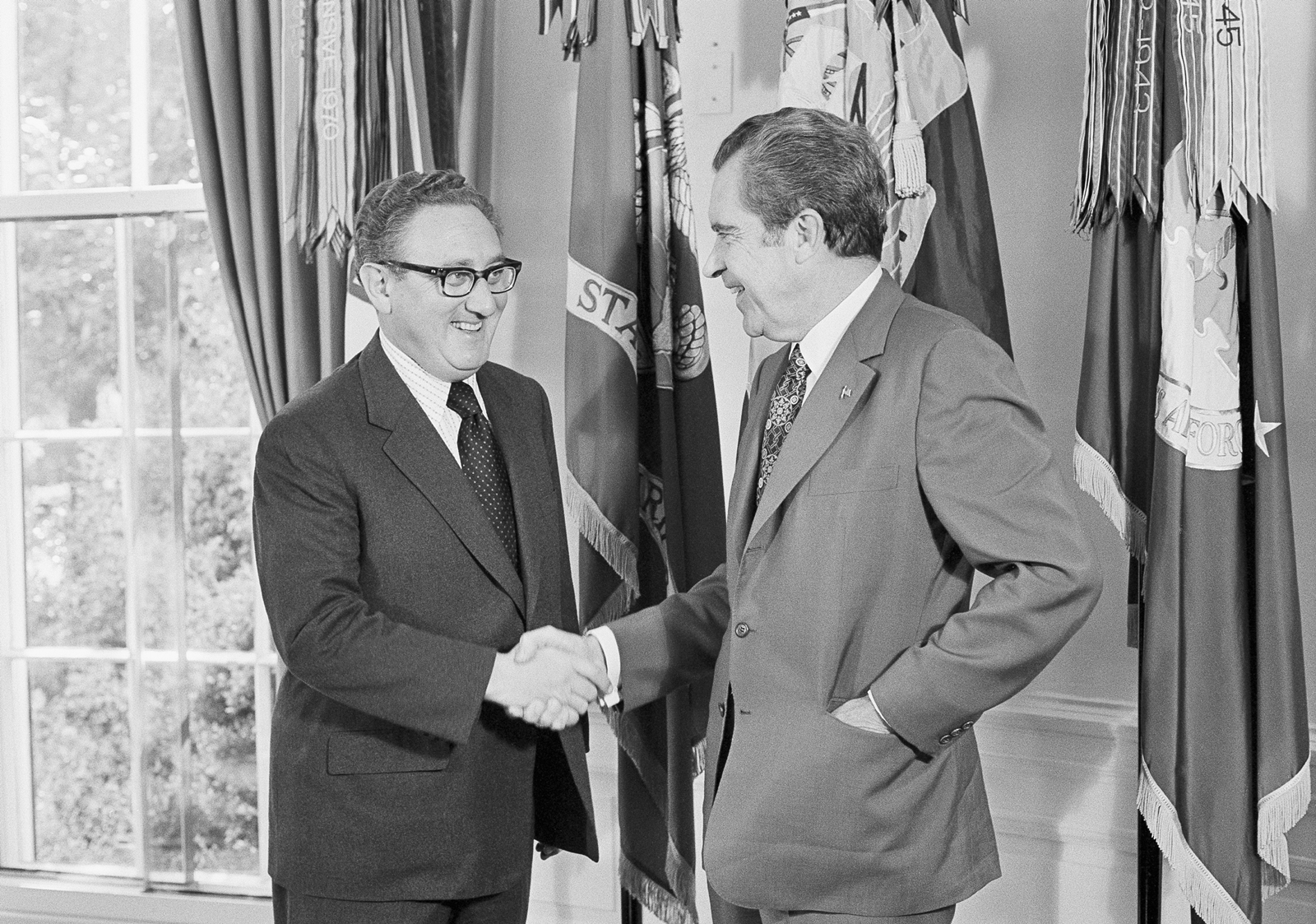 US President Richard Nixon, right, offers his congratulations to Secretary of State Henry Kissinger, after the secretary won the 1973 Nobel Peace Prize, in the Oval Office of the White House in Washington, Oct. 16, 1973. (AP, file)
“Critics held Dr Kissinger responsible for the 1969 ‘secret bombing’ of neutral Cambodia and for the American ground invasion of that country the following year, which expanded the conflict in Southeast Asia and led to a takeover of the country by the murderous Khmer Rouge,” The Washington Post wrote in its obituary.
During his tenure, he has also been accused of having a hand in numerous coups around the world, including those in Cyprus and Chile, and for supporting Pakistan during the pre-secession protests in now-Bangladesh, with his critics branding him a war criminal.
In his book titled ‘Ending the Vietnam War’, Kissinger wrote “History presents unambiguous alternatives only in the rarest of circumstances. Most of the time, statesmen must strike a balance between their values and their necessities, or to put it another way, they are obliged to approach their goals not in one leap but in stages, each by definition imperfect by absolute standards. It is always possible to invoke that imperfection as an excuse to recoil before responsibilities, or as a pretext to indict one’s own society.”
Kissinger was awarded the Nobel Peace Prize “for jointly having negotiated a ceasefire in Vietnam in 1973”. In a letter to the committee, Kissinger said that he accepted the award “with humility,” adding, “I am deeply moved by the award of the Nobel Peace Prize, which I regard as the highest honour one could hope to achieve in the pursuit of peace on this earth.”
However, his counterpart, North Vietnam’s chief negotiator Le Duc Tho, who was jointly awarded the Nobel in 1973, refused to accept it. The controversial choice also resulted in two members of the Peace Prize committee leaving it in protest for the first time in its history.
“Political satire became obsolete when Henry Kissinger was awarded the Nobel Peace Prize,” musician Tom Lehrer famously commented, as per a Reuters report.
Stay updated with the latest - Click here to follow us on Instagram