24 min read

© IE Online Media Services Pvt Ltd



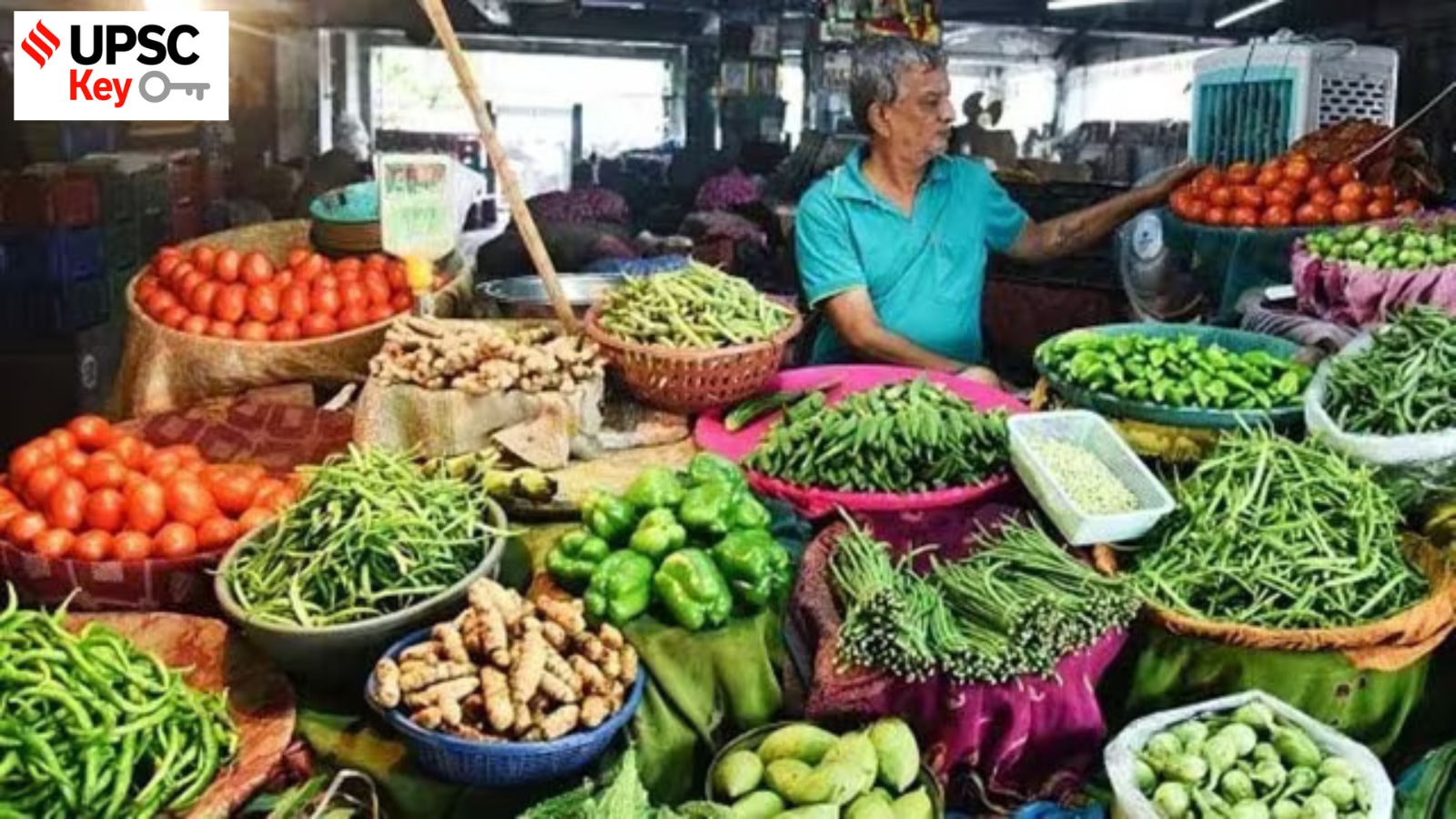 Households spending relatively less on food with rising incomes over time shouldn’t surprise. What’s interesting, though, is the kind of food items on which they are spending more or less. Know more in our UPSC Key. (Source: Express photo)
🚨 Attention: UPSC Key is now all 7 Days a Week!🚨
Important topics and their relevance in UPSC CSE exam for June 8th, 2024. If you missed the June 7th, 2024 UPSC CSE exam key from the Indian Express, read it here.
🚨 The Indian Express UPSC Essentials brings to you the May edition of its monthly magazine. Click Here to read. Share your views and suggestions in the comment box or at manas.srivastava@indianexpress.com🚨
UPSC Syllabus:
Preliminary Examination: Economy
Mains Examination: GS-III: Economy
What’s the ongoing story- The Reserve Bank of India Friday left the repo rate unchanged at 6.5 percent on concerns over the rise in food inflation, and revised upwards the real gross domestic product (GDP) growth projection for 2024-25 to 7.2 percent.
Prerequisites:
— What is a repo rate?
— What is the consumer price index (CPI) headline inflation?
— What is the Monetary Policy Committee (MPC)?
— What is disinflation?
Key takeaways:
— The central bank retained the FY25 consumer price index based inflation (CPI) projection at 4.5 per cent but indicated that it will fall below 4 per cent during the July-September quarter.
— The policy panel kept the repo rate unchanged in a 4:2 majority decision as inflation remains above the 4 per cent target. India’s retail inflation rate was 4.83 per cent in April 2024, down from 4.85 per cent in March 2024. The overall tone of the policy remained cautious with upside risk to food inflation from current heat wave conditions.
For Your Information:
— The repo rate is the interest rate at which the RBI lends money to commercial banks. When RBI wants to incentivise economic activity in the broader economy, it reduces the repo rate, which makes it cheaper for banks to borrow from it and lend onwards to customers.
— When it wants to disincentivise economic activity, it raises the repo rate, which makes it costly for everyone in the economy to borrow money.
— The primary objective of the RBI’s monetary policy is to maintain price stability while keeping in mind the objective of growth. Price stability is a necessary precondition to sustainable growth.
— By law, the RBI is required to target an inflation rate of 4%, which means that the general price level should go up by 4% from one year to another. Research suggests that this is the sweet spot where producers have an incentive to produce (and earn more) without being a huge disincentive for consumers (for whom inflation reduces purchasing power).
Points to Ponder:
— What does the RBI use the various tools to control inflation?
— What is the inflation target?
— What is the composition of the MPC?
— Why does the government care about the inflation?
Post Read Question:
With reference to the Indian economy, consider the following statements: (UPSC CSE 2022)
1. If the inflation is too high, Reserve Bank of India (RBI) is likely to buy government securities.
2. If the rupee is rapidly depreciating, RBI is likely to sell dollars in the market.
3. If interest rates in the USA or European Union were to fall, that is likely to induce RBI to buy dollars.
Which of the statements given above are correct?
(a) 1 and 2 only
(b) 2 and 3 only
(c) 1 and 3 only
(d) 1, 2 and 3
Other Important Articles Covering the same topic:
Everyday Economics: What is the RBI’s MPC, and what does it do?
Why has RBI policy panel kept repo rate unchanged, hiked GDP growth projection?
UPSC Syllabus:
Preliminary Examination: History of India
Mains Examination: GS-I: Indian Heritage and Culture
What’s the ongoing story- Three days after the 2024 Lok Sabha election results, in a meeting of the Bharatiya Janata Party (BJP)-led National Democratic Alliance (NDA) on Friday (June 7), Prime Minister Narendra Modi was unanimously elected as the coalition’s Parliamentary Party leader. The event took place at the Central Hall of the old Parliament building.
Prerequisites:
— Recent election verdict
— Location of the Parliamentary building complex
Key takeaways:
— The circular Central Hall, topped by a dome 98 feet in diameter, has witnessed several historical events since it was established in 1927,
— The Parliament House Complex in the heart of New Delhi contains several buildings: the new Parliament House that was opened last year; the old Parliament House, the iconic circular building that has now been renamed as Constitution House; Parliament House Annexe; and the Parliament Library Building.
— The Speaker of Lok Sabha is the custodian of the Parliament House Complex. Political parties and groups are allocated office space inside the complex.
— Central Hall was originally used as the library for the members of the legislature.
— In 1946, when the Constituent Assembly needed a space to meet to deliberate on the Constitution of independent India, Central Hall was refurbished and benches were added — its name was changed to Constituent Assembly Hall. The Constituent Assembly met at this venue for about three years between 1946 and 1949.
— It was primarily used for formal occasions such as the annual President’s Address to Members of both Lok Sabha and Rajya Sabha, and swearing-in ceremony of the President. It was also the venue for farewells of the President, and Parliamentary events like the outstanding Parliamentarian award ceremony.
For your information:
— The new Parliament building was inaugurated on May 28, 2023. It is designed by Ahmedabad-based HCP Design, Planning and Management under architect Bimal Patel.
— The new Parliament building has three storeys and a built-up area of 64,500 sqm. The Lok Sabha chamber will have 888 seats, up from the existing 543, with the option of expanded seating up to 1,272. The Lok Sabha will be used for joint sittings of both Houses in the absence of a Central Hall, which was the fulcrum of the old building.
Points to Ponder:
— What was the need for a new parliament complex?
Post Read Question:
Who is the chief architect of the new parliament building?
(a) Bimal Patel
(b) Arun Yogiraj
(c) B.V. Doshi
(d) Sanjay Puri
Other Important Articles Covering the same topic:
20 things you must know about India’s new Parliament
UPSC Syllabus:
Preliminary Examination: Current events of national and international importance
Mains Examination: GS-II: Education
What’s the ongoing story- Madhulika Sonkar writes: “The 2024 Lok Sabha election results have thrown up several issues to be decoded around social engineering experiments steered by political parties. It is a classic case study of how the often mundane agendas of education and employment for the young can become surprising centrepieces of politics.”
Prerequisites:
— Recent instances of paper leaks
— What are the Public Examinations (Prevention of Unfair Means) 2024?
Key takeaways:
— “Exam paper leaks and scams in Uttar Pradesh, Rajasthan, Madhya Pradesh, and Bihar, among other states, have been a key concern for young voters in the age group of 18-25.”
— “An investigation by The Indian Express (‘The big all India exam leak’, February 6) bears this out as 41 paper leaks over the last five years in 15 states affected 1.4 crore job seekers who had applied for over one lakh vacancies.”
— “In UP itself, three major competitive exams for government jobs were hit by question paper leaks in 2024. The latest in this list was the UP police constable recruitment exam in February, in which over 48 lakh candidates appeared.”
— “For each paper leak scandal, the question to be asked is: What must be the compensation for years of labour, exorbitant financial cost, and the emotional toll incurred by lakhs of candidates who pin all their hopes on the exam? Beneath this question is also the fatigue of reappearing for the exams and the fear of a new generation of aspirants joining the queue as exams get cancelled.”
— Even after passing the Public Examinations (Prevention of Unfair Means) 2024, the government ought to ask whether deploying special task forces to investigate the organised use of unfair means in examinations is constructive.”
Points to Ponder:
— What are the issues related to the paper leak in India?
— What are the provisions of the new Public Examination Bill?
— What is the impact of the paper leak on the mental health of the aspirants?
Post Read Question:
The inaction and lack of appropriate measures to curb the leaks are compounded by anxiety and disappointment among youth. Discuss.
Other Important Articles Covering the same topic:
The big all India exam leak: Over 5 years, 1.4 crore job seekers in 15 states bore the brunt
Explained: What’s in the new Public Examinations Bill, aimed at stopping cheating in exams?
UPSC Syllabus:
Preliminary Examination: Polity
Mains Examination: GS-II: Polity and Governance
What’s the ongoing story- In September last year, when the Women’s Reservation Bill was passed in Parliament, it raised hopes of a more gender-equal legislature.
Prerequisites:
— What is the status of women’s representation in the Parliament?
— What is the Women’s Reservation Act?
Key takeaways:
— The near-unanimous support for a Bill that promised 33 percent reservation to women in Lok Sabha and state assemblies…Yet, eight months on, with the 18th Lok Sabha set to convene for its first session in a few weeks, the number of women in the lower House has dropped, from 78 out of 543 (an all-time high) in the 17th Lok Sabha to 73.
— In the recent elections too, while the number of women who turned out to vote saw a dip in some phases, the overall gender gap was almost non-existent, with both male and female voter turnout pegged at about 66 percent by the Election Commission.
— Women have used the power that comes with their participation to shape electoral outcomes, with even political parties recognising the growing importance of the “woman vote”
— In West Bengal, for instance, the popularity of women-centric schemes such as Lakshmir Bhandar, a monthly cash transfer to over 2 crore women, is believed to have helped in sustaining the dominance of the ruling TMC. Earlier, the impact of Laadli Behna was seen to play a role in the BJP’s return to power in the Madhya Pradesh assembly polls.
— Countries like Norway, Sweden, Denmark and the Netherlands, with the highest female political representation, employ other kinds of affirmative action; parties in Sweden, for example, use the “zipper system”, wherein candidate lists alternate between male and female candidates.
— For India, the Women’s Reservation Bill is neither the beginning nor the end of the road to gender parity in politics — it is one milestone among many more to come.
For Your Information:
— India has elected 74 women MPs to Lok Sabha this year, four fewer than in 2019 and 52 more than in India’s first elections in 1952. These 74 women make just 13.63% of the elected strength of the Lower House, much less than the 33% that will be reserved for women after the next delimitation exercise.
Points to Ponder:
— What are the reasons for low women representation in the Lok Sabha?
— What is the significance of increased women representation in the Lok Sabha?
— What initiatives have been taken been by the government to increase women participation in the Parliament?
Post Read Question:
Which of the following constitutional amendments reserved one-third of all seats for women in Lok Sabha and State legislative assemblies?
(a) 101th Constitutional Amendment Act
(b) 103rd Constitution Amendment Act
(c) 104th Constitution Amendment Act
(d) 106th Constitution Amendment Act
Other Important Articles Covering the same topic:
Women’s reservation Bill gets President’s assent, becomes law
UPSC Syllabus:
Preliminary Examination: Economy
Mains Examination: GS-III: Economy
What’s the ongoing story- Households across the country’s rural and urban areas spent the highest share of consumption expenditure on ‘beverages, refreshments and processed food’ among food items in 2022-23, but some states bucked the trend in favour of other items — ‘milk and milk products’, and ‘egg, fish & meat’.
Prerequisites:
— What is the Household Consumption Expenditure Survey (HCES)?
— What is the need for HCES?
Key takeaways:
— In rural areas among all major states, the households of Haryana spent the maximum on ‘milk and milk products’ at 41.7 percent as a percentage of total expenditure on food, while Kerala spent the most on ‘egg, fish & meat’ at 23.5 percent.
For Your Information:
— The factsheet of the HCES survey report released earlier in February had shown that rural average monthly consumption spending per person increased to Rs 3,773 per month in 2022-23 from Rs 1,430 per person in 2011-12, a jump of 164 percent.
— This is higher than the 146 percent increase in urban average monthly consumption expenditure per person to Rs 6,459 in 2022-23 compared with Rs 2,630 per person in 2011-12.
— In rural India, food accounted for about 46 percent of the households’ consumption spending. In urban India, the share of food in average monthly per capita consumption expenditure (MPCE) in 2022-23 was about 39 percent.
— Among non-food items, households spent the most on conveyance in both rural and urban areas of almost all the major states.
Points to Ponder:
— What is the significance of HCES?
— What is the impact of inflation on the Household consumption expenditure?
Post Read Question:
Consider the following statements:
1. The Household Consumption Expenditure Survey (HCES) is conducted by the Niti Aaayog.
2. The survey aims to gather data on household consumption of goods and services and publish it every five years.
Which of the statements given above is/are correct?
(a) 1 only
(b) 2 only
(c) Both 1 and 2
(d) Neither 1 nor 2
Other Important Articles Covering the same topic:
With new consumption survey, the need for new indices
UPSC Syllabus:
Preliminary Examination: Economy
Mains Examination: GS-III: Economy
What’s the ongoing story- Gearing up to remain “future-ready for India’s fast-growing economy”, the Reserve Bank of India (RBI) has listed a series of aspirational goals, including capital account liberalisation and internationalisation of the Indian rupee (INR), universalising of digital payment system and globalisation of India’s financial sector in a multi-year timeframe.
Prerequisites:
— What is the internationalisation of the Indian rupee (INR)?
— What is the capital account?
— What is e-Rupee?
— What is the Capital account convertibility?
Key takeaways:
— The central bank has proposed enabling availability of the rupee to non-residents for facilitating cross-border transactions in the rupee and enhancing accessibility of rupee accounts to persons resident outside India (PROIs).
— India has not yet opened up its capital account fully which will allow free flow of capital to the country and outside. The rupee was made full float in the trade account during the 1991 reforms initiated by the then government.
— Meanwhile, on deepening and universalisation of Digital payment systems domestically and globally, the RBI’s agenda includes plans for the internationalisation of India’s Payment Systems (UPI, RTGS and NEFT) and participation in payment systems linkage projects across countries – bilateral and multilateral. It has planned to increase the domestic usage of digital payments and phased implementation of Central Bank Digital Currency (e – Rupee).
— On dealing with climate change, the RBI plans guidance for regulated entities (REs) to stress test their asset portfolio to assess impact of climate change and strengthening payment systems’ resilience to climate risks.
For Your Information:
— Capital account convertibility means the freedom to convert rupee into any foreign currency and foreign currency back into rupee for capital account transactions.
— The Tarapore committee had listed several preconditions such as fiscal consolidation, inflation control, low level of non-performing assets, low current account deficit and strengthening of financial markets for achieving capital account liberalisation.
Points to Ponder:
— What are the benefits of the internationalisation of the Indian Rupees?
— What are the concerns associated with the internationalisation of INR?
— What are the challenges of full capital account convertibility?
— What is the partial capital account convertibility?
Post Read Question:
Convertibility of rupee implies (UPSC CSE 2015)
(a) being able to convert rupee notes into gold
(b) allowing the value of rupee to be fixed by market forces
(c) freely permitting the conversion of rupee to other currencies and vice versa
(d) developing an international market for currencies in India
Other Important Articles Covering the same topic:
Internationalisation of rupee: Why and what are the benefits?
UPSC Syllabus:
Preliminary Examination: Economy
Mains Examination: GS-III: Economy
What’s the ongoing story- The Reserve Bank of India has proposed to set up a Digital Payments Intelligence Platform which will harness advanced technologies to mitigate payment fraud risks.
Prerequisites:
— What is the Digital Payment Infrastructure (DPI)?
— What is the domestic payment fraud?
— What is the bulk deposit?
Key takeaways:
— To take this initiative forward, the RBI has constituted a committee to examine various aspects of setting up a digital public infrastructure for the platform. The committee is expected to give its recommendations within two months.
— Domestic payment frauds jumped by 70.64 per cent to Rs 2,604 crore during the six-month period ended March 2024 from Rs 1,526 crore in the same period of last year.
— The Reserve Bank has proposed to revise the definition of bulk deposits as ‘single rupee term deposits of Rs 3 crore and above’ from the current limit of Rs 2 crore and above for commercial banks (excluding RRBs) and small finance banks.
— The RBI has decided to bring UPI Lite within the ambit of the e-mandate framework.
— The Reserve Bank has decided to rationalise existing guidelines on export and import of goods and services in line with the changing dynamics of cross-border trade transactions globally.
Points to Ponder:
— How is the RBI integrating new technologies in digital payment?
— What are the mechanisms for protection against digital fraud?
Post Read Question:
Which of the following statements is correct about the Digital Payment Index (DPI)?
(a) Niti Aayog has launched DPI to examine the full capital account convertibility.
(b) Launched by the Ministry of Finance to check digital fraud.
(c) Introduced by RBI to measure the extent of digitisation of payments across the country.
(d) The central government has introduced it to measure the integration of UPI in all digital payment modes.
Other Important Articles Covering the same topic:
Banks saw highest number of frauds in digital payments in FY23: RBI
UPSC Syllabus:
Preliminary Examination: Economy
Mains Examination: GS-III: Economy
What’s the ongoing story- Josh Felman and Arvind Subramanian write: India’s electoral shock poses a stunning economic puzzle. How is it possible that the electorate chastised rather than handsomely rewarded a leader who has presided over an astonishing economic boom?
Prerequisites:
— How is GDP measured in India?
— What is the nominal GDP and Real GDP?
— What is the Wholesale Price Index (WPI)?
— What is K-shaped recovery?
— What are the Fast-Moving Consumer Goods (FMCG)?
Key takeaways:
— “Within the economic community, it is no secret that there are many problems with Indian GDP measurement — faulty deflators, the failure to deflate inputs and outputs separately, outdated sectoral weights, poor measurement of the large informal sector.”
— “In the past two years, the nominal and real GDP numbers have been telling two completely different stories. According to the nominal GDP numbers, growth has sharply decelerated from 14.2 per cent to 9.6 per cent. But the real GDP numbers show that growth has surged from 7 to 8.2 per cent. The only way to square these numbers is if broad inflation has completely collapsed, falling to just 1.4 per cent. This seems highly implausible.”
— “Some analysts have argued that the electorate was dissatisfied because the fruits of growth have been shared unequally. In this K-shaped view, government policies enabled the very rich to gain at the expense of the poor.”
— “In sum, there are only two ways to reconcile the economy and the voting results. We would suggest that growth has not been as dynamic as the official numbers suggest, nor has it been very balanced…As a result, the unskilled people working in the agricultural, informal, and manufacturing sectors — the bulk of the workforce and voters — experienced the economy in a way that accords with ground-level reporting: that is, negatively.”
Points to Ponder:
— What are the issues with the Production-Linked Incentives (PLI) scheme?
—Is there any connection between the government’s economic policies and the election verdict?
— What are the concerns with the economic data released by the government?
— What initiatives need to be taken by the government to ensure balanced economic growth?
Post Read Question:
Which of the following statements correctly describes the K-shaped economic recovery?
(a) Some parts of the economy may experience strong growth while others continue to decline.
(b) When an economy passes through a recession into recovery and then immediately turns down into another recession.
(c) It occurs when, after a steep recession, the economy experiences a slow rate of recovery.
(d) It is characterised by a quick and sustained recovery in measures of economic performance after a sharp economic decline
Other Important Articles Covering the same topic:
Roti dal sabzi and the general election
UPSC Syllabus:
Preliminary Examination: General issues on Environmental Ecology, and Climate Change – that do not require subject specialisation.
Mains: GS-I, GS-II, GS-III: Important Geophysical Phenomena, Climate Change Environmental Pollution & Degradation, Government Policies & Interventions.
What’s the ongoing story- The severe heatwave over North and Central India in late May — when temperatures neared the 50° Celsius mark in Delhi and Rajasthan — was warmer than past heatwaves and strengthened by human-induced climate change, an analysis by a European Union-funded organisation has said.
Prerequisites:
— What is a heatwave?
— What are heatwave conditions in India?
— What are the criteria for declaring a heatwave in India?
Key takeaways:
— More than 37 cities in the two regions recorded temperatures above 45° C, leading to heat-related illness warnings, said the analysis by ClimaMeter.
— The researchers assessed past and present weather conditions such as atmospheric pressure at the surface, temperature and precipitation.
— The scientists found that heatwaves, such as those that hit India, are now almost 1.5° C more intense. Temperatures in parts of Delhi such as Najafgarh, Mungeshpur and Narela were in the range of 47-49° C while even central and leafier parts such as Safdarjung recorded temperatures as high as 46° C.
— “ The findings show a complex interplay between natural variations and climate change, with the latter playing an important role in weather-pattern changes in tropical and subtropical regions “that may significantly aggravate heatwaves in the near future”.
For Your Information:
— According to IMD the favorable conditions for Heatwaves are:
(i) Transportation / Prevalence of hot dry air over a region (There should be a region of warm dry air and appropriate flow pattern for transporting hot air over the region).
(ii) Absence of moisture in the upper atmosphere (As the presence of moisture restricts the temperature rise).
(iii) The sky should be practically cloudless (To allow maximum insulation over the region).
(iv) Large amplitude anti-cyclonic flow over the area.
Points to Ponder:
— What is the impact of heatwave on health?
— What is the impact of heatwave on food security?
— How is climate change aggravating the heatwave situation in the world?
— What needs to be done to reduce the impact of the heatwave?
Post Read Question:
Prelims
The scientific view is that the increase in global temperature should not exceed 2°C above pre-industrial level. If the global temperature increases beyond 3oC above the pre-industrial level, what can be its possible impact/impacts on the world?
1. Terrestrial biosphere tends toward a net carbon source.
2. Widespread coral mortality will occur.
3. All the global wetlands will permanently disappear.
4. Cultivation of cereals will not be possible anywhere in the world.
Select the correct answer using the code given below.
(a) 1 only
(b) 1 and 2 only
(c) 2, 3 and 4 only
(d) 1, 2, 3 and 4
Mains
Climate change is a global problem. How India will be affected by climate change? How Himalayan and coastal states of India will be affected by climate change? (UPSC CSE 2017)
Other Important Articles Covering the same topic:
UPSC Issue at a Glance | Heatwaves: 5 Key Questions You Must Know for Prelims and Mains
“Wordly Wise” from The Editorial Page
“Women belong in all places where decisions are being made. It shouldn’t be that women are the exception.”
– Ruth Bader Ginsburg
(Thought Process: The recently concluded general election saw a dip in the representation of women in Parliament. Given that the number of women voters who participated in this election was almost the same as that of men, what does this remind us about the stark reality of gender representation in politics? Whether in Madhya Pradesh, or West Bengal, why are policies drafted to woo women voters, but when it comes to giving party tickets, women are kept at a distance? Does this quote highlight the slow progress made in terms of women’s representation in the legislature? Is gender equality in politics a distant dream? Is the reservation of women in the Lok Sabha just one milestone among many on the road to gender parity in politics? You can also refer, A Woman’s Place).
Subscribe to our UPSC newsletter and stay updated with the news cues from the past week.
The UPSC articles of Indian Express is now on Telegram. Join our Telegram channel- Indian Express UPSC Hub and stay updated with the latest Updates.
https://www.youtube.com/watch?v=wsnxUastCeM?si=OSy6iJyyqvASg29H


Read UPSC Magazine