© IE Online Media Services Pvt Ltd
 32 min read


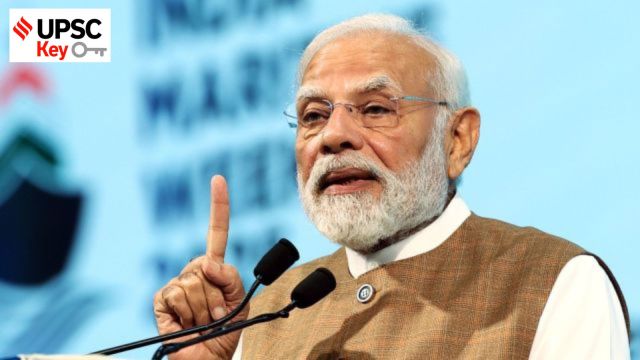 Addressing the India Maritime Week-2025, which has participants from more than 85 countries, Prime Minister Narendra Modi spoke about the reforms undertaken in the past 10 years to give new impetus to the maritime sector. Know more in our UPSC Key. (DPR PMO/ANI Photo)
Important topics and their relevance in UPSC CSE exam for October 30, 2025. If you missed the October 29, 2025, UPSC CSE exam key from the Indian Express, read it here.
Syllabus:
Preliminary Examination: Current events of national and international importance.
Mains Examination: General Studies-II, III: Government policies and interventions for development in various sectors and issues arising out of their design and implementation; Infrastructure: Energy, Ports, Roads, Airports, Railways etc.
What’s the ongoing story: India is ready to play the role of a steady lighthouse providing global players vast opportunities for expansion and investments in the country’s maritime sector with massive potential, Prime Minister Narendra Modi said on Wednesday.
Key Points to Ponder:
— What is the status of India in the maritime sector?
— What is the importance of the India Maritime conclave?
— What are the major developments in the Maritime sector?
— What are the important schemes of the government in the maritime sector?
— What is the rank of India in the World Bank Logistic Performance Index?
Key Takeaways:
— Addressing the India Maritime Week-2025, which has participants from more than 85 countries, Modi spoke about the reforms undertaken in the past 10 years to give new impetus to the maritime sector.
— “We have a vibrant democracy and reliability. When the global seas are rough, the world looks for a steady lighthouse. And India is ready and capable to play the role of lighthouse very strongly,” Modi said.
— The government has decided an investment of Rs 70,000 crore in the maritime sector to boost domestic capacity, build greenfield and brownfield shipyards with an ecosystem that brings both investment opportunities and jobs to lakhs of people, the PM said.
— Pointing out that the 21st century has proved crucial for the maritime sector in India, the PM said the next 25 years holds great significance. “The creation of Coastal Shipping Act has helped to make trade easier…”
— Calling the transformation in the maritime sector in the past 10-11 years “truly historic”, Modi said, “Our port capacity has doubled, and the turnaround time and cruise tourism has increased phenomenally. The inland waterways cargo movement increased 700 per cent, while operationalised waterways have risen from three to 32. Our ports net annual surplus has gone up nine times.”
— Claiming that Indian ports are at par or at times ahead of the ports in developed nations, the PM said that the World Bank Logistic Performance Index has acknowledged remarkable improvement in the maritime sector.
— India’s focus is on sustainable coastal development, green logistics and port connectivity, while ship building is high on agenda, Modi said.
— Recalling warrior king Chhatrapati Shivaji Maharaj’s vision in using the sea for security and as potential trade route, the PM said, “India-made ships played a major role in global trade. Then we went into the ship breaking sector. Now, India again is emerging as global maritime power.”
Do You Know:
— IMW 2025 is being hosted by the Ministry of Ports, Shipping and Waterways (MoPSW) from October 27 to 31 at NESCO Grounds in Mumbai. The stated objective is to provide a forum for global stakeholders to discuss innovation, sustainability, and growth in the maritime domain.
— The theme of IMW 2025 is ‘Uniting Oceans, One Maritime Vision’ – reflects the timeless Indian ethos of ‘Vasudhaiva Kutumbakam’. With 11,000 kilometres of coastline and 13 coastal states and Union Territories, India has the strategic advantage of location, this conference provides an opportunity for global investors to “explore opportunities.”
— According to the latest World bank’s LPI, India has climbed six places on the LPI 2023, now ranking 38th in the 139 countries index. India was ranked 44th on the index in 2018 and has now climbed to 38th in the 2023 listing. India’s performance has drastically improved from 2014, when it was ranked 54th on the LPI.
Other Important Articles Covering the same topic:
📍Knowledge Nugget: India Maritime Week 2025 — key highlights and schemes for your UPSC Exam
Previous year UPSC Prelims Question Covering similar theme:
(1) With reference to ‘Indian Ocean Rim Association for Regional Cooperation (IOR-ARC)’, consider the following statements: (UPSC CSE 2015)
1. It was established very recently in response to incidents of piracy and accidents of oil spills.
2. It is an alliance meant for maritime security only.
Which of the statements given above is/are correct?
(a) 1 only
(b) 2 only
(c) Both 1 and 2
(d) Neither 1 nor 2
Previous year UPSC Mains Question Covering similar theme:
“Investment in infrastructure is essential for more rapid and inclusive economic growth.” Discuss in the light of India’s experience. (UPSC CSE 2021)
Syllabus:
Preliminary Examination: Current events of national and international importance.
Mains Examination: General Studies-II: India and its neighbourhood- relations.
What’s the ongoing story: In the first high-level military talks since India and China completed the disengagement of troops from key friction points along the Line of Actual Control (LAC) in eastern Ladakh last October, the two sides agreed to continue to use “existing mechanisms to resolve any ground issues along the border to maintain stability”.
Key Points to Ponder:
— Know the history of India-China relations.
— What are the areas of cooperation and conflict between India and China?
— What are the issues and challenges in the India-China relations?
— What is LAC?
— India-China Border Dispute: Know the Background
— Know the terms ‘de-induction’, ‘disengagement’ and ‘de-escalation’?
— How are the current global order and Trump’s policies impacting India’s relations with China?
— Map Work: Line of Actual Control, Galwan Valley, Depsang Plains.
Key Takeaways:
— The 23rd round of Corps Commander-level talks was held at the Chushul-Moldo border meeting point on October 25, the Ministry of External Affairs (MEA) said on Wednesday.
— The meeting — the first high-level engagement since the Special Representatives’ talks on August 19 — came a year after both sides disengaged from the friction points in October last year, following the 22nd round of military talks.
— Following the agreement between the two sides last October, both sides have been carrying out coordinated patrols to avoid clashes between the troops on the ground.
— The latest round of military talks comes amid efforts from both sides to consolidate relative calm on the ground, following the heightened deployment of troops since the military standoff in eastern Ladakh began in 2020.
— Even after the disengagement process, a full de-escalation is yet to take place. While sources say that China has withdrawn some troops, an estimated 50,000-60,000 troops are still stationed on either side of the LAC in the region.
— Discussions at the diplomatic and military levels have been underway to prioritise existing border areas that can be taken up first for the resolution of issues.
— After over four years of the military standoff, the breakthrough came in October last year, when India and China reached an agreement on patrolling arrangements in the Depsang Plains and Demchok, the two friction points along the LAC. The announcement of the agreement set the stage for a meeting between Modi and Xi on the sidelines of the BRICS Summit in Kazan, Russia, on October 23, 2024, when their talks resulted in disengagement of troops from the friction points.
— In a series of steps towards stabilisation of ties, the two sides have announced the resumption of the Kailash Mansarovar Yatra and direct flights.
— On the ground, even as thousands of troops continue to maintain high vigilance along the LAC, both sides have been working on reducing the trust deficit by implementing additional confidence-building measures.
— For India, this also means placing a greater reliance on the technical surveillance infrastructure that has been established over the last five years, which is being further upgraded and strengthened, with the long-term aim of reducing additional patrolling efforts.
Do You Know:
— The LAC is the demarcation that separates Indian-controlled territory from Chinese-controlled territory. India considers the LAC to be 3,488 km long, while the Chinese consider it to be only around 2,000 km. It is divided into three sectors: the eastern sector which spans Arunachal Pradesh and Sikkim, the middle sector in Uttarakhand and Himachal Pradesh, and the western sector in Ladakh.
Other Important Articles Covering the same topic:
📍Line of Actual Control (LAC): Where it is located, and where India and China differ
📍Thaw in China chill: Direct flights, Mansarovar Yatra, easing of visas
Previous year UPSC Prelims Question Covering similar theme:
(2) “Belt and Road Initiative” is sometimes mentioned in the news in the context of the affairs of : (UPSC CSE 2016)
(a) African Union
(b) Brazil
(c) European Union
(d) China
Previous year UPSC Mains Question Covering similar theme:
‘China is using its economic relations and positive trade surplus as tools to develop potential military power status in Asia’, In the light of this statement, discuss its impact on India as her neighbor. (UPSC CSE 2017)
Syllabus:
Preliminary Examination: Current events of national and international importance.
Mains Examination: General Studies-II: Bilateral, regional and global groupings and agreements involving India and/or affecting India’s interests.
What’s the ongoing story: Prime Minister Narendra Modi spoke to new Japanese PM Sanae Takaichi on Wednesday, and agreed to focus on “economic security, defence cooperation and talent mobility”.
Key Points to Ponder:
— What do you understand about ‘Free and Open Indo-Pacific’?
— What is the significance of QUAD and G20 for India and Japan?
— What are the areas of cooperation between India and Japan?
— Know the historical background to India-Japan relationship
— What are the key challenges in their relationship?
Key Takeaways:
— Sources told The Indian Express that the two leaders are also looking at the possibility of meeting in South Africa on the sidelines of the G20 leaders’ summit in November.
— This was the first phone conversation between Modi and Takaichi since she assumed office as Japan’s first woman PM, succeeding Shigeru Ishiba, last week.
— A Japanese Foreign ministry statement said, “At the outset, Prime Minister Takaichi stated that, as the two countries share fundamental values and strategic interests, Japan intends to continue to work together toward realising a ‘Free and Open Indo-Pacific’, including through Japan-Australia-India-U.S. (Quad).
— Last week, Modi extended his wishes to Takaichi on her election… Takaichi, who is a protege of former Prime Minister of Japan, Shinzo Abe, is a hardline conservative and replaced former Prime Minister Shigeru Ishiba after the long-ruling Liberal Democratic Party suffered disastrous losses in July elections.
Do You Know:
— The partnership between India and Japan, two of Asia’s leading democracies and among the world’s top five economies, is rooted in civilizational ties that have been reinforced by convergence in their regional and global outlooks.
— India’s Act East Policy and Indo-Pacific Oceans Initiative (IPOI) align closely with Japan’s Free and Open Indo-Pacific (FOIP) policy. Japan leads IPOI’s connectivity pillar, and is India’s largest Overseas Development Assistance (ODA) donor.
— Cooperation between the countries extends to plurilateral platforms such as the Quad, International Solar Alliance (ISA), Coalition for Disaster Resilient Infrastructure (CDRI), and Supply Chain Resilience Initiative (SCRI).
— Key agreements on defence and security include the Joint Declaration on Security Cooperation (2008), Defence Cooperation and Exchanges MoU (2014), Information Protection Agreement (2015), Reciprocal Provision of Supplies and Services Agreement (2020), and co-development of the UNICORN naval mast (2024).
— Bilateral trade reached $22.8 billion in 2023-24. In Apr-Jan 2024-25, trade reached $21 billion, demonstrating stability. Imports from Japan continue to outweigh exports. India’s main exports are chemicals, vehicles, aluminium, and seafood; imports include machinery, steel, copper, and reactors.
— Japan is India’s fifth-largest source of FDI, with $43.2 billion cumulative investment up to December 2024. Annual inflows have been strong – $3.1 billion in 2023-24 and $1.36 billion in 2024-25 (Apr-Dec).
— The Quadrilateral Security Dialogue, or the Quad, comprises India, Japan, Australia, and the US. It was formed as an informal alliance after the Indian Ocean tsunami of December 2004. It was formalised in 2007 by the efforts of the then-Prime Minister of Japan, Shinzo Abe.
Other Important Articles Covering the same topic:
📍PM Modi in US: What is the Quad grouping?
📍Explained: As PM Modi lands in Tokyo, an overview of the India-Japan relationship
UPSC Prelims Practice Question Covering similar theme:
(3) Consider the following countries:
1. Denmark
2. Japan
3. United Kingdom
4. United States of America
5. Australia
Which of the above are the members of the ‘QUAD’?
(a) 1, 2 and 3 only
(b) 2, 4 and 5 only
(c) 1, 3 and 4 only
(d) 3, 4 and 5 only
Previous year UPSC Mains Question Covering similar theme:
‘The time has come for India and Japan to build a strong contemporary relationship, one involving global and strategic partnership that will have a great significance for Asia and the world as a whole.’ Comment. (UPSC CSE 2019)
Syllabus:
Preliminary Examination: Current events of national and international importance.
Mains Examination: General Studies-II: India and its neighbourhood- relations.
What’s the ongoing story: Shashi Tharoor writes- “India’s rationale for engaging the Taliban is threefold and plainly pragmatic. First, Kabul matters to New Delhi’s security calculus: A stable Afghanistan that refuses to harbour, let alone unleash, anti-India militants is a strategic imperative, especially given the legacy of cross-border terrorism and the country’s historical and geographic proximity to Pakistan.”
Key Points to Ponder:
— What is the history of India-Afghanistan relations?
— What is the Taliban, and what is its history?
— What are the areas of cooperation and conflict between India and Afghanistan?
— What are the main products imported from and exported to Afghanistan?
— How has India navigated its relationship with the Taliban since they took power?
— What key factors have prompted India to engage with the Taliban at a higher level?
— Map work: Location of Afghanistan.(Refer Atlas)
Key Takeaways:
— “Second, India has long-standing development footprints and people-to-people ties with Afghanistan, which was for years the largest recipient of our development assistance ($2.3 billion); keeping aid, infrastructure and consular channels open protects those investments and influence.”
— “Third, India’s engagement is a hedging strategy in a region where geopolitical rivalry is intensifying. Failure to keep channels open with Kabul would only cede space to Pakistan, China and others to deepen ties, undermine India’s interests and shape outcomes to their advantage.”
— “Those considerations explain why New Delhi hosted Amir Khan Muttaqi, allowed him the use of the Afghan Embassy, negotiated logistics for upgraded consular facilities and reaffirmed humanitarian commitments — steps announced publicly in a joint statement after the meetings. Formal recognition did not follow, but our “technical mission” in Kabul was upgraded to an “embassy”. The distinction matters; it signalled both engagement and caution.”
— “This episode is a concentrated lesson. Engagement can yield access and concessions— assurances about non-use of Afghan territory by anti-India groups were publicly reiterated — but it can also force domestic audiences to confront the dissonance between India’s constitutional commitments to gender equality and its willingness to accommodate a movement that systematically curtails women’s fundamental rights.”
— “India’s present outreach cannot be understood without recalling the fraught past. The first Taliban regime’s complicity in Pakistani hostility to India — most starkly during the December 1999 hijacking of Indian Airlines Flight IC 814 to Kandahar — left deep scars when negotiations led to the release of jailed Pakistani terrorists and the flight’s harrowing denouement. That episode hardened New Delhi’s stance for years and underpinned unequivocal non-recognition of, and non-cooperation with, the Taliban for the subsequent quarter-century.”
— “What has changed since then is geopolitical context, the Taliban’s attempt to claim a measure of diplomatic normalcy, its increasing estrangement from its erstwhile sponsors and patrons in Pakistan (together with border clashes between the two countries), and India’s own strategic imperatives.”
— “The US withdrawal in 2021, the reconfiguration of regional alignments, and Afghanistan’s dependence on external aid have created incentives to reopen channels. New Delhi calculates that quiet diplomacy, humanitarian engagement and selective cooperation on counterterrorism and connectivity can better secure Indian interests than isolation alone.”
— “India’s diplomatic posture can be both realistic and moral if it embeds accountability mechanisms — transparent aid-monitoring, specific benchmarks on rights-resumption, and public reporting on security assurances. Civil society, media and Opposition politics have a role in pressing the government to make those conditions explicit rather than implicit.”
— “The Taliban episode is a study in the contradictions of contemporary diplomacy — the need to secure tangible national interests colliding with the moral standards and expectations of a pluralistic democracy. History’s reminders should inform, but not dictate nor be erased by, our current choices. Engagement without ethical guardrails risks normalising repression; isolation without pragmatic engagement risks strategic setbacks.”
— “The hard task for New Delhi is to reconcile principle with pragmatism in ways that protect both national security and the dignity of the rights-bearing citizenry our government represents.”
Do You Know:
— Afghanistan’s geopolitical significance goes beyond India and Pakistan. It is a multi-ethnic, landlocked country positioned at the crossroads of Central Asia, the Middle East, and South Asia. This strategic location has historically drawn the interest of major global and regional powers, making Afghanistan a focal point in global politics. Acknowledging Afghanistan’s significance, India has carefully crafted its policy towards the country.
Other Important Articles Covering the same topic:
📍UPSC Issue at a Glance | India-Taliban Talks: Key Questions You Must Know for Prelims and Mains
Previous year UPSC Prelims Question Covering similar theme:
(4) Consider the following countries: (UPSC CSE 2022)
1. Azerbaijan
2. Kyrgyzstan
3. Tajikistan
4. Turkmenistan
5. Uzbekistan
Which of the above have borders with Afghanistan?
(a) 1, 2 and 5 only
(b) 1, 2, 3 and 4 only
(c) 3, 4 and 5 only
(d) 1, 2, 3, 4 and 5
(5) Consider the following pairs:
1. Chabahar Port: Iran
2. Salma Dam: Aghanistan
3. Kursk: Russia
Which of the pairs given above are correct?
(a) 1 and 2 only
(b) 2 and 3 only
(c) 1 and 3 only
(d) 1, 2 and 3
Previous year UPSC Mains Question Covering similar theme:
The proposed withdrawal of the International Security Assistance Force (ISAF) from Afghanistan in 2014 is fraught with major security implications for the countries of the region. Examine in light of the fact that India is faced with a plethora of challenges and needs to safeguard its own strategic interests. (UPSC CSE 2013)
Syllabus:
Preliminary Examination: Current events of national and international importance.
Mains Examination: General Studies-II: Government policies and interventions for development in various sectors and issues arising out of their design and implementation.
What’s the ongoing story: In a ruling with wide implications for property transactions involving minors, the Supreme Court has held that a person, on attaining majority, can reject a property sale executed by their guardian without court approval, either by filing a suit or by conduct, such as reselling the property, within the limitation period prescribed by law.
Key Points to Ponder:
— Who is defined as a minor in India?
— What is the meaning of power-of-attorney?
— Know about the rights of minors in ancestral property?
— Is Right to property a fundamental right in India?
— How does the law regulate the powers and duties of a natural guardian with regard to a minor’s property?
— What are the conditions required by the court on the guardian for selling the property under the name of a minor?
— What legal remedies are available to a minor upon attaining majority if their property was sold or transferred without court approval during the minority?
Key Takeaways:
— A division bench of Justices Pankaj Mithal and Prasanna B. Varale, on October 7, stated that “it is not always necessary for a minor to institute a suit for cancellation of a voidable sale transaction executed by his guardian… such a transaction can be avoided or repudiated by his conduct.”
— The court thus reaffirmed a century-old principle that a minor’s property rights can be protected through conduct demonstrating clear repudiation, not only through formal litigation.
— The laws on property acquired by minors through their guardians are determined through three pieces of legislation— the Indian Contract Act 1872, the Hindu Minority and Guardianship Act, 1956, and the Guardian and Wards Act, 1890.
— To enter into a valid contract, four conditions must be met. There must be consent between the parties, the transaction must have a lawful object, it must be supported by legal consideration, and the parties must be competent to contract. Of these, the competency becomes key when one of the parties is a minor represented by a guardian.
— Section 11 of the Indian Contract Act states that, “Every person is competent to contract who is of the age of majority according to the law to which he is subject, and who is of sound mind, and is not disqualified from contracting by any law to which he is subject.” This places minors outside the scope of those who are competent to enter into a valid contract.
— However, a contract that is entered into by a minor is considered “void ab initio” — unenforceable from the start. This is because minors’ lack of competency carves out their liability during a breach of contract. Such contracts can not be enforced by or against them in a court.
— There are limited exceptions. If a minor is provided with necessities suited to their condition in life, the supplier can recover the cost of those items from the minor’s property. Contracts that are clearly for the benefit of the minor may also be upheld. A guardian may enter into contracts on behalf of a minor if the arrangement serves the minor’s interest.
— The Hindu Minority and Guardianship Act, under Section 8, lays down the powers of a ‘natural guardian’ to act reasonably “for the benefit of the minor or for the realization, protection or benefit of the minor’s estate.”
— The common view has been that the now-major individual must file a suit to cancel the sale deed executed by the guardian. However, an earlier precedent from 1905, Abdul Rahman v. Sukhdayal Singh, held that, where a property was leased by a guardian not for the minor’s benefit, the court held that it was “not necessary that a suit should be instituted” and that “the act of the minor of selling the property on attaining majority is enough to repudiate the lease deed.”
— Once the minor, who turned major, repudiates the sale, the earlier sale is treated as void from the beginning, and no rights pass to the buyer from that sale.
— In this case, the Court found that the surviving sons had, after attaining majority, executed a new sale deed in favour of K.S. Shivappa. They did so within the three-year limitation period, while their names continued to appear in the revenue records, and the earlier buyers had never taken possession.
— This, the Court said, was enough to show that they had rejected their father’s sale, and filing a separate suit was not necessary.
— Since the plaintiff failed to appear before the court to provide evidence regarding her ownership of the plot, her case was presented through a power-of-attorney holder, who had no personal knowledge of the sale.
Do You Know:
— As per the Indian succession laws, a son is heir to his father’s and grandfather’s property by birth. In a case where the father dies intestate then the son, who is a Class I heir, will have succession rights along with his living brother, mother, sister and grandmother. However, if none of them are alive, then he becomes the sole successor.
— But here’s the hitch: In a situation related to a minor child, a case has to be filed in a court or a petition through a guardian under the law or a guardian appointed by the court. In essence, even though the minor child becomes the owner of his parent’s wealth, he cannot legally manage it.
— The inheritance is managed by a guardian, appointed from among his relatives, till he becomes an adult. Under Indian law, if no relative comes forward to become the guardian then due to the responsibility being of fiduciary nature, the court appoints a guardian.
Other Important Articles Covering the same topic:
📍Female heirs win 30-year fight for share in ancestral home
📍Protecting the minor’s inheritance
Previous year UPSC Prelims Question Covering similar theme:
(6) With reference to the history of ancient India, which of the following statements is/are correct? (UPSC CSE 2021)
1. Mitakshara was the civil law for upper castes and Dayabhaga was the civil law for lower castes.
2. In the Mitakshara system, the sons can claim right to the property during the lifetime of the father, whereas in the Dayabhaga system, it is only after the death of the father that the sons can claim right to the property.
3. The Mitakshara system deals with the matters related to the property held by male members only of a family, whereas the Dayabhaga system deals with the matters related to the property held by both male and female members of a family.
Select the correct answer using the code given below:
(a) 1 and 2 only
(b) 2 only
(c) 1 and 3 only
(d) 3 only
Syllabus:
Preliminary Examination: Current events of national importance and Economic development.
Mains Examination: General Studies-III: Indian Economy and issues relating to planning, mobilisation of resources, growth, development and employment, Effects of liberalisation on the economy.
What’s the ongoing story: At a time when India’s net foreign direct investment has seen a sharp moderation, the country’s financial landscape is in the midst of a transformation. Over the last 24 months, some of the world’s biggest financial institutions — from Dubai’s Emirates NBD to Japan’s Sumitomo Mitsui Banking Corporation (SMBC), Blackstone, Zurich Insurance and Abu Dhabi’s International Holding Company (IHC) — have lined up to acquire significant stakes in Indian banks, insurers and non-banking financial companies (NBFCs).
Key Points to Ponder:
— What are NBFCs?
— Why are major global investors investing in India’s financial sector?
— What are the benefits and risks associated with rising foreign ownership in the Indian financial sector?
— Read about the recent major policy changes related to India’s financial sector.
— Know about the RBI and its functions.
Key Takeaways:
— It was once a tightly protected sector, dominated by Indian promoters and conservative regulation. The sector is now witnessing a wave of global money flow. The latest in the series came on Friday, with Blackstone announcing the acquisition of a 9.99 per cent stake in Kerala-based Federal Bank.
— Blackstone Inc, the world’s largest alternative asset manager, has acquired a minority stake of 9.99 per cent in Federal Bank Ltd for Rs 6,196 crore while Bain Capital will be investing Rs 4,385 crore to acquire an 18.0 per cent stake on a fully diluted basis via preferential allotment of equity & warrants in Manappuram Finance.
— The Reserve Bank of India gave Canada-based Fairfax special approval to hold a majority stake in CSB Bank for five years, deviating from the normal 40 per cent foreign ownership cap, considering it a strategic revival investment.
— While each of these deals is significant on its own, they signal something larger, like a global relook of India’s financial sector and growth potential. The sector was once considered as over-regulated and fragmented, but now it’s emerging as one of the world’s fastest-growing and most interesting destinations for long-term investment in financial services.
— The regulator RBI has also taken a positive, but cautious, stance in allowing the entry of global entities.
— According to McKinsey & Company, the banking industry is the largest sector in India by net income, generating $46 billion in 2024, with a 31 per cent YoY growth. Higher profitability is observed compared with the global average, with ample liquidity, strong capital levels and reduced credit risk.
— India’s revenue growth is expected to be healthy in both retail and wholesale banking as financial penetration deepens. “Despite strong performance, the banking sector is valued lower among industries, indicating market scepticism about long-term value creation,” McKinsey said in its latest report on global banking.
— India’s financial services sector is expanding faster than major global economies with credit demand robust from small businesses, retail consumers and housing. On the other hand, the formal banking system is matching the country’s economic growth.
— India presents a vast, untapped and rapidly expanding financial market with over 400 million underbanked population, a vast informal credit system and a robust digital infrastructure enabling growth. Consumption is now expected to pick up following the GST rationalisation and reduction while credit offtake continues to grow.
— What has helped is the fact that the Reserve Bank and the government have been gradually relaxing restrictions on foreign ownership in insurance and private banks. Insurance companies can now go up to 100 per cent foreign ownership, and private banks up to 74 per cent levels with approval from the respective regulators.
— Foreign portfolio investors (FPIs) hold 48.39 per cent stake in HDFC Bank, the second largest bank in the country. On the other hand, there are no promoters in many private sector banks like Federal Bank and South Indian Bank.
— The message is unmistakable, say analysts: that the financial sector welcomes capital, provided control and compliance stay under Indian regulation and it remains largely insulated from global shocks. This measured liberalisation offers an ideal entry point for global banks and insurers facing stagnant growth in developed markets like Europe and the US.
— For global investors, this is an ideal scenario. While India’s macroeconomic fundamentals remain strong, many entities are available at attractive valuation and acquiring them provides global players with immediate access to customers, licenses and branch networks.
— While this inflow of foreign ownership reflects confidence in India, there are also risks involving trade and border conflicts. When a foreign institution takes a majority stake in an Indian bank or insurer, control over strategic decisions gradually is likely to shift offshore. Even if regulation remains Indian, what the new owners bring in, especially in crisis situations, may not always align with domestic policy goals and regulations. This means Indian regulators like the RBI will have to put checks and balances to keep the system stable and liquid.
— No doubt, foreign ownership can also make India’s financial system vulnerable to global shocks. If global interest rates rise or liquidity dries up or trade tensions increase, these foreign entities might take decisions which are not favourable to Indian entities and regulators, putting strain on domestic credit flows.
— The test for India will be to ensure that this inflow strengthens its financial independence and stability.
Do You Know:
— NBFC is a company registered under the Companies Act, 1956 or Companies Act, 2013, and engaged in the business of loans and advances, acquisition of shares/stocks/bonds/debentures/securities issued by Government or local authority or other marketable securities of a like nature, leasing, hire-purchase, etc., as their principal business, but does not include any institution whose principal business is that of agriculture activity, industrial activity, purchase or sale of any goods (other than securities) or providing any services and sale/purchase/construction of immovable property.
— A non-banking institution which is a company and has principal business of receiving deposits under any scheme or arrangement in one lump sum or in installments by way of contributions or in any other manner, is also a non-banking financial company (Residuary non-banking company).
Other Important Articles Covering the same topic:
📍Knowledge Nugget | Small Finance Bank transition to Universal Bank: A must-know for the UPSC Exam
Previous year UPSC Prelims Question Covering similar theme:
(7) With reference to the Non-banking Financial Companies (NBFCs) in India, consider the following statements: (UPSC CSE 2010)
1. They cannot engage in the acquisition of securities issued by the government.
2. They cannot accept demand deposits like Savings Account.
Which of the statements given above is/are correct?
(a) 1 only
(b) 2 only
(c) Both 1 and 2
(d) Neither 1 nor 2
|
ALSO IN NEWS |
|
| Seven states and UTs seek to add breakfast to midday meals, Centre weighing costs | Seven States and Union Territories, including Rajasthan, Kerala, Chhattisgarh, and Delhi, have asked the Centre to consider providing breakfast under the PM-POSHAN or midday meal scheme. Sikkim, Lakshadweep, and Gujarat have also asked for breakfast to be included under the scheme. Providing breakfast under PM-POSHAN is a recommendation of the National Education Policy (NEP) 2020, which the Centre is yet to implement. Under the PM-POSHAN scheme, a cooked midday meal is provided to students in government and government-aided schools from pre-primary to class 8. The Centre provides foodgrains, shares the material cost with the States (and the UTs of Delhi and Puducherry, which have legislatures) in a 60:40 ratio; for the States in the northeastern and Himalayan region, the ratio is 90:10. |
| Significant progress in trade talks with EU, says Goyal | Commerce and Industry Minister Piyush Goyal Wednesday said significant progress has been made in talks with the European Union (EU) to reach a free trade agreement.
New Delhi is keen to wrap up the India-EU Free Trade Agreement. The EU provides a stable market for a range of Indian merchandise exports. India’s exports to the EU in the last financial year stood at $82 billion, slightly lower than to the US ($86.5 billion). |
| DDA’s East Delhi Hub set to roll, what is ‘transit-oriented development’? | Registration of flats in Delhi’s tallest residential building opens on Friday (October 31). The 48-storey Towering Heights project, currently under construction in Delhi Development Authority’s (DDA’s) East Delhi Hub in Karkardooma, will be the first transit-oriented development (TOD) project in the country. TOD is an urban development strategy that aims to create the maximum possible numbers of houses, shops, offices and recreational spaces near public transport facilities. Unlike road-centric planning approaches and other planning paradigms which separate residential, commercial, and industrial zoning, a TOD approach puts public transportation at the centre of the urban development plan. The objectives are to minimise use of personal vehicles, make commutes shorter, and reduce the cost of transport and exposure to pollutants. |
| PRELIMS ANSWER KEY |
| 1. (d) 2. (d) 3. (b) 4. (c) 5. (d) 6. (b) 7. (b) |
Subscribe to our UPSC newsletter. Stay updated with the latest UPSC articles by joining our Telegram channel – Indian Express UPSC Hub, and follow us on Instagram and X.
🚨 Click Here to read the UPSC Essentials magazine for October 2025. Share your views and suggestions in the comment box or at manas.srivastava@indianexpress.com🚨

Read UPSC Magazine