


© IE Online Media Services Pvt Ltd
Tags:


🚨 Attention: UPSC Key is now all 7 Days a Week!🚨
Important topics and their relevance in UPSC CSE exam for September 29, 2024. If you missed the September 28th, 2024 UPSC CSE exam key from the Indian Express, read it here.


UPSC Syllabus:
Preliminary Examination: Current events of national and international importance
Mains Examination: GS-II: International Relations and Effect of policies and politics of developed and developing countries on India’s interests
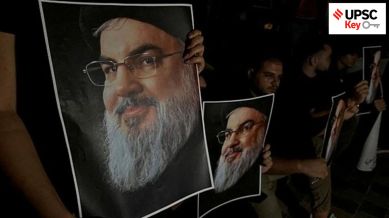
What’s the ongoing story- Israel killed Hezbollah leader Sayyed Hassan Nasrallah in a powerful airstrike in Beirut, dealing a heavy blow to the Iran-backed group as it reels from an escalating campaign of Israeli attacks.
Prerequisites:
— What is Hezbollah?
— Read about the Israel-Hezbollah conflict.
— What was the Arab-Israeli war?
— Map work: Location of Lebanon, Israel, Iran, West Bank, Gaza strip.
Key takeaways:
— The Israeli military said on Saturday it had eliminated Nasrallah in the strike on the group’s central command headquarters in Beirut’s southern suburbs on Friday. Hezbollah confirmed he had been killed, without saying how.
— Nasrallah’s death is a major blow to both Hezbollah and Iran, removing an influential ally who helped build Hezbollah into the linchpin of Tehran’s network of allied groups in the Arab world.
— Iran later called for a United Nations Security Council meeting on Israel’s actions in Lebanon and elsewhere in the region. It also warned against any attacks on its diplomatic facilities and representatives.
— Hezbollah and Israel have been fighting a conflict in parallel with Israel’s war against the Palestinian group Hamas in Gaza since Hamas’ attack on Israel last Oct. 7, in a cross-border confrontation that has sharply escalated in recent days.
From “His death breaks Iran axis into more erratic parts”
— Nasrallah’s death marks an unprecedented blow to Iran’s regional instruments of influence. Given his unparalleled prominence in the pantheon of Iranian resistance leaders, Nasrallah’s killing is arguably a bigger loss to Iran than even Major General Qassem Soleimani of the Revolutionary Guards, in 2020, and Hamas’ political chief Ismail Haniyeh earlier this year.
— The rapid depletion of Iran’s strategic human resources in its ‘axis of resistance’, is bound to set a regional re-arrangement in motion, since Tehran is the only prominent opponent of the pro-Israel drift in Middle Eastern politics in recent years.
— The Iranian card in the Middle East is a spoiler for India. Even as Tehran and New Delhi continue their point focus on developing Chabahar, Iran’s value in India’s strategic calculus has plummeted, adding to the historic strain of Western sanctions on anything India-Iran and the struggling pace of the International North South Transport Corridor.
— For India, a weakened Iranian axis of resistance means fewer sources of disruption to its grand regional connectivity plans; without requiring changes in its traditional principled support for the two-state solution. India believes that the Palestine question can be resolved through Arab-Israeli negotiations, sans a third-party disruptor.
From the World Page “Why Nasrallah’s killing has West Asia on the edge”
Shubhajit Roy writes– “7 takeaways from Israel’s attack on Hezbollah chief Hasan Nasrallah
1. A seismic episode, in its context potentially as big as the killing of Osama bin Laden. Hezbollah under Nasrallah has been by far the most powerful of the armed groups opposing Israel. His killing has ended one of the most serious military threats to the Jewish nation.
2. Israel has taken out the bulk of Hezbollah’s senior leadership.
3. Hezbollah is the strongest of the Iran-backed ‘Axis of Resistance’; Nasrallah’s killing is a power moment for Israel.
4. Hezbollah has suffered a debilitating setback, but much will depend on how Iran — its main backer and the arch rival of Israel — reacts now.
5. This could be a significant moment for Lebanon as well. For decades, Hezbollah has been the most powerful entity in a country with chronically weak power structures. While there were protests in the streets by people mourning Nasrallah on Saturday, his killing also presents an opportunity for Lebanon to loosen some of Hezbollah’s iron grip on the country.
6. Saudi Arabia, UAE, and Qatar have a key role to play going forward.
7. For India, an early return of peace in the region works best. Like its partners in West Asia, especially, Saudi Arabia and the UAE, New Delhi would want stability to return soon, so that they can go back to the connectivity initiatives like the India-Middle East-Europe Economic Corridor, and work on the prosperity of the region and beyond.
For Your Information:
— Hezbollah, meaning “Party of God”, is a Shiite militant organisation that was set up by Iran’s Revolutionary Guards in 1982 to fight Israeli forces that had invaded Lebanon that year.
— Iranian Revolutionary Guard Corps (IRCG): It was set up in 1979. After the 1979 Islamic Revolution, a theocratic state was established in Iran following the removal of the ruling Shah from power. For its protection, the IRCG was created to deal with both domestic and external threats.
Points to Ponder:
— What is the “axis of resistance”?
— What is the significance of West Asia for India?
— What do recent developments in the middle east mean for India’s Middle East policy?
— What impact could tensions in the Middle East have on the India?
Post Read Question:
(1) Consider the following statements:
1. The Quds Force is the paramilitary and intelligence wing of the Iranian Revolutionary Guard Corps (IRCG).
2. IRCG was created to deal with external threats only.
Which of the statement(s) given above is/are not correct?
(a) 1 only
(b) 2 only
(c) Both 1 and 2
(d) Neither 1 Nor 2
Other Important Articles Covering the same topic:
What is Hezbollah and what do we know about its military capabilities?
Israel and Hezbollah: A short history of long conflict in Lebanon
UPSC Syllabus:
Preliminary Examination: Current events of national importance; Indian Polity and Governance- Rights Issues
Mains Examination: GS-II, GS-III: Government policies and interventions; Transparency & Accountability, Awareness in IT and Computers.
What’s the ongoing story- Amid protests from stakeholders including Opposition parties and the civil society on provisions of the Digital Personal Data Protection Act, the government faced some pushback from within as well. Niti Aayog, the top think tank of the government, had opposed some of the provisions of the law, and particularly red flagged the changes proposed to the Right to Information (RTI) Act that could “weaken” the legislation.
Prerequisites:
— What is the Digital Personal Data Protection Act?
— Read about the Right to Information (RTI) Act.
— Organisation to look for: Niti Aayog
Key takeaways:
— In simple words, what the data protection law proposed is an amendment to a section in the RTI Act with such effect that disclosure of personal information about public officials would not be allowed even when these are justified in larger public interest.
— On January 16, 2023, the Niti Aayog formally wrote to the Ministry of Electronics and Information Technology (MeitY) urging it to not pass the proposed law in its current form as it could weaken the RTI Act, and suggested the Bill be amended and fresh opinion sought, records reviewed by The Indian Express as part of an RTI application showed.
— Niti Aayog’s suggestions had come as part of the then ongoing inter-ministerial consultations, and the law was still in its draft stage. The Bill was passed in Parliament in August 2023 and received the President’s assent the same month, but all through the process, MeitY kept the proposed changes to the RTI Act unchanged despite the reservations of Niti Aayog. As of now, the law is yet to be operationalised, with necessary rules for its implementation awaited.
— The reason for Niti Aayog’s caution is a single line in the data protection law, that is rather easy to miss as a footnote. The law proposes to amend Section 8(1)(j) of the Right to Information Act, 2005. This prevents a public authority from sharing anyone’s personal information on two main grounds – that the disclosure will have no bearing on any public activity, and that revealing such information would cause unwarranted invasion of the privacy of an individual, unless such disclosure is justified in larger public interest.
— However, the law proposes that the personal information of public officials will not be disclosed under the RTI Act. The two key grounds, that such information could be disclosed provided it serves a larger public interest, have been done away with.
For Your Information:
— The Right to Information (RTI) Act is often hailed as the most important piece of legislation for empowering the common citizen. It mandates timely response to citizen requests for government information.
Points to Ponder:
— What are the potential benefits of the Digital Personal Data Protection Act?
— What are the laws related to data governance in India?
— What are the issues and challenges associated with the Digital Personal Data Protection Act?
— What measures should be taken to ensure data privacy and cyber security?
Post Read Question:
Prelims
(2) With reference to the Data Protection Board (DPB), consider the following statements:
1. It will be established through the Digital Personal Data Protection Act (DPDP), 2023
2. The board will have quasi-judicial powers.
3. The members of the board will be appointed partially by the central government and partially by the state governments.
How many of the statements given above are correct?
(a) Only one
(b) Only two
(c) All three
(d) None
Mains
“Recent amendments to the Right to Information Act will have a profound impact on the autonomy and independence of the Information Commission”. Discuss. (2020)
Other Important Articles Covering the same topic:
Digital Personal Data Protection Act: The speedbumps ahead
UPSC Syllabus:
Preliminary Examination: Current events of national and international importance
Mains Examination: GS-II, GS-III: Important international institutions, agencies and fora- their structure, mandate; India and its neighbourhood- relations; Security challenges and their management in border areas – linkages of organized crime with terrorism.
What’s the ongoing story- Maintaining that Pakistan’s GDP can only be measured in terms of “radicalization” and its exports in the form of “terrorism”, External Affairs Minister S Jaishankar said Saturday that Pakistan’s cross-border terrorism policy will “never succeed”, can have no expectation of impunity and “actions will certainly have consequences”.
Prerequisites:
— What is Terrorism? What are the types of terrorism?
— What is India’s counter-terrorism policy?
— Read about the China-Pakistan Economic Corridor
— Organisation to look for: UN General Assembly.
Key takeaways:
— Speaking at the 79th UN General Assembly, Jaishankar said, “Terrorism is antithetical to everything that the world stands for. All its forms and manifestations must be resolutely opposed. The sanctioning of global terrorists by the United Nations should also not be impeded for political reasons.”
— He also took on China on the China-Pakistan Economic Corridor and its debt-trap diplomacy when he said, “Unfair trade practices threaten jobs, just as unviable projects raise debt levels. Any connectivity that flouts sovereignty and territorial integrity acquires strategic connotations. Especially when it is not a shared endeavour.”
— Jaishankar also flagged the challenges posed by Beijing’s economic strategy, as he said, “An important cause of many getting left behind has been the unfairness of the current globalization model. Over-concentration of production has hollowed out many economies, impacting their employment and social stability.”
— “And, he underlined the need for reform of the UN. “The global order is inherently pluralistic and diverse. The UN began with 51 members; we are now 193. The world has changed profoundly and so have its concerns and opportunities. But to address both and indeed to strengthen the order itself, it is essential that the UN be the central platform for finding common ground. And that it certainly cannot be, by remaining anachronistic. Large parts of the world cannot be left behind when it comes to deciding the key issues of our times. An effective and efficient UN, a more representative UN and a UN fit for purpose in the contemporary era, is essential.”
For Your Information:
— India’s counter-terrorism policy extends beyond its borders, emphasizing bilateral and multilateral cooperation in the fight against terrorism. India is not only a signatory of important UN conventions but also has entered into agreements with various countries to bolster its anti-terrorism efforts.
Points to Ponder:
— How has terrorism impacted India’s internal security and socio-economic stability?
— What are the security challenges from Pakistan?
— What initiatives have been taken by the government of India to counter-terrorism?
— What role does international cooperation play in India’s counter-terrorism strategy?
— What reforms are required in UN?
Post Read Question:
Prelims
(3) In which of the following matters placed before the UN General Assembly, a resolution by a two-thirds majority of the members present and voting is required?
1. Admission of new members to the UN
2. Election of the non-permanent members of the Security Council
3. Election of members of the Economic and Social Council
Select the correct answer using the code given below: (UPSC-CDS (II) – 2024)
(a) 1 and 2 only
(b) 2 and 3 only
(c) 1 and 3 only
(d) 1, 2 and 3
Mains
‘Terrorism has become a significant threat to global peace and security.’ Evaluate the effectiveness of the United Nations Security Council’s Counter Terrorism Committee (CTC and its associated bodies in addressing and mitigating this threat at the international level. (UPSC CSE 2024)
Analyse internal security threats and transborder crimes along Myanmar, Bangladesh and Pakistan borders including Line of Control (LoC). Also, discuss the role played by various security forces in this regard. (UPSC CSE 2020)
UPSC Syllabus:
Preliminary Examination: Indian Polity and Governance-Constitution, Political System, Panchayati Raj, Public Policy, Rights Issues, etc.
Mains Examination: GS-II, GS-IV: Government Policies and Interventions; Rights issue, Ethics and Human Interface: Essence, determinants and consequences of Ethics in-human actions; dimensions of ethics; ethics – in private and public relationships.
What’s the ongoing story- The Union Health Ministry released draft guidelines on withdrawing or withholding medical treatment in terminally ill patients, closing a regulatory gap that left medical professionals in a lurch. The guidelines, formulated by experts from AIIMS, allow patients to make a considered decision on whether they want to go on life support and whether they want to be resuscitated.
Prerequisites:
— What is Euthanasia? What are the types of Euthanasia?
— Active Euthanasia and Passive Euthanasia-compare and contrast
— What is the Right to life under Article 21 of the Constitution of India?
Key takeaways:
— It also allows withdrawal of supportive care like ventilation, dialysis, or ECMO when they have been declared brain dead, they are unlikely to benefit from advanced intervention, and the patient or their surrogate document an informed refusal of care.
— The guidelines also make a mention of advance medical directive — a written declaration made by a person with decision-making capacity documenting how they would like to be medically treated or not treated should they lose capacity.
(Thought Process: Talking about Passive Euthanasia in India, can you recall the Aruna Ramchandra Shanbaug v. Union of India (2011) case? What was the Supreme court’s verdict in Aruna Ramchandra Shanbaug v. Union of India (2011)? )
— Once the physician determines the inappropriateness of the life sustaining measures, it says, they will refer the case to the primary medical board. If the board reaches consensus then there will be another multidisciplinary meeting with family and a shared decision will be made.
— For forgoing life sustaining treatments, the case will be referred to a secondary medical board, and the support would be withdrawn only after its nod.
For Your Information:
— Euthanasia, which comes from the Greek words meaning “a good death”, refers to the practice under which an individual intentionally ends their life. Euthanasia falls under the category of assisted dying.
— Euthanasia can be categorised as active or passive. Passive euthanasia is far more common and usually entails withholding lifesaving interventions with the consent of the patient or someone on their behalf. Active euthanasia is legal in only a handful of countries and necessitates deliberately using substances or forces to end the life of another person.
— The Supreme Court allowed passive euthanasia while recognising the living wills of terminally ill patients who could go into a permanent vegetative state, and issued guidelines regulating this procedure.
Points to Ponder:
— What is the legal provision for euthanasia in India?
— What are the arguments for euthanasia?
— What are the ethical issues concerning euthanasia?
— How does passive euthanasia align with the Right to Life?
Post Read Question:
Evaluate the implications of passive euthanasia on medical ethics and patient rights.
Other Important Articles Covering the same topic:
The law and the ground realities of passive euthanasia in India
UPSC Syllabus:
Preliminary Examination: History of India
Mains Examination: GS-I: History; Indian culture will cover the salient aspects of Art Forms, literature and Architecture from ancient to modern times.
What’s the ongoing story- Arjun Sengupta writes— “Recently, researchers from IIT Gandhinagar uncovered fresh evidence that supports the existence of a dock in Lothal, one of the most important Harappan sites in India.”
Prerequisites:
— Read about the Indus Valley Civilisation — the Early Harappan Phase, the Mature Harappan Phase, and the Late Harappan Phase.
— Know in detail about the Origin of the Indus Valley Civilisation, town planning, craft, and economy.
— Map work: Major sites of Indus civilisation.
Key takeaways:
— “Since Lothal was first discovered in 1954, archaeologists have debated whether the roughly 215-m long and 37-m wide structure, excavated at the township’s eastern edge, was a dockyard. ASI has always supported the dockyard thesis, but some scholars have argued that its size and inlet suggest more mundane usage. Here is the story of Lothal, and its “dock”.”
— “The Lothal excavations were led by S R Rao, among the finest Indian archaeologists of his generation who discovered over 30 Harappan sites. It is he who identified the excavated Lothal structure as a dockyard.”
— “Other evidence that Lothal served as a hub for maritime commerce came from the presence of seals — more than in any other site in Kathiawar/Saurashtra — that were likely used to seal documents or mark packages, discovery of various items that were likely traded, a warehouse, and what Rao referred to as stone anchors for ships.”
— “But not everyone was convinced. In 1968, anthropologist Lawrence S Leshnik posited the “port” was actually a reservoir for drinking water and irrigating crops. He held that the dimensions of the inlet for ships to dock were inadequate to support the draught (hull) of seafaring vessels.”
— “The IIT-Gandhinagar study addresses some of these doubts. Today, the Sabarmati flows into the Gulf of Khambhat about 20 km from Lothal. The ASI has long believed that the river used to run much closer to the Harappan town at some point.”
— “Satellite imagery used by IIT-Gandhinagar researchers has “unveiled the old channels of river Sabarmati”, which used to flow right next to Lothal. The river gradually shifted its course, leaving the ruins of Lothal’s dockyard with a seemingly odd orientation. The study found that via the Sabarmati, boats could have sailed to as far as Dholavira, another important Harappan site in the Rann of Kutch.”
— “This, the study said, put Lothal at the heart of a bustling trade network that stretched from India all the way to ancient Mesopotamia (modern-day Iraq), where the earliest Bronze Age civilisation flourished.”
— “Just like water brought Lothal prosperity as a commercial port, it also ushered in destruction.
Lothal’s archaeological record indicates its settlements were rebuilt multiple times.”
— “The decline, and eventual destruction of Lothal, occurred due to catastrophic flooding, and the Sabarmati changing course. As Rao noted in Lothal: A Harappan Port Town (1979), circa 2000 BCE, Lothal was submerged in a catastrophic flood — the acropolis was levelled and flood debris and silt destroyed buildings. Another flood destroyed the township for good circa 1900 BCE.”
For Your Information:
— Lothal, among southernmost Harappan sites, lies 80 km southwest of Ahmedabad, at the head of the Gulf of Khambhat. In Gujarati, “Lothal” loosely translates to the “place of the dead” — a name given by villagers who knew of the existence of an ancient settlement (and remains of the long dead) much before the site’s official discovery.
Points to Ponder:
— What are the characteristics of the Indus Valley civilisation?
— What insights do we get about the economy, trade, and religion of the Indus Valley Civilisation from its artefacts and seals?
— What are the similarities and differences between the Indus Valley Civilisation and other contemporary civilisations?
— What is the debate related to the decline of the Indus Valley civilisation?
Post Read Question:
(4) It was one of the southernmost sites of the Indus Valley civilisation. This port city is believed to have been built in 2,200 BC. It was a thriving trade centre in ancient times, with its trade of beads, gems and ornaments reaching West Asia and Africa. Archaeologist SR Rao led the team which discovered this place.
The above-mentioned lines refer to which of the following Harappan Sites?
(a) Surkotada
(b) Lothal
(c) Dholavira
(d) Banawali
Other Important Articles Covering the same topic:
Who were the people of the Indus Valley Civilisation?
UPSC Syllabus:
Preliminary Examination: Economic and Social Development
Mains Examination: GS-I, GS-III: Indian Society and economy
What’s the ongoing story- According to a survey by global digital travel player Booking.com, as many as 66 per cent of Indians who have taken a leisure trip over the past year and are planning another one use social media as a trove to draw travel ideas and inspiration from, be it from the Instagram feeds of family and friends or from content posted by celebrities and travel influencers on social media platforms.
Prerequisites:
— Read about social media and its regulation in India.
— What are the positive impacts of social media?
— What is the status of the tourism sector in India?
Key takeaways:
— With the explosion of social media and deep penetration of mobile internet and smartphones, the trend has evidently assumed a larger dimension globally as well as in India. In a way, screens allow us to first travel with our eyes. And it comes as no surprise that their influence over travel-related decisions is palpable.
— The survey showed that 49 per cent of Indians are willing to travel to participate in an activity depicted on a show or movie, and 46 per cent seek accommodations that allow them to relive the experience of their favourite characters.
For Your Information:
— Today, social media has become an integral part of people’s lives in India, with the country having a rapidly growing user base. According to Global Statistics, Indians spend an average of 2.36 hours on social media daily.
— India had approximately 821 million internet users and 462 million active social media accounts, representing an increase of 19 million internet users, or 2.6%, as per DataReportal and Kepios analysis.
Points to Ponder:
— How has social media transformed the tourism industry in India and globally?
— What initiatives have been taken by the government of India to promote tourism in India?
— How can social media be used for tourism promotion and management?
— What are the environmental and cultural impacts of travel trends inspired by social media?
(Thought process: Think about the potential negative impacts of over-tourism, such as environmental degradation and other issues.)
Post Read Question:
Child cuddling is now being replaced by mobile phones. Discuss its impact on the socialisation of children. (UPSC CSE 2023)
Other Important Articles Covering the same topic:
The impact of social media on young India’s mental health
| ALSO IN NEWS | |
| Govt eases export curbs for non-basmati white rice | A day after removing the export duty, the Centre on Saturday revised the export policy for non-basmati white rice from “prohibited” to “free,” but imposed a minimum export price (MEP) of $490 per tonne. A notification to this effect was issued by the Directorate General of Foreign Trade (DGFT).
India banned the export of non-basmati white rice in July of last year to boost domestic supply. While the Centre had banned shipments of non-basmati white rice, it had allowed exports through the newly formed National Cooperative Exports Limited (NCEL). |
| Gold prices at all-time high: Rate cuts, geopolitical conflicts drive demand | International and domestic gold prices are at record high levels. This fresh surge in the price of the yellow metal has been driven mainly by the 50 basis points (bps) cut in interest rates announced by the US Federal Reserve recently and expectations of more cuts by the American central bank. Besides, geo-political tensions arising from the Israel and Hezbollah conflict and the ongoing Russia-Ukraine war have also increased the demand for gold. One factor which has been supporting gold prices for the past many months is the continued buying by central banks across the globe. |
| Prelims Answer Key |
| 1. (a) 2. (b) 3. (d) 4. (b) |
Subscribe to our UPSC newsletter and stay updated with the news cues from the past week.
Stay updated with the latest UPSC articles by joining our Telegram channel – Indian Express UPSC Hub, and follow us on Instagram and X.


