8 min read
© IE Online Media Services Pvt Ltd
Latest Comment
Post Comment
Read Comments



 Check your progress and revise your topics through this quiz on Science and Technology. Find a question on the influenza infection in today's quiz. (Image: ETH Zurich)
UPSC Essentials brings to you its initiative of subject-wise quizzes. These quizzes are designed to help you revise some of the most important topics from the static part of the syllabus. Attempt today’s subject quiz on Science and Technology to check your progress.
🚨 Click Here to read the UPSC Essentials magazine for November 2025. Share your views and suggestions in the comment box or at manas.srivastava@indianexpress.com🚨
With reference to influenza (flu) infection, the clathrin protein plays which of the following roles?
(a) It destroys viral RNA before it enters the host cell.
(b) It prevents the virus from binding to host receptors.
(c) It is used by the virus to enter the host cell through endocytosis.
(d) It produces antibodies against the virus.
Explanation
— As winter brings the familiar symptoms of fever, body aches and runny noses, the study sheds new light on how influenza viruses invade the body. These viruses typically enter through respiratory droplets and target susceptible cells, but until now, the critical moments of the virus’s entry had never been observed with such clarity.
— Before entering, the flu virus latches onto specific molecules on the cell’s membrane and glides across the surface, almost like surfing, until it reaches an area densely packed with receptors. These clustered sites provide the smoothest entry point.
— Once the virus binds there, the cell begins shaping a small pit beneath it. A protein called clathrin strengthens and deepens this indentation. It is a normal cellular process in which clathrin coatings aid in the formation of vesicles. As the pocket expands, it envelopes the virus, forming a vesicle that the cell pulls inward. Once inside, the outer coating dissolves, and the virus is set free to begin infection.
Therefore, option (c) is the correct answer.
With reference to the Starlink constellation, consider the following statements:
1. It consists of more than 9000 active satellites.
2. It supports in-flight WiFi on commercial aircraft.
Which of the statements given above is/are correct?
(a) 1 only
(b) 2 only
(c) Both 1 and 2
(d) Neither 1 nor 2
Explanation
— SpaceX has set another milestone in rocket reusability after a Falcon 9 first-stage booster completed its 32nd mission, touching down safely following the latest Starlink satellite deployment, reported Space.com. Booster 1067 lifted off, carrying an upper-stage booster and 29 Starlink satellites into low Earth orbit.
— The Starlink constellation now consists of more than 9,100 active satellites, extending broadband coverage to regions lacking traditional internet infrastructure. The network also supports inflight WiFi on commercial aircraft and limited satellite-to-cell connectivity on certain mobile carriers. Hence, statements 1 and 2 are correct.
Therefore, option (c) is the correct answer.
Which of the following missiles have been successfully tested with Multiple Independently Targetable Re-Entry Vehicle ( MIRV) technology?
(a) Agni-IV
(b) Agni-V
(c) Prithvi-II
(d) K-15 (Sagarika)
Explanation
— The flight test named Mission Divyastra was carried out from Dr APJ Abdul Kalam Island in Odisha. Various Telemetry and radar stations tracked and monitored multiple re-entry vehicles. The Mission accomplished the designed parameters.
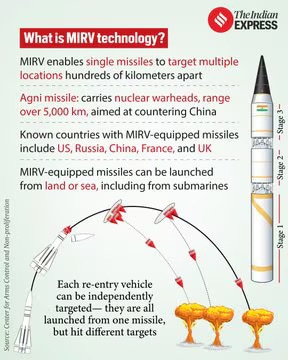
— It was developed in the 1960s and was first implemented by the United States in the 1970s and then later by the Soviet Union. Over time, China, the United Kingdom and France have also developed this technology.
— Agni is a long-range missile system indigenously developed by the DRDO. It is the main land-based delivery system for India’s nuclear arsenal. The first-generation Agni missiles were developed in the 1990s, and entered service with the armed forces in the mid-2000s.
— The Agni-1 to Agni-IV missiles have ranges of 700 to 3,500 kilometres and can carry single payloads weighing 12 to 40 kilotonnes.
— But the latest variant of the Agni missile family – Agni-5 equipped with MIRV technology – is capable of striking targets at ranges up to 5,000 kilometres with a very high degree of accuracy. It uses a three-stage solid fuelled engine.
Therefore, option (b) is the correct answer.
(Other Source: http://www.pib.gov.in)
Read more: MIRV equipped Agni-5 missile: What you need to know
Which of the following space agencies launched the Rosetta probe, which discovered amino acids and complex organic molecules on Comet 67P?
(a) Japan Aerospace Exploration Agency
(b) China National Space Administration
(c) National Aeronautics and Space Administration
(d) European Space Agency
Explanation
— When ESA’s Rosetta probe landed on Comet 67P in 2014, it discovered amino acids and complex organic molecules – stuff uncannily similar to the building blocks of biology.
Therefore, option (d) is the correct answer.
Recently, the rocket-sled test of a fighter aircraft escape system was conducted by:
1. Defence Research and Development Organisation
2. Indian Space Research Organisation
3. Aeronautical Development Agency
4. Hindustan Aeronautics Limited
Select the correct answer using the codes given below:
(a) 1 and 2 only
(b) 2 and 4 only
(c) 1, 3 and 4
(d) 1, 2 and 4
Explanation
— The Defence Research and Development Organisation (DRDO) conducted a successful high-speed rocket-sled test of a fighter aircraft escape system at controlled velocity. The technical achievement places India in an elite club of nations with advanced in-house escape system testing capability.
— The test was conducted in collaboration with the Aeronautical Development Agency (ADA) of the Ministry of Defence and public sector entity Hindustan Aeronautics Limited (HAL). It was carried out at the Rail Track Rocket Sled (RTRS) facility of the Terminal Ballistics Research Laboratory (TBRL), a key DRDO facility in Chandigarh.
— The rocket sled is a ground-based testing system, which is propelled by rockets to climb to high speeds while moving on rail tracks, simulating the aerodynamic conditions of an aircraft in flight.
— The dual-sled system allows the forebody of an aircraft to be mounted and tested under controlled velocities. In the recent test, a system with the forebody of the indigenous Light Combat Aircraft (LCA) was propelled to a precisely controlled velocity of 800 kilometres per hour through phased firing of multiple solid propellant rocket motors.
— Dynamic ejection tests are significantly more complex than static tests, which occur with the aircraft stationary or at zero altitude and zero speed. They are also considered the true measure of evaluating the pilot’s escape aid, such as ejection seats and canopy severance systems.
Therefore, option (c) is the correct answer.
Daily Subject-wise quiz — History, Culture, and Social Issues (Week 135)
Daily subject-wise quiz — Polity and Governance (Week 140)
Daily subject-wise quiz — Science and Technology (Week 139)
Daily subject-wise quiz — Economy (Week 139)
Daily subject-wise quiz — Environment and Geography (Week 139)
Daily subject-wise quiz – International Relations (Week 139)
Subscribe to our UPSC newsletter and stay updated with the news cues from the past week.
Stay updated with the latest UPSC articles by joining our Telegram channel – IndianExpress UPSC Hub, and follow us on Instagram and X.
🚨 Click Here to read the UPSC Essentials magazine for November 2025. Share your views and suggestions in the comment box or at manas.srivastava@indianexpress.com🚨

Read UPSC Magazine