8 min read
© IE Online Media Services Pvt Ltd
Latest Comment
Post Comment
Read Comments



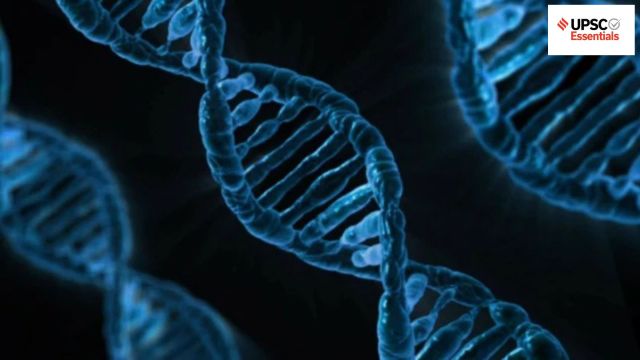 Check your progress and revise your topics through this quiz on Science and Technology. Find a question on DNA in today's quiz. (Representational image)
UPSC Essentials brings to you its initiative of subject-wise quizzes. These quizzes are designed to help you revise some of the most important topics from the static part of the syllabus. Attempt today’s subject quiz on Science and Technology to check your progress.
🚨 Click Here to read the UPSC Essentials magazine for October 2025. Share your views and suggestions in the comment box or at manas.srivastava@indianexpress.com🚨
With reference to the DNA (deoxyribonucleic acid), consider the following statements:
1. It is a large molecule containing the genetic information of an individual.
2. The chemical existence of DNA was discovered in 1869 by Francis Crick.
3. All living organisms have identical DNA sequences.
How many of the statements given above are correct?
(a) Only one
(b) Only two
(c) All three
(d) None
Explanation
— The discovery of the double helical structure of the DNA molecule in 1953 is considered one of the biggest breakthroughs in Science, which not only enhanced understanding of how life replicates itself, but also profoundly impacted fields ranging from health to agriculture.
— DNA is a large molecule containing the genetic information of an individual. This information, encoded in the genes, determines all the individual characteristics of the organism — from physical appearance to internal biology. During reproduction, these genes are replicated and transmitted to the offspring, sometimes with small changes that lead to genetic diversity and drive evolution. Hence, statement 1 is correct.
— The chemical existence of DNA was discovered in 1869 by the Swiss chemist Friedrich Miescher. Decades later, it was learnt that chromosomes, made of DNA and some proteins, were associated with inheritance. By the 1940s, scientists figured out that it was DNA, and not the proteins inside the chromosomes that carried genetic information. But scientists still did not know how DNA was able to store genetic information or how it was passed on. Thus, its structure had to be deciphered. Hence, statement 2 is not correct.
— In 1952, Watson and Crick experimented with three-dimensional wooden models to fit into a structure that matched the information provided by other scientists.
— DNA sequences vary among species and individuals. Hence, statement 3 is not correct.
Therefore, option (a) is the correct answer.
With reference to NASA’s ESCAPADE, consider the following statements:
1. It is the first multi-spacecraft orbital science mission to the Red Planet.
2. The mission is designed to understand planets’ magnetospheres and atmospheric escape.
Which of the statements given above is/are correct?
(a) 1 only
(b) 2 only
(c) Both 1 and 2
(d) Neither 1 nor 2
Explanation
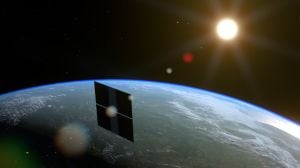
The much-anticipated launch of the New Glenn rocket by the Jeff Bezos-owned Blue Origin has been postponed due to unfavourable weather conditions. Reports say the weather was not suitable due to the violation of the cumulus cloud rule, a key safety guideline that prevents launches through thick cloud formations that could trigger lightning. This is Blue Origin’s first NASA space flight.
The rocket is named after John Glenn, a NASA astronaut, who was the first American to orbit the Earth.
Codenamed ‘NG-2’, the project was set to carry NASA’s ESCAPADE probes — the twin satellites designed to understand Mars’ magnetosphere and atmospheric escape, from Cape Canaveral Space Force Station in Florida.
About ESCAPADE
ESCAPADE is the first multi-spacecraft orbital science mission to the Red Planet. Hence, statement 1 is correct.
Its twin orbiters will conduct simultaneous observations from several places around Mars. The measurements will disclose how the planet responds to space weather in real time, as well as how the Martian magnetosphere changes over time.
ESCAPADE will investigate how Mars’ magnetic field directs particle fluxes around the planet, how energy and momentum are transferred from the solar wind through the magnetosphere, and what processes govern the flow of energy and matter into and out of the Martian atmosphere. Hence, statement 2 is correct.
Therefore, option (c) is the correct answer.
(Other Source: science.nasa.gov)
With reference to the ‘Ricin’, recently in the news, consider the following statements:
1. The seeds of the castor bean plant typically contain 30 per cent to 60 per cent ricin as the solid residue.
2. It is used as a food additive in some traditional medicines.
Which of the statements given above is/are correct?
(a) 1 only
(b) 2 only
(c) Both 1 and 2
(d) Neither 1 nor 2
Explanation
— Earlier this week, the Gujarat Anti-Terrorist Squad arrested three men — including a doctor with a “Chinese medical degree” – for allegedly trying to produce a lethal chemical compound called Ricin.
— Ricin is essentially a protein that can be extracted from the castor bean, largely grown industrially for the production of castor oil in countries such as India, Brazil, and China.
— The seeds typically contain 30 per cent to 60 per cent castor oil, with ricin accounting for 1 per cent to 5 per cent of the weight of the solid residue. Hence, statement 1 is not correct.
— “The plant is widely available, and the poison is not very difficult to extract from the seeds. Yet, the substance can be very lethal. Even 1 mg mixed in food can kill an adult,” said Dr YK Gupta, former head of the National Poison Information Centre at AIIMS, New Delhi.
— Once the poison has been absorbed, it attaches itself to the ribosomes – tiny structures found in cells that are responsible for reading genetic code and synthesising proteins.
— Ingesting ricin can lead to severe vomiting and diarrhoea, which can become bloody, and low blood pressure. It could also lead to hallucinations and seizures, multi-organ failure, and death. Ricin is exceedingly dangerous and is not used in food or traditional medicine; even small quantities can be fatal. Hence, statement 2 is not correct.
Therefore, option (d) is the correct answer.
With reference to Nuclear fission, consider the following statements:
1. It is a process in which a heavy atomic nucleus splits into two or more lighter nuclei.
2. It does not release any energy during the reaction.
Which of the statements given above is/are correct?
(a) 1 only
(b) 2 only
(c) Both 1 and 2
(d) Neither 1 nor 2
Explanation
— Nuclear technology is one of the few innovations that have changed the modern world profoundly and controversially. It involves harnessing nuclear reactions of atomic nuclei through the processes of nuclear fission and fusion.
— Nuclear fission is a process in which a heavy atomic nucleus splits into two or more lighter nuclei. It is also associated with the process of radioactive decay as heavier nuclear elements decay into lighter ones. Hence, statement 1 is correct.
— Nuclear fission produces a tremendous quantity of energy, principally in the form of kinetic energy from fragments and gamma radiation.Hence, statement 2 is not correct.
— Nuclear fusion is considered a process of creation as it involves the formation of a new, heavier atomic nucleus from the merger of two lighter and smaller nuclei.
Therefore, option (a) is the correct answer.
The Indian Space Research Organisation has conducted the deployment sequence of the parachute system for:
(a) Gaganyaan Mission
(b) Chandrayaan-3 Mission
(c) Aditya-L1 Mission
(d) PSLV-C58 Mission
Explanation
— The Indian Space Research Organisation (ISRO) conducted another key test last week as part of preparations for the country’s first human spaceflight mission, Gaganyaan. The test, held on November 3, was designed to verify the crew module’s stability in the event of a delay in the deployment of one of its main parachutes.
 (Image: ISRO)
— The experiment used an IL-76 aircraft from the Indian Air Force, which carried a 7.2-tonne (6.5-metric-tonne) capsule mass simulator. The aircraft took off from the Babina Field Firing Range in Uttar Pradesh and released the dummy capsule from an altitude of 2.5 kilometers, triggering the deployment sequence of the Gaganyaan parachute system.
Therefore, option (a) is the correct answer.
Daily Subject-wise quiz — History, Culture, and Social Issues (Week 131)
Daily subject-wise quiz — Polity and Governance (Week 136)
Daily subject-wise quiz — Science and Technology (Week 135)
Daily subject-wise quiz — Economy (Week 135)
Daily subject-wise quiz — Environment and Geography (Week 135)
Daily subject-wise quiz – International Relations (Week 135)
Subscribe to our UPSC newsletter and stay updated with the news cues from the past week.
Stay updated with the latest UPSC articles by joining our Telegram channel – IndianExpress UPSC Hub, and follow us onInstagramand X.

Read UPSC Magazine