© IE Online Media Services Pvt Ltd
Latest Comment
Post Comment
Read Comments
 8 min read


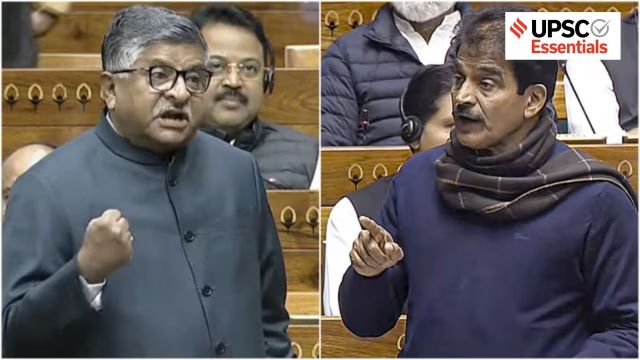 BJP member Ravi Shankar Prasad (left) and Congress MP K C Venugopal in Lok Sabha on Wednesday. (Image: ANI, PTI)
— Dileep P Chandran
In addition to questioning the timing of the ongoing Special Intensive Revision (SIR) in several poll-bound states, the Opposition raised concerns over freebies, immunity to the Chief Election Commissioner, and pressure on Booth Level Officers (BLOs) during an intense Lok Sabha debate on electoral reforms.
Opposition leaders even alleged that the intention behind the SIR exercise was to “delete” electors and “not authenticate them”. In response, the treasury bench rejected these claims by asserting that the Election Commission of India (ECI) has a constitutional mandate to purify electoral rolls for the fair conduct of elections.
Let’s explore the significance of SIR for free and fair elections, the constitutional provision for ECI’s power to revise electoral rolls, and, most importantly, the pivotal role of BLOs in ensuring electoral role accuracy.
The ECI conducts SIR with the objective of deleting duplicate and illegal registrations of voters. The exercise was first carried out in Bihar ahead of its Assembly elections in November this year, and now is being rolled out across the country, starting with nine states and three Union Territories.
Article 324(1) of the Constitution vests the ECI with the power of superintendence, direction, and control of the preparation of the electoral roll. Specifically, Section 21(2) of the Representation of the People Act, 1950 provides that “the Election Commission may at any time, for reasons to be recorded, direct a special revision of the electoral roll for any constituency or part of a constituency in such manner as it may think fit.”
During the Lok Sabha debate, both the treasury and the Opposition benches agreed on the necessity of maintaining accurate electoral rolls for the fair conduct of elections. But they differed over the intentions and manner in which the SIR was conducted.
Union Home Minister Amit Shah, however, stated that the purpose of the SIR is to identify and remove infiltrators from voters’ list. He articulated the government’s rationale as DDD formula – ‘Detect, Delete, and Deport’.
The debate on SIR subsequently expanded to a wider discussion on electoral reforms, and issues such as blanket immunity enjoyed by members of the ECI, access to CCTV footage of polling stations, overall accountability of the ECI, voter list irregularities, and the architecture of EVM.
Moreover, there are reports from various parts of the country about BLOs deployed for the SIR dying by suicide, allegedly due to excessive workload. Relatives of the deceased claimed that superior officers had exerted pressure on the BLOs to complete data collection and its digitisation within the stipulated and unmanageable timelines, amounting to acute workplace stress.
These tragic developments triggered widespread discussions on electoral reforms, raised public concerns regarding the modalities of purification of the electoral roll, and invited judicial scrutiny. Following the Supreme Court’s intervention, the ECI extended the deadline for electors to submit enumeration forms in the ongoing SIR, pushing the electoral roll publication date from February 7 to February 14 next year.
This episode underlines the fundamental importance of maintaining the fidelity of the electoral roll, which is an essential precondition for conducting free and fair elections. Section 13B of the Representation of the People Act, 1950, empowers the Electoral Registration Officer (ERO) for each constituency to prepare and revise the electoral roll. In discharging this function, the ERO can employ persons deemed fit for the preparation and revision of the electoral roll. This statutory provision enables the appointment of BLOs.
A BLO serves as a representative of the Election Commission of India (ECI) at the grassroots level and is responsible for collecting authentic field information about the electoral roll. BLOs, who are familiar with local electors, act as guides for voters at their doorstep in matters of electoral enrolment, correction, and verification. They are instructed to thoroughly study the part of the electoral roll assigned to them, make frequent field visits, and interact with voters at the local level.
Apart from assisting in the preparation and revision of the electoral roll, BLOs are assigned other duties such as distributing voter slips, providing assistance at polling booths, promoting IT applications launched by the ECI, informing eligible voters about the postal ballot option, and promoting EC guidelines and programmes at the doorstep of voters. Other major functions of BLO are:
1. Identification of non-existent voters
2. Checking inclusion and exclusion errors in the electoral roll
3. Submitting reports to the Electoral Registration Officer (ERO)
4. Receiving claims and objections from voters
5. Imparting voter education as part of Systematic Voters’ Education and Electoral Participation (SVEEP)
6. Coordinating with Booth Level Agents (BLAs)
Although BLOs are not full-time election officials, they play a pivotal role in regular revision and purification of the electoral roll, thereby helping to keep it error free and updated. This role of BLOs becomes particularly evident during the Special Intensive Revision (SIR) of the electoral roll carried out across the country. By ensuring the integrity of the electoral roll at the preparatory stage, BLOs contribute directly to the credibility of the entire electoral process.
The election process begins well before the formal announcement of elections and the notification of the election schedule by the ECI. The preparatory phases include the delimitation of the constituencies, when applicable, and the regular updation and revision of the electoral rolls. The actual conduct of elections commences with the announcement of the election schedule by the ECI, often through a press meet, upon which the model code of conduct (MCC) comes into immediate effect.
As soon as the notification is formally issued, candidates can file their nominations to the Returning Officer, who is also responsible for the scrutiny of nominations filed. Candidates are also allowed to withdraw their nominations by submitting a written notice within the prescribed time. The contesting candidates are then given considerable time for campaigning, during which they must strictly abide by the model code of conduct.
After the polling is conducted, votes are counted under the supervision of the Returning Officers, who are empowered to announce the result and issue certificates to the winning candidates. In case of any disputes, candidates can approach the concerned High Court by filing an election petition. The Representation of the People Act, 1951, also provides a detailed framework governing corrupt practices, electoral offences, and remedies available through election petitions.
Field-level officials and the broader administrative machinery play a critical role in ensuring that each stage of the election process is conducted in accordance with constitutional spirit and principles and statutory provisions. Preparatory activities are as important as the polling itself for the conduct of free and fair elections. Therefore, elections cannot be viewed as events occurring at periodic intervals. They represent a continuous administrative and institutional process involving multi-layered procedures that demand sustained attention and coordinated administrative efforts.
BLOs, working at the grassroots level of the election machinery, play a critical role in ensuring the accuracy of the electoral rolls and, in doing so, form one of the foundational pillars sustaining the integrity of India’s electoral system.
Why is the accuracy (fidelity) of the electoral roll essential to the democratic process? Who is a Booth Level Officer (BLO) and what is their significance in the electoral machinery?
What is meant by Special Intensive Revision (SIR) of electoral rolls? How does the Representation of the People Act, 1950 empower the ECI to revise electoral rolls?
Discuss the ethical obligations of superior officers during time-bound electoral exercises. Should there be institutional safeguards to protect BLOs from excessive workload and stress?
Enumerate the phases of the electoral process in India. How do preparatory activities contribute to the conduct of free and fair elections?
(Dileep P Chandran is an Assistant Professor at the Department of Political Science in P M Government College, Chalakudy, Kerala.)
Share your thoughts and ideas on UPSC Special articles with ashiya.parveen@indianexpress.com.
Click Here to read the UPSC Essentials magazine for November 2025. Subscribe to our UPSC newsletter and stay updated with the news cues from the past week.
Stay updated with the latest UPSC articles by joining our Telegram channel – IndianExpress UPSC Hub, and follow us on Instagram and X.


The Lionel Messi GOAT India Tour concluded in Delhi after a whirlwind four-city run that drew massive crowds eager to catch a glimpse of the World Cup winner. Alongside Messi, teammates Luis Suarez and Rodrigo De Paul wrapped up the tour after stops in Kolkata, Hyderabad and Mumbai, with fan turnout remaining strong throughout.

Read UPSC Magazine