8 min read


© IE Online Media Services Pvt Ltd



 Aspirants believe that some deserving candidates missed to enter the Mains cycle as they weren’t able to qualify CSAT. How is CSAT evolving? Zeeshan Hashmi tells us.
 You don’t want to miss a chance to serve the nation as an IAS officer just because you failed in a qualifying paper at the very first stage of the exam, do you? As the UPSC CSE 2023 cut-offs and results were released this week, the CSAT chapter reopened with aspirants revisiting the Prelims 2023 ‘CSAT shocker’ where many candidates weren’t able to write Mains not because of the compulsory General Studies paper but because of the qualifying CSAT paper. Scoring 33 per cent marks in a paper seems like a cakewalk but if you are aware of the unpredictability of the UPSC CSE, candidates should not overlook the CSAT paper and prepare for it well in advance. UPSC Prelims 2023 is a testimony to this fact.
With less than two months left for the prelims exam, Zeeshan Hashmi, our expert, talks to Manas Srivastava and gives a bird eye view on what were the major shifts in 2023 CSAT that aspirants must know for the upcoming Prelims.
About our Expert: Zeeshan Hashmi an educator, mentor and UPSC expert guides aspirants in approaching the civil services exam in a smart way by focusing on strategies which helps in analysing the trends of the exam and strategising the preparation accordingly. In the past, he has provided valuable insights with the UPSC Essentials of The Indian Express on the importance of mentorship. Today he throws light on the changing trends of CSAT.
The CSAT paper refers to the General Studies Paper-II of the Civil Services (Preliminary) Examination which is a qualifying paper with minimum qualifying marks fixed at 33 per cent. This 200 marks paper comprises questions on comprehension, interpersonal skills including communication skills, logical reasoning, and analytical ability, decision making and problem solving, general mental ability, basic numeracy (numbers and their relations, orders of magnitude, etc.) (Class 10 level), data interpretation (charts, graphs, tables, data sufficiency etc. — Class 10 level). The questions are of multiple choice, objective type.
Manas: Aspirants believe that some deserving candidates missed to enter the Mains cycle as they weren’t able to qualify CSAT. This year’s UPSC Prelims was seen as one of the toughest papers so far. What were the major changes from the past?
Zeeshan: In the past four years preceding CSAT 2023, UPSC maintained a judicious balance between the number of questions asked from Reading Comprehension, Logical Reasoning, and Quantitative Aptitude. Roughly 27 questions from each area were asked. However, in 2023 we did not see this balance in the number of questions. In 2023, 27 questions from Reading Comprehension, 14 questions from Reasoning Ability, and 39 questions from Quantitative Aptitude were asked.
So, there were two major evolutions in 2023:
1. Greater weightage to Quantitative Aptitude & lesser weightage to Reasoning Ability.
2. Increased difficulty level especially of Quantitative Aptitude and Reasoning Ability.
Manas: Can you provide a bird’s eye view over shifting trends in UPSC CSAT?
Zeeshan: As compared to GS I, the CSAT syllabus is defined and can be prepared through practice. However, the problem is with the nature of the questions which troubled the candidates last year. Broadly, the CSAT paper tests a candidate’s logical reasoning, quantitative aptitude, general mental ability, and reading comprehension. Each of this section saw a shift from the past year trend. Let’s see how…
Among 39 questions asked from Quantitative Aptitude, 26 questions were asked from Number System. 9 questions were asked from Permutations and Combinations followed by other topics. So, the break up of questions was skewed towards relatively difficult topics.
On the other hand, a neglect of Time and Distance, Mensuration, Percentage, Mixtures & Allegations, Clocks etc was visible. Notably, these have traditionally been scoring areas for students.
In Quantitative Aptitude, questions became more complex, lengthy, and confusing in 2023 compared to 2022.
Let’s have a look on the following question from CSAT 2023:
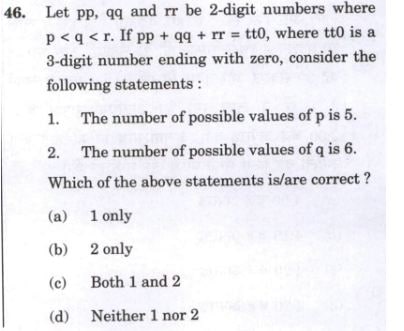 UPSC CSE 2023 CSAT Question (image courtesy: Zeeshan Hashmi)
No formula is usable in the above question asked in CSAT 2023. You need to probe all 12 possibilities. Multiple questions on similar lines were asked, thus eating up candidate’s time in the exam.
Among questions from Logical Reasoning, there were no questions on Figures, Direction Test, Sitting arrangement. Again, these areas have been traditionally scoring for students. Questions were asked from series, venn diagrams, cubes, analogy, coding & decoding etc.
Even in Reasoning Ability section, difficulty level of questions has been starkly increased. For example, a calender based question was asked in 2023 CSAT which had an element of number system. It can still be solved in less time if the trick involved is known, otherwise it’s a complex and time consuming question.
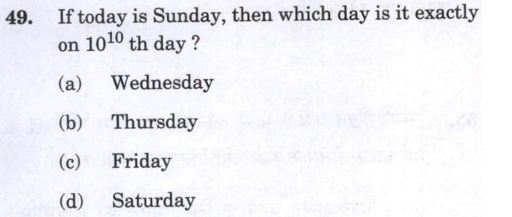 UPSC CSE 2023 CSAT Question (Courtsey: Zeeshan Hashmi)
On the contrary, the calendar question below from CSAT 2022 is relatively straightforward.
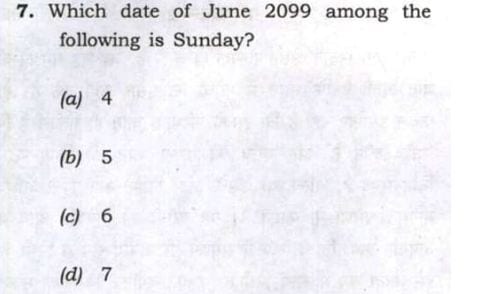 UPSC CSE 2022 CSAT Question (Image Courtsey: Zeeshan Hashmi)
In Reading Comprehension, direct questions have been replaced with analytical questions. Thus, the importance of understanding the essence of the passage and applying it in realtime has increased.
The two examples below from CSAT 2022 directly ask questions with regards to objective information provided in the respective passages.
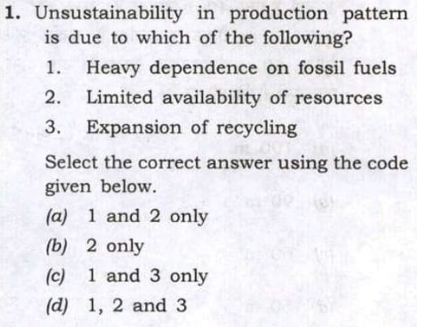 UPSC CSE 2022 CSAT Question (Image Courtsey: Zeeshan Hashmi)
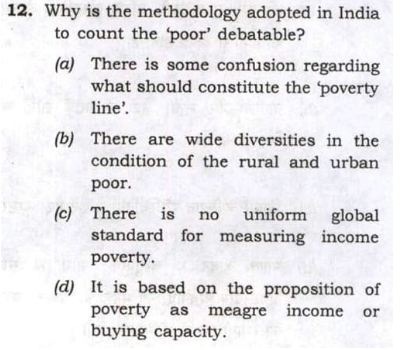 UPSC CSE 2022 CSAT Question (Image Courtsey: Zeeshan Hashmi)
On the contrary, the two questions below from CSAT 2023 are more analytical in nature.
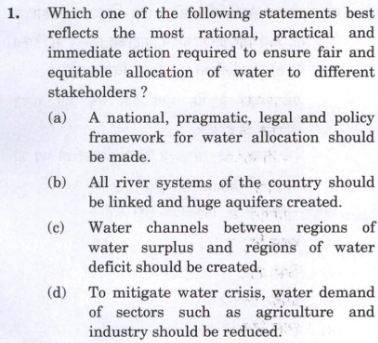 UPSC CSE 2023 CSAT Question (Image Courtsey: Zeeshan Hashmi)
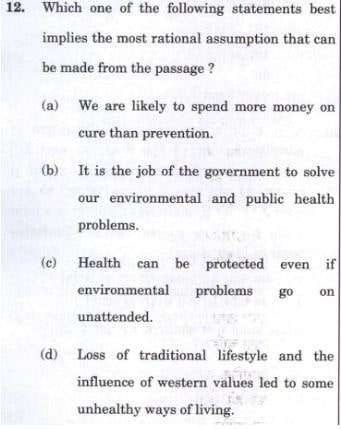 UPSC CSE 2023 CSAT Question (Image Courtsey: Zeeshan Hashmi)
– The comprehension asked in the CSAT paper falls in all three categories: easy, moderate and difficult levels. aspirants end up losing precious marks in the comprehension section by spending excessive time in solving a passage.
– The most effective way of preparing this area is by including reading in your daily routine. Read articles, columns, magazines to improve your language skills and reading speed.
– While solving a comprehension, mark important keywords while reading the passage. To identify the keywords, it is suggested to read the questions first. So when you go back to reading the comprehension, keep marking those keywords you identified in the questions.
Manas: So, what needs to be done to prepare for the CSAT paper?
Zeeshan: There are four key things every aspirant should keep in mind while strategising to solve the CSAT paper:
1. Prepare all 3 major components of CSAT. Don’t take a risk to prioritise one over the other. It’s difficult to predict which area will be given more weightage by UPSC in upcoming years.
2. Step up your preparation by practicing tougher questions asked in other traditionally difficult exams like banking, SSC, RBI, CAT. These exams are known for their difficulty level with respect to Quantitative Aptitude and Reasoning Ability.
3. Memorise and practice relevant formulae, tricks, and shortcuts as their relevance has increased.
4. Develop analytical ability in Reading Comprehension by decoding sample passages. Newspaper columns can be used as ready references.
– Poor time management in CSAT paper can cause you an early elimination from the UPSC CSE cycle. Therefore you need to take care of it while solving the questions.
– It is advised to not spend more than two to three minutes on a particular question.
– It is better to jump to the next question than spend extra time on one question.
– Time management can be learned by solving the mock tests before the exam.
– Identifying which type of questions you are repeatedly attempting wrong and correctly is an important part of your revision and practice sessions before prelims.
– Attempting mock tests helps – analyze your performance in the mock papers and find out your strengths and weaknesses accordingly.
– Once you have identified your strength, solve your strength topic first in the exam hall. For example, if you are good at comprehension, solve those questions first and keep the time-consuming questions to the end.
So, you know it will take diligent preparation to get the minimum marks. A planned strategy should be followed in pursuing each area covered in the paper.
https://www.youtube.com/watch?v=Wgw-Y4c2m9U?si=hSWBks6-oPmvicOR

Read UPSC Magazine