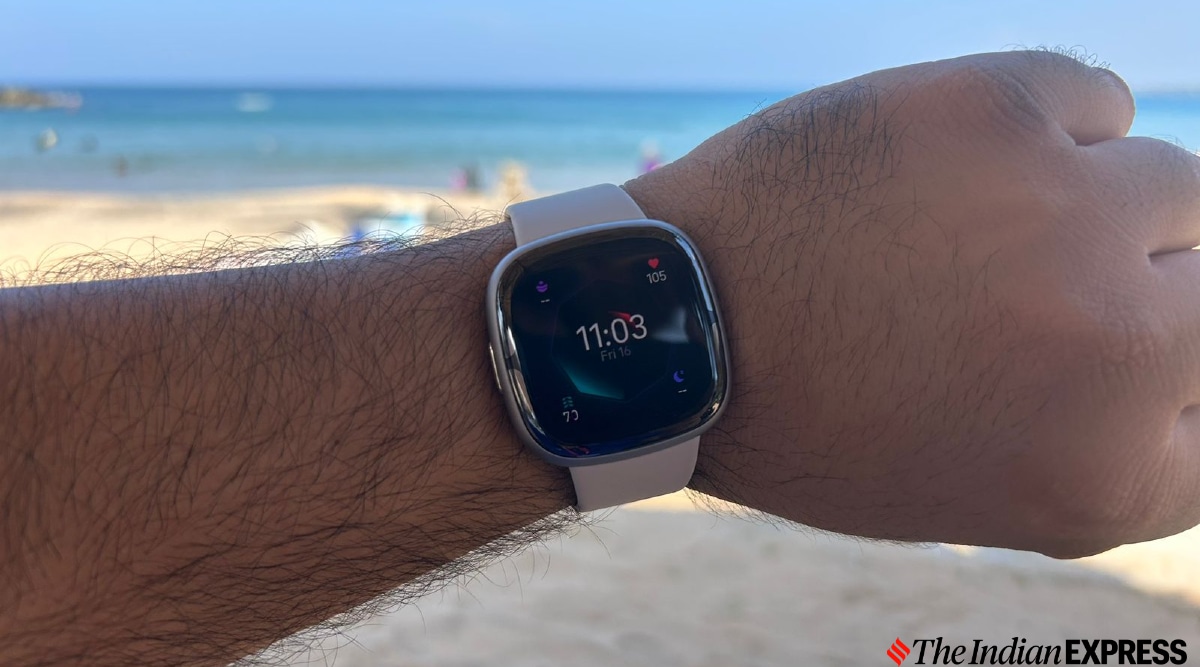
Fitbit’s great strength lies in sleep tracking and its subscription service that unlocks extra fitness features, classes and health insights. (Image credit: Anuj Bhatia/Indian Express)
Listen to this articleYour browser does not support the audio element.
On my way through the airport last week, I realised I had forgotten to carry the charging cable for the Fitbit Sense 2. As anxiety kicked in, I wondered how I would survive with a dead smartwatch on my short trip to Thiruvananthapuram. But about 48 hours later, the Sense 2 had a 60 per cent battery left. That’s Fitbit’s newest Sense 2, which has made my life easier in a way because I don’t need to charge it each day. But is battery life the only upside to the Sense 2 or are there other features that make this smartwatch truly compelling? I tried Sense 2 for a week, and here’s what I found.
You’ve Read Your Free Stories For Now
Sign up and keep reading more stories that matter to you.
Fitbit Sense 2 price in India (as reviewed): Rs 24,999
Design that blends in
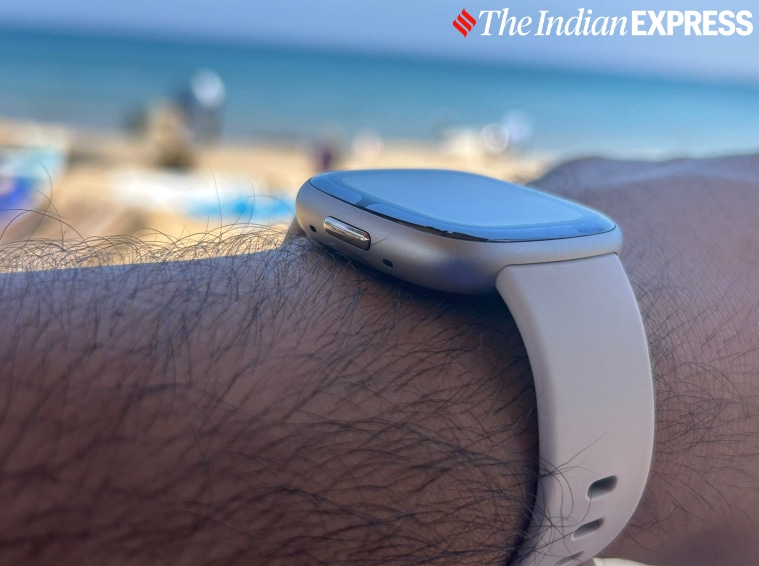
Sense 2 looks similar to the original Sense that came out in 2020, though I must say the new version is slightly thinner and lighter. Otherwise, it still features a square face with rounded corners with a crisp, clear 1.6-inch always-on OLED display and a solid aluminum build. So yes, it feels similar. But the most notable design change is the addition of a physical button. With a quick tap, it takes you back to the home screen while a double tap can be customised to perform various shortcuts. Although Fitbit doesn’t technically use IP ratings, the company says the device is water resistant up to a depth of 50m. Swapping straps is very easy. All you need to do is press the button, remove the strap, and then snap the new one in its place. While jogging, I didn’t feel I was wearing a watch, making this piece barely noticeable when strapped on.
The Sense 2 has a square casing, but with curves on the sides, rounded edges and rounded corners. (Image credit: Anuj Bhatia/Indian Express)
Terrific battery life
The Fitbit Sense comes with a proprietary charger that fits into a USB port and sticks to the back of the watch magnetically. Sense 2 has the same 162maAh cell as the original Sense. Charging the watch fully takes up to two hours and should give you up to six days of battery life. In my testing, I found that the Sense 2’s battery lasted close to two-and-a-half days on a single charge. Smartwatches used to be something one had to charge every night, but now I’m not worried about the battery every single day.
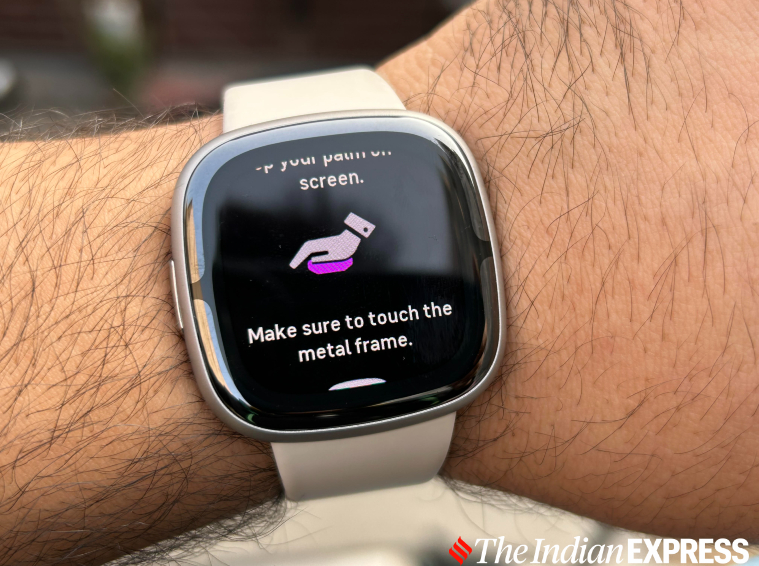
For me, the standout feature of the Sense 2 has been the ability to measure stress via an EDA sensor. The EDA scanner uses skin temperature to check stress levels along with other metrics like heart rate variation, and deliver a stress management score. The Sense 2 has an upgraded sensor, this time you get automatic alerts in real-time. It works, at least for me. For example, I had a bit of a hectic week. I had a lot of travelling; first I went on a vacation and immediately I had to attend an event in Thiruvananthapuram. I barely had a few hours to relax.
When I was stressed, I got a body response alert and Sense 2 prompted me to meditate. I won’t say the alerts come on time every time I feel under pressure but somehow Fitbit’s stress management feature helped me to acknowledge my fears and work on them to destress my life.
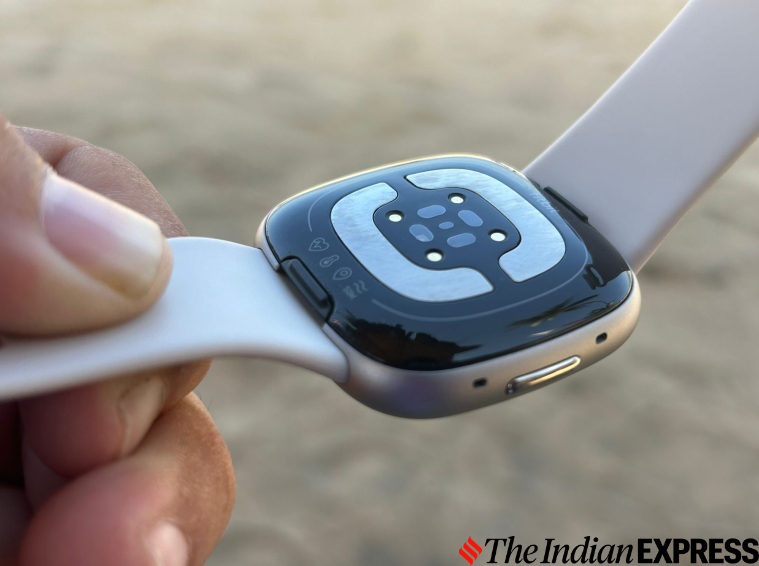
The Sense 2 can detect possible heart-related health issues (ECG readings), and rising stress levels (continuous skin conductance). (Image credit: Anuj Bhatia/Indian Express)
Top-notch fitness tracking
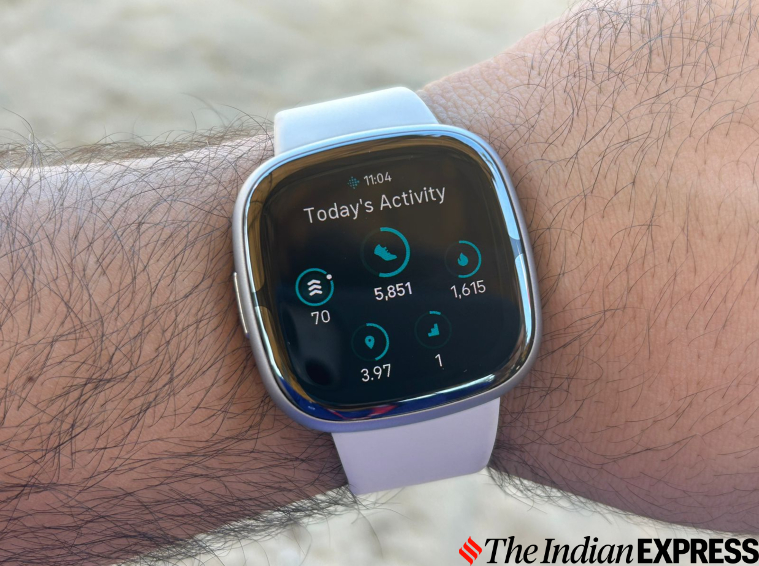
The Sense 2 is pitched as a fitness coach on the wrist and it does live up to the promise with 40 types of activities to choose from. Best of all, it’s easy to stop and start any activity with the button. The watch has seven exercise types: walking, running, outdoor cycling, elliptical, sports, aerobic workout and swimming, all supporting auto-recognition. Some activities have GPS integration, although it’s not comparable to the accuracy of a dual-band watch. As I found in my testing, the accuracy of the tracking wasn’t great. In fact, GPS was slow to connect, sometimes requiring 15 to 20 minutes.
The Sense 2 can also be used to collect data while you sleep, which is the best in the industry. Every user gets Fitbit’s sleep score and sleeps stages, with detailed info available only when you subscribe to a premium service. Besides that, Sense 2 can notify you of abnormal high or low heart rate readings as well as look for signs of AFib, an irregular heart rhythm condition.
Story continues below this ad
Fitbit can track your workout through about 40 modalities, including running, strength training, spinning, walking, and bike riding. (Image credit: Anuj Bhatia/Indian Express)
A fitness tracker in a smartwatch body
The Sense 2’s ships with a brand new Fitbit OS that is more like WearOS. The user interface is tailored for a smartwatch and that is a good thing. Swiping left and right to view widgets or pressing the button brings up an app list. Swiping up brings up notifications, and swiping down gets you to the quick menu. I must say the watch’s UI is a step forward but at the same time, Google, which owns Fitbit, has done something that bogs down the Sense 2 capabilities. There’s no Google Assistant, Gmail or Calendar integration – despite being a Google product now. Although Amazon Alexa is there, it’s there on every smartwatch available on the market. The promise of Fitbit services being deeply integrated with Google hasn’t happened, and what we are getting is a confusing product.
The omission of Wi-Fi on the Sense 2 is another missed point. Without Wi-Fi support, updating Sense 2’s software will be super slow. Sense 2 doesn’t support native music storage at all – and support for apps like Spotify is also missing. The Sense 2 doesn’t have third-party apps and you are limited to basic apps pre-installed on the device like alarms, timers and weather. And that’s not all.
If you are an iPhone user, there is no way to reply to a text message on the watch itself. You can read a message but cannot reply. That’s annoying, especially if you are in the middle of a meeting or stepping outside for a walk. You have no choice but to pull the iPhone out of your pocket to reply to a text message. It seems that Google deliberately wants to curtail features on the Sense 2 , so that more people buy its Pixel watch. That defeats the purpose of a smartwatch, making the Sense 2 more like a premium smart band.
The Sense 2 also features a physical button, rather than the capacitive one on the first Sense. (Image credit: Anuj Bhatia/Indian Express)
Should you buy Fitbit Sense 2
At this point, you might be thinking, “Right, why don’t I get an Apple Watch?” Starting at Rs 24,999, the Sense 2 is priced on the premium side. And that to me is a bit problematic. It really is a fitness tracker and not a smartwatch. Fitbit’s great strength lies in sleep tracking and its subscription service that unlocks extra fitness features, classes and health insights. You can get those features on any Fitbit wearable. To put it in another way, the Sense 2 is a weird product not because it’s a bad device – rather it is thoughtfully designed to do less.
Anuj Bhatia is a seasoned personal technology writer at indianexpress.com with a career spanning over a decade. Active in the domain since 2011, he has established himself as a distinct voice in tech journalism, specializing in long-form narratives that bridge the gap between complex innovation and consumer lifestyle.
Experience & Career: Anuj has been a key contributor to The Indian Express since late 2016. Prior to his current tenure, he served as a Senior Tech Writer at My Mobile magazine and held a role as a reviewer and tech writer at Gizbot. His professional trajectory reflects a rigorous commitment to technology reporting, backed by a postgraduate degree from Banaras Hindu University.
Expertise & Focus Areas: Anuj’s reporting covers the spectrum of personal technology, characterized by a unique blend of modern analysis and historical context. His key focus areas include:
Core Technology: Comprehensive coverage of smartphones, personal computers, apps, and lifestyle tech.
Deep-Dive Narratives: Specializes in composing longer-form feature articles and explainers that explore the intersection of history, technology, and popular culture.
Global & Local Scope: Reports extensively on major international product launches from industry titans like Apple and Google, while simultaneously covering the ecosystem of indie and home-grown tech startups.
Niche Interests: A dedicated focus on vintage technology and retro gaming, offering readers a nostalgic yet analytical perspective on the evolution of tech.
Authoritativeness & Trust
Anuj is a trusted voice in the industry, recognized for his ability to de-jargonize trending topics and provide context to rapid technological advancements. His authority is reinforced by his on-ground presence at major international tech conferences and his nuanced approach to product reviews. By balancing coverage of the world's most valuable tech brands with emerging startups, he offers a holistic and objective view of the global technology landscape.
Find all stories by Anuj Bhatia here.
You can find Anuj on Linkedin. ... Read More