Six years ago, Rajat Jain lost a classmate to heart attack. He was just 21. The loss shook Jain who was then studying engineering at a Dehradun college and led to the development of ‘Spandan’, a smartphone-operated portable ECG device.
“I have seen people living with cardiac issues. When they have a heart attack, there often confuse it with gastric pain. Most are unaware of early symptoms in India,” explains Jain who founded the Dehradun-based Sunfox Technologies.

The idea behind a portable ECG device was to help people living in remote areas have access to the proper diagnoses of early symptoms. An electrocardiogram (ECG) is a reliable method to collect electrical signals generated by the heart and study heart rhythm and diagnose issues. But ECG machines are still expensive and can cost over Rs 1 lakh. They also need to be operated by trained professionals.
Heart diseases rank among one of the top causes of death globally according to World Health Organization. (Image credit: Sunfox Technologies)
“All this limits ECG machines to hospitals and tertiary care centres,” says Jain. Also, the government policy that puts ECG machines in a list of desired items, and not essential items, adds to the problem. On top of that, most districts don’t have more than one cath lab. Worrying for a country which now accounts for 13.86 per cent of the total deaths from heart ailments globally, according to a recent study.
Work on Spandan started in 2016 and it took Jain and his team four years to complete the development, conduct clinical trials and get regulatory approval to be able to bring the product to the market. From its inception, Jain wanted to make Spandan a replica of a gold-standard ECG machine but in a portable form factor.
Jain describes Spandan as a “plug and play” device which is as easy to use as a pair of headphones. Weighing just 12 gram, the device is smaller than a car key and can be kept inside a matchbox. The device uses no battery, has no moving parts, and is completely buttonless. “This is the leanest version we could have made,” Jain says on designing the portable ECG device.
The final prototype of the Spandan portable ECG device. (Image credit: Sunfox Technologies)
Spandan works with a smartphone, and that’s what makes it unique. Inside, the device’s electronic components take the data from the chest and then pass it to the smartphone. The portable ECG device connects with two cables – one goes to your phone and another one lets you stick the electrodes to your chest. The whole process is safe and painless, claims Jain.
Story continues below this ad
To use the portable ECG device, users need to download a mobile app from the Google Play Store. The same app tracks and generates PDFs of health reports which can be shared with a doctor through email or WhatsApp. Jain says the mobile app has the ability to notify the user of irregular heart rhythms (arrhythmias) as well as extract the HRV signal, which is defined as the time interval between consecutive heartbeats measured in milliseconds. There is also a live monitoring feature which monitors users on multiple parameters like oxygen levels and breathing levels.
Jain’s Spandan app is not dependent on the internet or mobile signals to deliver the results. This means users can perform a mobile ECG at high-altitude regions where networks are a little patchy.
The Spandan device has gone through multiple prototype stages and ideations. “The first variant we designed internally was limited to rhythm monitoring only but at a later stage, we found that there are so many devices that can actually monitor your rhythm,” Jain explains. “The main challenge comes when you have to monitor a blockage or ischemic change which causes a sudden heart attack,” says Jain, who was helped by Dr Yogendra Singh, an associate director of Cardiology at Max Super Speciality Hospital in Dehradun.
The Spandan device relies entirely upon the smartphone for computing purposes. (Image credit: Sunfox Technologies)
Unlike the Apple Watch which replicates a single-lead ECG, Spandan records a 12-lead ECG, the gold standard for measuring the heart’s electrical pattern. A 12-lead ECG measures the heart’s electrical activity in several directions and planes and is highly sensitive and Jain says this is why Spandan is a medical device which can be used for diagnostic information.
Story continues below this ad
It takes 10 seconds to get the results, and according to Jain, has an accuracy of 99.7 per cent based on trials conducted on over 3,000 people between 2017 and 2021. “The amount of data and the quality of the data which you get from a standard ECG machine inside the ICU will be exactly the same as the data obtained by Spandan,” Jain says, adding that AI and the use of machine learning algorithms helped improve the accuracy.
Designing and manufacturing Spandan in Dehradun hasn’t been easy due to the lack of an R&D ecosystem and the skilled resources required, admits Jain. “There are a lot of dependencies in hardware. This is not there in the case of developing software which can be done out of one room,” Jain says, adding that the challenge is understanding the regulatory requirements makes it tougher for medical hardware.
Spandan is now sold for under Rs 7000 via Amazon, 1MG and other e-retailers. The device does not require a subscription or a doctor’s involvement. This year, Jain aims to move 100,000 units of Spandan, up from 50,000 last year. Also in the works are new versions that will create a clear distinction between home healthcare and hospital use.


 6 min read


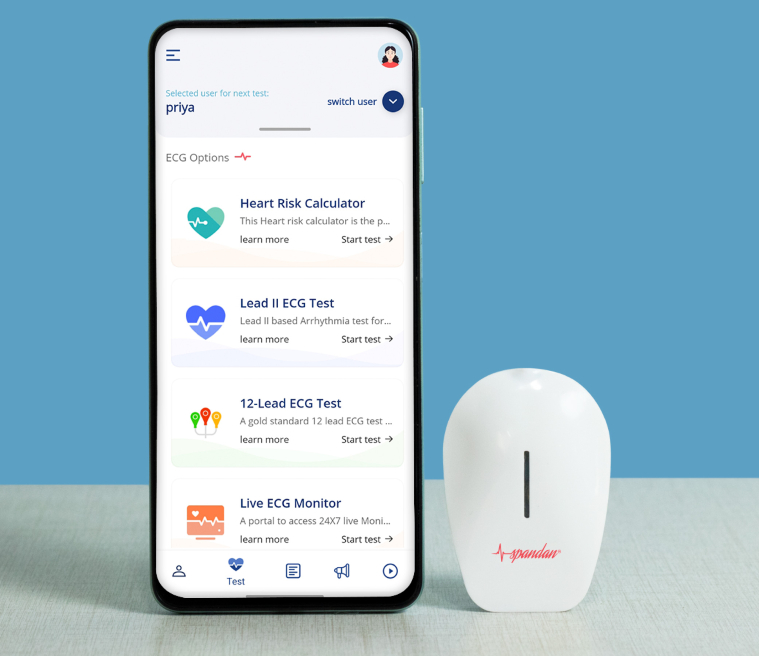 Heart diseases rank among one of the top causes of death globally according to World Health Organization. (Image credit: Sunfox Technologies)
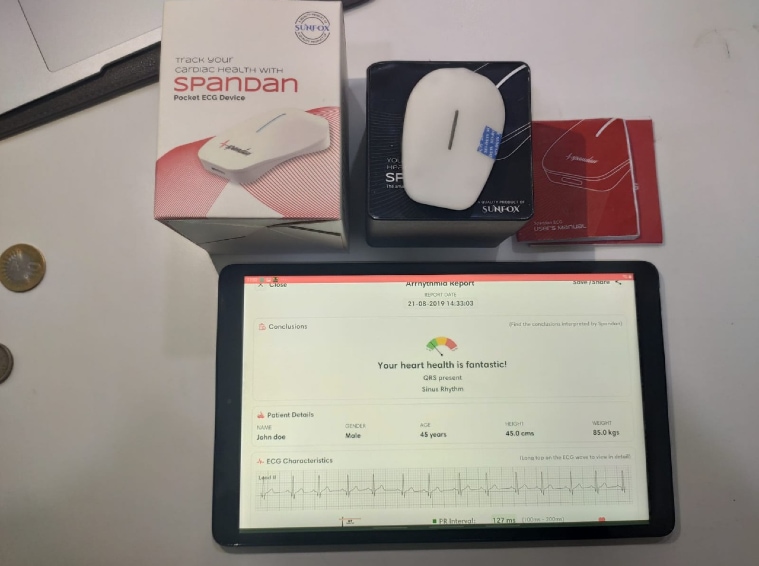 The final prototype of the Spandan portable ECG device. (Image credit: Sunfox Technologies)
 The Spandan device relies entirely upon the smartphone for computing purposes. (Image credit: Sunfox Technologies)