3 min read
© IE Online Media Services Pvt Ltd



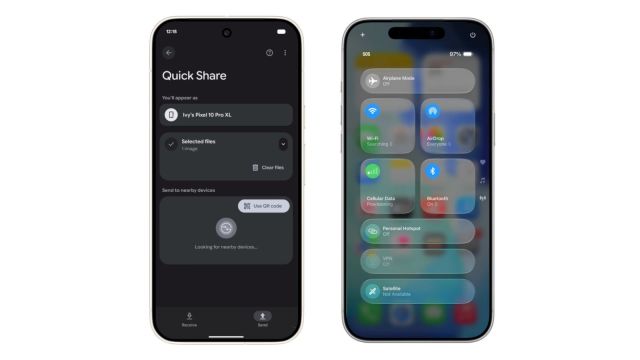 A Google spokesperson confirmed that the functionality was engineered solely by Google’s internal teams and vetted through both in-house security reviews and a third-party penetration test. (Image: Google)
Google has revealed a development few saw coming: owners of the new Pixel 10 series can now exchange files with Apple devices using AirDrop, marking one of the most significant breakthroughs in cross-platform sharing to date. Google built the capability entirely on its own, without technical coordination or partnership from Apple.
The company says the feature works across iPhone, iPad, and macOS hardware and is debuting exclusively on the Pixel 10 lineup before rolling out more broadly. According to Google spokesperson Alex Moriconi, the company plans to extend the feature to additional devices after this initial release.
To initiate a transfer from a Pixel 10 to an Apple device, the iPhone, iPad, or Mac owner must temporarily adjust their AirDrop settings to allow discovery by “everyone,” an option that automatically reverts after ten minutes. Once enabled, the Pixel 10 can detect the Apple device through Quick Share, and the file can be sent normally. On the Apple side, the request appears indistinguishable from a standard AirDrop prompt, which the recipient can accept to begin the direct transfer.
The process works in reverse as well. If the Pixel 10 is set to be discoverable or placed in receive mode, Apple users can initiate an AirDrop transfer that the Pixel owner then approves. The exchange completes just as seamlessly, offering Android users a file-sharing experience long limited to Apple’s ecosystem.
Google published additional details in a security blog, emphasising that the system does not rely on any workaround or server-based handoff. Instead, the connection is direct and peer-to-peer, with no logging, data routing, or hidden information exchange. A Google spokesperson confirmed that the functionality was engineered solely by Google’s internal teams and vetted through both in-house security reviews and a third-party penetration test.
While Google did not speculate on Apple’s reaction, the company expressed openness to future collaboration that could improve interoperability between Android and iOS.
The security documentation also highlights Google’s efforts to pre-empt concerns Apple might raise regarding safety or privacy, including an independent assessment from cybersecurity firm NetSPI. Apple has not yet issued a statement on the development.
Although the feature is not yet an Android-wide capability, its arrival on Pixel 10 devices signals a major shift. Until now, AirDrop has been one of Apple’s most tightly guarded conveniences, powering frictionless sharing exclusively within its ecosystem.