4 min read
© IE Online Media Services Pvt Ltd



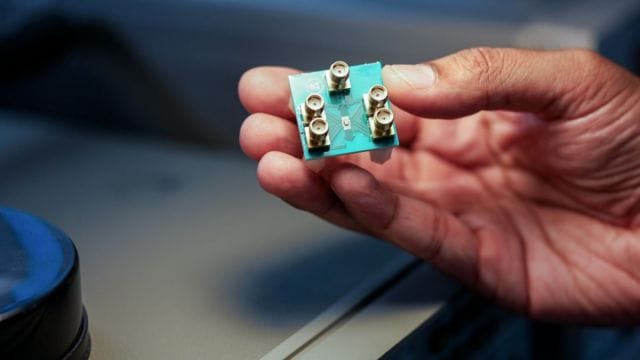 The MNN chip leverages analogue waves in the microwave range of the electromagnetic spectrum within an AI neural network, generating a distinctive comb-like waveform pattern. (Image: Charissa King-O’Brien/Cornell Engineering)
Researchers have developed a completely new type of microprocessor that operates using microwaves instead of traditional digital circuitry. According to a study published on August 14 in Nature Electronics, the processor—capable of outperforming conventional CPUs—is the first fully functional microwave neural network (MNN) integrated onto a single chip.
High-bandwidth applications such as radar imaging demand exceptionally fast processing speeds. To meet these requirements, scientists have been exploring new computing architectures based on analogue microwaves, which can handle data at much higher rates than digital systems.
“Because it’s able to distort in a programmable way across a wide band of frequencies instantaneously, it can be repurposed for several computing tasks. It bypasses a large number of signal-processing steps that digital computers normally have to do,”
said Bal Govind, a Cornell University doctoral student and the study’s lead author.
The MNN chip leverages analogue waves in the microwave range of the electromagnetic spectrum within an AI neural network, generating a distinctive comb-like waveform pattern. The frequency comb’s evenly spaced spectral lines act like a ruler, enabling extremely rapid and precise frequency measurements.
Neural networks—the foundation of the MNN—are machine learning systems inspired by the human brain’s structure. The “microwave brain” employs interconnected electromagnetic nodes within tunable waveguides to recognize patterns in data and adapt dynamically to new information.
The MNN’s integrated circuit processes spectral components (the individual frequencies in a signal) by capturing features of input data across a wide bandwidth. This enables the chip to execute both simple logic operations and complex tasks such as binary sequence recognition and high-speed pattern detection—with an accuracy rate of 88 per cent. The researchers validated this performance across multiple wireless signal classification problems.
Operating in the microwave analogue range and using a probabilistic computing approach, the chip can process data streams on the order of tens of gigahertz—at least 20 billion operations per second. In comparison, most consumer-grade CPUs operate between 2.5 and 4 GHz (2.5–4 billion operations per second).
“Bal threw away a lot of conventional circuit design to achieve this,” said Alyssa Apsel, co-senior author and director of the School of Electrical and Computer Engineering at Cornell University. “Instead of trying to mimic the structure of digital neural networks exactly, he created something that looks more like a controlled mush of frequency behaviors that can ultimately give you high-performance computation.”
Govind explained that maintaining accuracy in traditional digital systems often demands additional circuitry, energy, and error correction. By contrast, the MNN’s probabilistic approach maintains accuracy for both basic and advanced computations without increasing power or hardware costs.
Another major advantage of the microwave chip is its remarkably low power consumption—less than 200 milliwatts (0.2 watts), roughly equivalent to the transmit power of a mobile phone. Most CPUs, by comparison, require at least 65 watts.
This efficiency makes the chip suitable for personal devices, wearables, and edge computing, where processing occurs locally rather than through a central server. It could also offer a low-power, high-performance solution for training and deploying AI models, especially in energy-constrained environments.
Looking ahead, the researchers plan to miniaturise the design by reducing the number of waveguides and simplifying the chip’s architecture. Interconnected microwave combs could further broaden the output spectrum and enhance neural network training on a smaller, more efficient device.