


Tags:


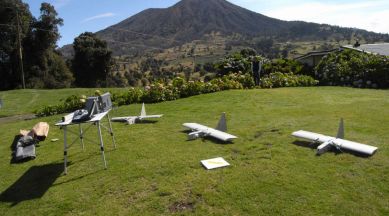
Drones can do more than just capture high-flying footage, say scientists who have successfully used the unmanned aerial vehicles to collect measurements from an inaccessible volcano as it erupted.
Researchers from the Universities of Bristol and Cambridge in the UK carried out many proof-of-concept flights at the summits of Volcan de Fuego and Volcan de Pacaya in Guatemala.Using lightweight modern sensors they measured temperature, humidity and thermal data within the volcanic clouds and took images of multiple eruptions in real-time.

Also Read: Japanese scientists develop sticky insect-sized drones to help pollinate crops
“These sensors not only help to understand emissions from volcanoes, they could also be used in the future to help alert local communities of impending eruptions – particularly if the flights can be automated,” said Emma Liu, Volcanologist from the Department of Earth Sciences at Cambridge.
This is one of the first times that bespoke fixed-wing unmanned aerial vehicles (UAVs) have been used at a volcano such as Fuego, where the lack of close access to the summit vent has prevented robust gas measurements, researchers said.The team carried out multiple beyond-visual-line-of-sight (BVLOS) flights from the observatory flying up to 10,000 feet above the launch site to reach the summit of Volcan de Fuego.
Also Read: Drones learn to land on their own using ‘fuzzy logic’
“Volcanoes are prodigious sources of volatiles and trace metals and have a key role in the geochemical cycling of these elements through the Earth system,” said Liu. “Drones offer an invaluable solution to the challenges of in-situ sampling and routine monitoring of volcanic emissions, particularly those where the near-vent region is prohibitively hazardous or inaccessible,” Liu said.
The group plans to return to Guatemala later in the year with a wider range of sensors including a multiGAS gas analyser, a four-stage filter pack, carbon stubs for ash sampling, thermal and visual cameras, and atmospheric sensors.


