3 min read
© IE Online Media Services Pvt Ltd



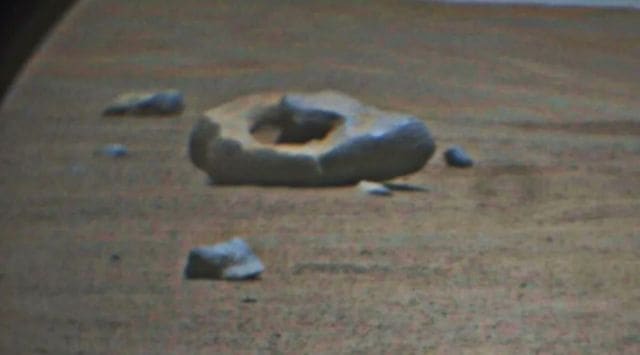 The donut-shaped rock could be a meteorite, according to the SETI institute. (SETI Institute)
 National Donut Day is celebrated on June 2 in the United States but it seems like the date is June 23 on Mars. That is when NASA’s Perseverance Rover took a picture of a bizarre rock with a hole at the centre, like a doughnut, on Mars.
The SETI Institute tweeted on Monday that the rock in the image could be a large meteorite surrounded by many smaller pieces. The image was taken with the Perseverance’s SuperCam Remote Micro-Imager on June 23, according to the institute.
#PPOD: @NASAPersevere took a picture using the SuperCam Remote Micro-Imager on 23 June 2023 of a donut-shaped rock off in the distance, which could be a large meteorite alongside smaller pieces. Credit: @NASA @NASAJPL @Caltech @LosAlamosNatLab @CNES @IRAP_France @mars_stu pic.twitter.com/9EFTr5tlno
— The SETI Institute (@SETIInstitute) June 26, 2023
That explanation is not unlikely since the Perseverance Rover has identified multiple potential meteorite candidates on the red planet since it landed there in 2021. Also, this is not the first time a rover or a spacecraft found strangely shaped rocks and other features on the planet.
Using the Mars Reconnaissance Orbiter, astronomers discovered a structure on the planet resembling a bear’s face, according to The Independent. The structure was made of a rock formation that had two craters that created the “eyes of the bear.” and a collapsed hill in a V-shape that resembled a snout.
In February this year, the Curiosity Rover had discovered an iron-nickel meteorite that was later renamed “Cacao.” the meteorite measure about 30 centimetres across.
Perseverance is currently exploring the 45-kilometre-wide Jezero Crater, which lies at the western edge on a flat plain called Isisi Planitia, which is just north of the planet’s equator. Perseverance’s landing site is around 3,700 kilometres away from Curiosity’s landing site in Gale Crater.
Scientists are of the opinion that the Jezero Crater was once filled with water and was home to an ancient river delta. More than 3.5 billion years ago, river channels could have spilt over the crater wall to create a lake. According to NASA, scientists see evidence that water carried clay minerals from the surrounding area into the crater lake.
But Perseverance is not alone in the crater, it is joined by the Ingenuity Mars Helicopter that is taking short flights around the planet looking for clues that will tell scientists more about the planet.