3 min read
© IE Online Media Services Pvt Ltd



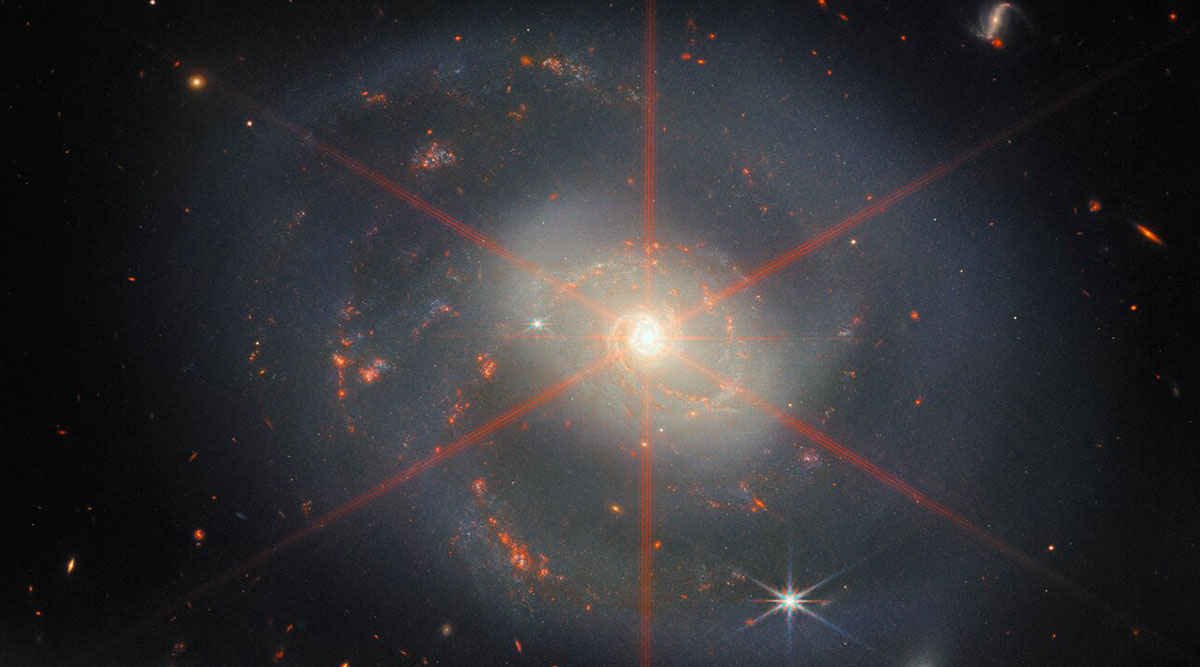 The six-pointed star in this James Webb Space Telescope image is not an actual celestial object but an imaging artifact. (Image credit: ESA/Webb, NASA & CSA, L. Armus, A. S. Evans)
 The European Space Agency (ESA) shared this image of a face-on spiral galaxy that is approximately 90,000 light-years in diameter and sits 220 million light-years away from our planet in the constellation Pegasus. The image is dominated by the galaxy’s extremely bright “active galactic nucleus.”
The active galactic nucleus (AGN) of NGC 7469—the spiral galaxy in the image—is so bright because of the light emitted by the dust and gas as it falls into the black hole at the galaxy’s centre. According to ESA, this galaxy provides astronomers with a “unique opportunity” to study the relationship between AGNs and starburst activity because its AGN is surrounded by a starburst ring that is at a distance of 1,500 light-years. Starburst refers to the intense activity involving the formation of new stars.
NGC 7469 is one of the best-studied AGNs in the sky but the compact nature of its systems and the presence of large amounts of dust made it difficult for scientists to achieve both the resolution and the sensitivity needed to study this relationship in the infrared. But thanks to Webb’s immense infrared capabilities, astronomers can explore the central AGN, the galaxy’s starburst ring and the gas and dust in between.
Also read: 4 important Indian space exploration milestones in 2022
Scientists used Webb’s MIRI, NIRCam and NIRspec instruments to obtain images and spectra of NGC 7469, revealing a number of new details. They discovered very young star-forming clusters that were not discovered before. They also discovered pockets of very warm, turbulent molecular gas and direct evidence for the destruction of small dust grains within a few hundred light-years of the nucleus. This proves that the AGN is affecting the interstellar medium that surrounds it.
There is also observed highly ionised atomic gas exiting the nucleus at nearly 6.4 million kilometres per hour. This is part of a galactic outflow that had previously been identified but Webb revealed it in unprecedented new detail.
The conspicuous six-pointed star aligned with the AGN at the heart of NGC 7469 is not a real celestial object. Rather, it is an image artefact known as a diffraction spike, caused by the brightness of the AGN. Diffraction spikes like these are caused by light bending around the sharp edges of the telescope. Webb’s main mirror is made of hexagonal segments that each have edges for light to diffract against, causing the six bright spikes. There are also two shorter, fainter spikes caused by the diffraction from the vertical strut that supports the telescope’s secondary mirror.