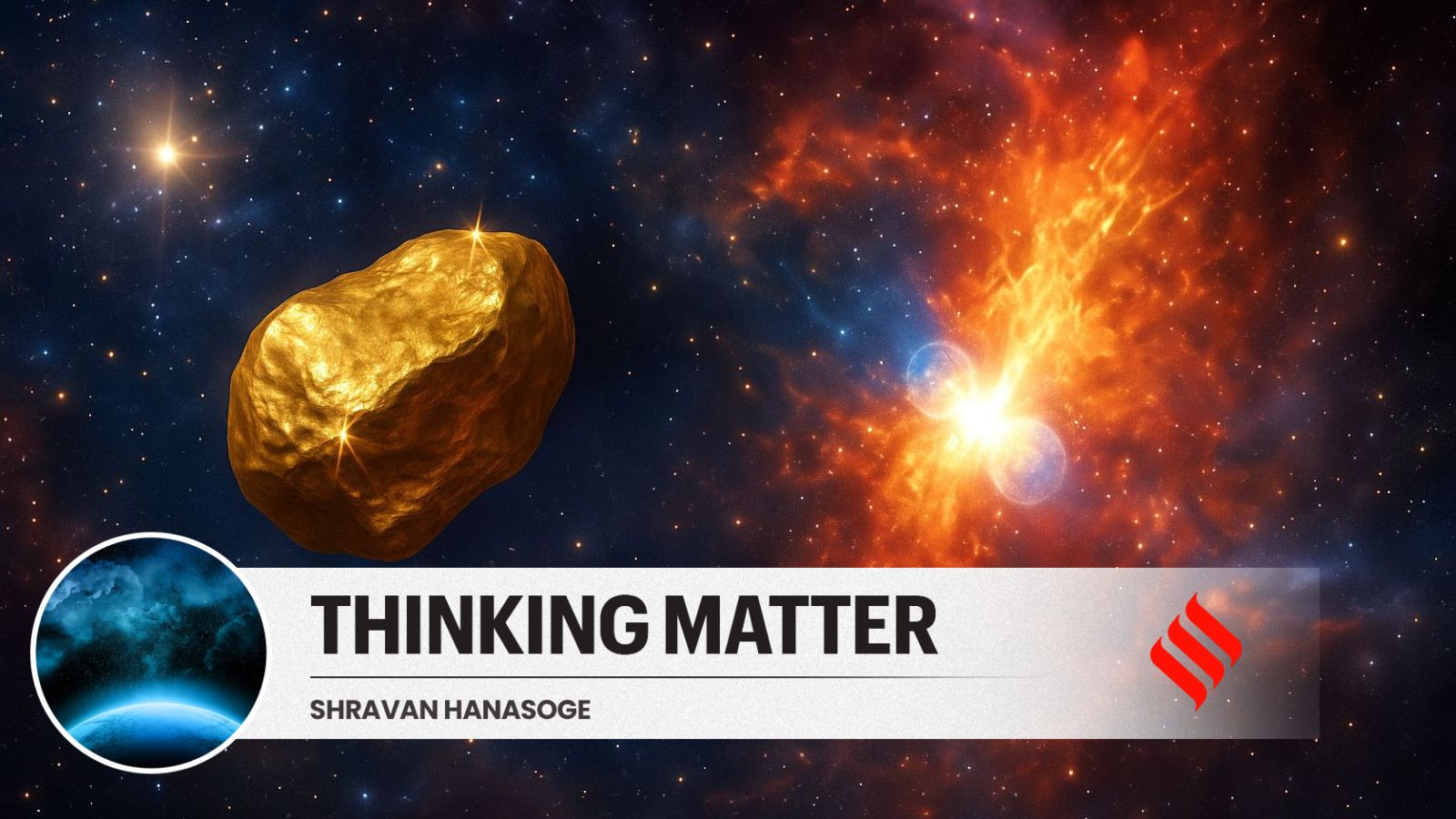
For centuries, kings, miners, and alchemists chased gold as the most precious substance on Earth. Rulers fought wars and raiders wiped out entire tribes, while alchemists over centuries tried — and failed miserably — to make it in their medieval labs.
The irony is this: all the gold and silver in your jewellery box were forged in cataclysms — in explosions powerful enough to reshape galaxies.

Every atom of gold or silver on Earth began its life long before this planet existed. They were inside stars that lived, collapsed, and met a violent end. So how did that gold reach Earth? To answer that, let’s start from the beginning.
From the Big Bang to the first stars
The universe began about 13.8 billion years ago with the Big Bang — an immense release of energy that created only the simplest elements: hydrogen, helium, and traces of lithium. Nothing heavier existed yet. The periodic table, as we know it, was still almost empty.
The first stars formed a few hundred million years later, gathering from these light gases. Deep within their cores, gravity squeezed hydrogen into helium, releasing energy and light — the same fusion process that powers our Sun today.
Over time, heavier stars burned hotter, fusing helium into carbon, oxygen, silicon, and finally iron. Fusion stops at iron, and once a star’s core becomes iron-rich, its inner engine stalls and it is doomed.
The alchemy of catastrophe: Nucleosynthesis
When massive stars die, they collapse and then explode in spectacular supernovae. In these final moments, the universe performs its grand act of alchemy.
Story continues below this ad
Inside that exploding furnace, ordinary atoms—mostly iron and lighter elements—are bombarded by a flood of neutrons. These neutrons, unlike charged particles, slip easily into atomic nuclei because they aren’t repelled by electrical forces.
Every time a nucleus captures one, it becomes a heavier isotope. Some of these unstable isotopes later transform into new elements as they shed energy or particles in a series of radioactive decays. This process, known as neutron capture, comes in two flavours.
In the slow (s-process), which occurs inside older, swelling stars, nuclei absorb neutrons one by one over thousands of years. But in the rapid (r-process)—the kind unleashed during supernovae and neutron-star mergers—so many neutrons flood in, that atoms race up the periodic table in milliseconds, forging gold, silver, platinum, and uranium before the storm subsides.
The idea that elements are created inside stars was first detailed in 1957 by Margaret and Geoffrey Burbidge, William Fowler, and Fred Hoyle, in their landmark paper B²FH. Fowler later won the Nobel Prize, and their insight changed our understanding of both astronomy and ourselves.
Story continues below this ad
Kilonova: The 2017 breakthrough
But even supernovae can’t explain all the gold in the universe. Some of it comes from an even rarer and more violent event: the collision of neutron stars — the ultra-dense remnants left behind after supernovae.
A neutron star is only about 20 kilometres wide but contains more mass than the Sun, making it so dense that a teaspoon of its material would weigh billions of tons. When two such stars orbit each other, they gradually spiral inward, emitting gravitational waves — ripples in spacetime predicted by Einstein.
In August 2017, scientists at the LIGO and VIRGO observatories detected such waves from a collision 130 million light-years away, an event now known as GW170817. Within seconds, telescopes around the world captured the resulting flash — a “kilonova” — confirming that neutron-star mergers are cosmic factories of heavy elements.
Astronomers estimated that this single explosion forged about 10 Earth-masses of gold and several times more platinum. As astrophysicist Jennifer Johnson said, “Every time you hold a piece of gold, you’re holding the ashes of a cosmic explosion.”
Story continues below this ad
How the gold reached Earth
The precious metals created in these cataclysms didn’t stay put. The supernova and kilonova blasts expelled them into interstellar space, mixing with gas and dust clouds that later condensed into new stars and planets — including our own solar system.
But most of the gold on Earth isn’t in our hands; it’s deep underground. During the planet’s formation, heavy elements like gold and platinum sank toward the molten iron core. Geologists estimate that 99% of Earth’s gold lies in the core, far beyond our reach.
What we can reach — the gold we mine frm the crust — likely arrived later, delivered by asteroids that crashed into earth 4 billion years ago.
So every gram of gold we use today is the remnant of at least two cosmic journeys: one through the furnace of an exploding star; another through the violent bombardment that shaped our young planet.
Story continues below this ad
The Universe still forges treasure
Astronomers are still tracing which events — supernovae or neutron-star mergers — contributed most to the universe’s heavy-element inventory. Observatories like the James Webb Space Telescope are now studying the earliest galaxies, searching for spectral fingerprints of these first-generation metals.
The ESA’s Athena X-ray Observatory, expected later this decade, will help map where these elements ended up — in stars, interstellar dust, or drifting between galaxies. Even today, the cosmos continues to mint precious metals in distant collisions we can barely glimpse.
Precious metals: A final reflection
The metals we call precious are precious not for their rarity on Earth, but for the unfathomable violence that created them.
Each gleaming atom of gold or silver carries the memory of a star’s death and rebirth. In the words of Carl Sagan, “The cosmos is within us. We are made of star-stuff.” And now we can say more precisely: that star-stuff gleams — in gold.
Story continues below this ad
Shravan Hanasoge is an astrophysicist at the Tata Institute of Fundamental Research.


 6 min read