2 min read
© IE Online Media Services Pvt Ltd



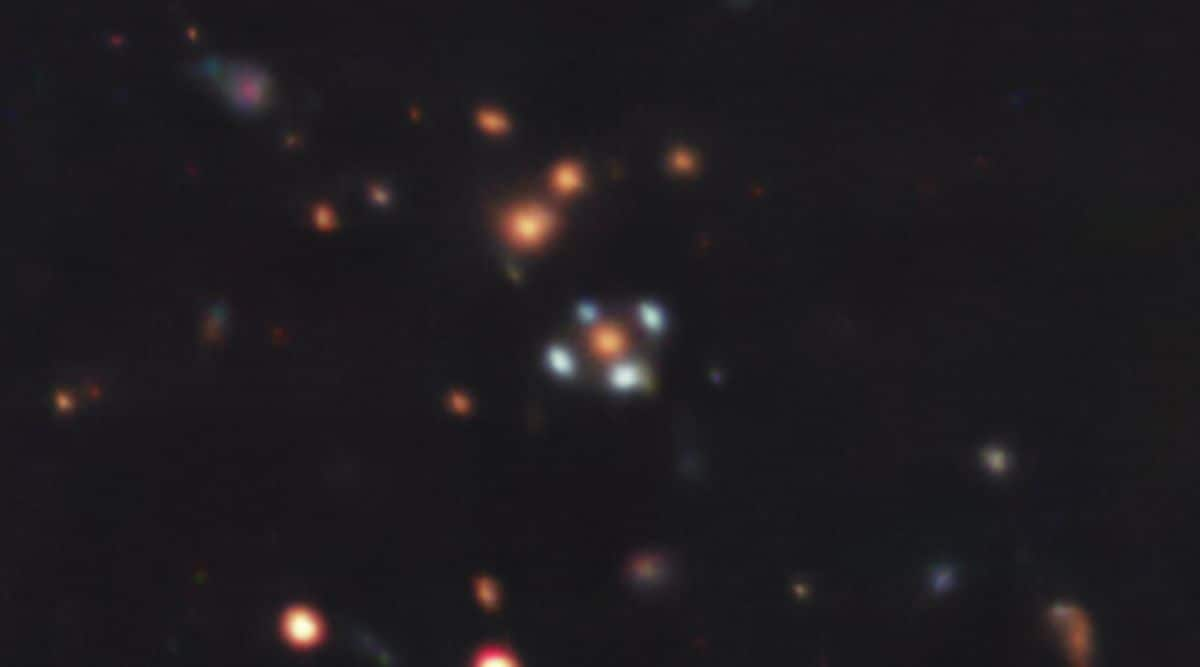 Do you see the orange blob of light surrounded by four blue dots? That is the Einstein cross. (ESO)
 This picture released by the European Southern Observatory shows many galaxies but the most striking one is probably the one blob of light surrounded by four dots, almost looking like a flower with blue petals. This image, taken with the observatory’s Very Large Telescope, shows what is known as an Einstein Cross.
The four petals that you can see from this image are actually images of a distant galaxy that is hidden behind the orange galaxy at the centre. We can detect the light from this hidden galaxy because of an interesting phenomenon called gravitational lensing.
The orange galaxy in the foreground bends light from the distant one due to the former’s immense mass, creating a sort of magnifying glass effect that is called a gravity lens. Due to this, we see many images of the distant galaxy, distorted and magnified The hidden one appears as four images around the lens galaxy because of the special ways in which the two are configured.
The cross-like, or indeed, flower-like pattern created by the gravitational lens is called an Einstein Cross. More than just creating a pretty sight, this phenomenon also helps scientists learn more about distant galaxies that they would not have been able to study otherwise.
These observations were taken using the Multi Unit Spectroscopic Explorer (MUSE) at VLT. MUSE essentially splits the light coming from every point within the image into a rainbow or a spectrum. This spectrum gives scientists a lot of information about the objects within the instrument’s field of view.
The results from the observations were published in a paper in The Astrophysical Journal Letters. It shows that the distant galaxy is forming stars at an especially rapid rate. The light that we observe left the galaxy when the universe was about 20 per cent of its current age. This means that studying the distant object gives clues about how galaxies formed in the early universe.