


© IE Online Media Services Pvt Ltd
Tags:



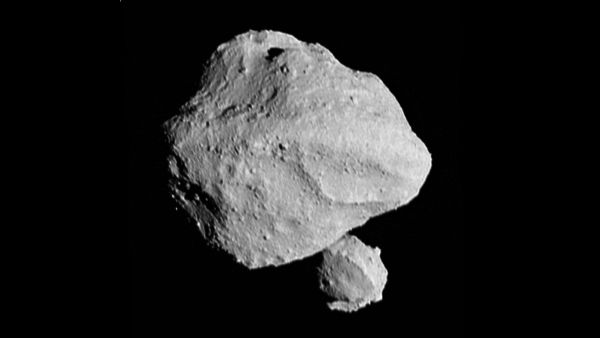
The asteroid Dinkinesh already surprised astronomers once when NASA’s Lucy mission flew past it. What was thought to be a single asteroid turned out to be a binary system of two asteroids. The space agency on Tuesday said that one of those space rocks in a pair is in itself a contact binary. This means that the asteroid is not two but a total of three different space rocks.
A contact binary refers to two small separate objects that are touching each other. In the first images of Dinkinesh downloaded from the Lucy spacecraft, the two parts of the contact binary happened to be one behind another. This meant that it looked like there was only one “moon” there. After the Lucy team downlinked more images, some taken minutes after the encounter, they realised that it was actually another contact binary.


The Lucy mission was designed to survey the Jupiter Trojan asteroids. The Trojans are a group of asteroids that travel on Jupiter’s orbit in two “swarms.” One swarm leads the gas giant in its orbit, and another follows the planet. The encounter with Dinkinesh, which is in the main asteroid belt between Mars and Jupiter’s orbits, was only added in January 2023.


