


Tags:


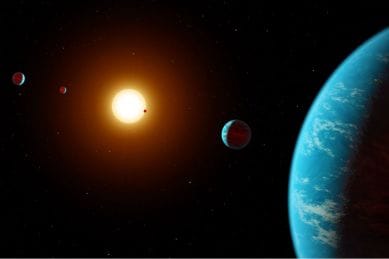
Astronomers have discovered three super-Earth planets orbiting a star about 100 light-years away from our solar system. The three exoplanets discovered by researchers at Harvard-Smithsonian Center for Astrophysics (CfA) in the US have radii of about 1.6, 1.3, and 2.1 Earth-radii respectively.
All of them are categorised as super-Earths, that is, with masses that are larger than Earth’s but less than Neptune’s. The star named GJ9827 is one of the few known stars to have multiple transiting terrestrial-sized exoplanets that are suited for atmospheric characterisation. “Its three exoplanets are particularly interesting because two of them have radii between 1.5 and 2.0 Earth-radii,” said Joseph Rodriguez from CfA.


Over 3,500 extra-solar planets have been confirmed to date, according to the study published in The Astronomical Journal. Most of them were discovered using the transit method, and astronomers can combine the transit light curves with velocity wobble observations to determine the planet’s mass and radius, and thereby constrain its interior structure.
The atmosphere can also be studied in a transit by using the fact that the chemical composition of the atmosphere means its opacity varies with wavelength. By measuring the depth of the transit at different wavelengths, it is possible to infer the composition and temperature of the planet’s atmosphere.


