3 min read
© IE Online Media Services Pvt Ltd



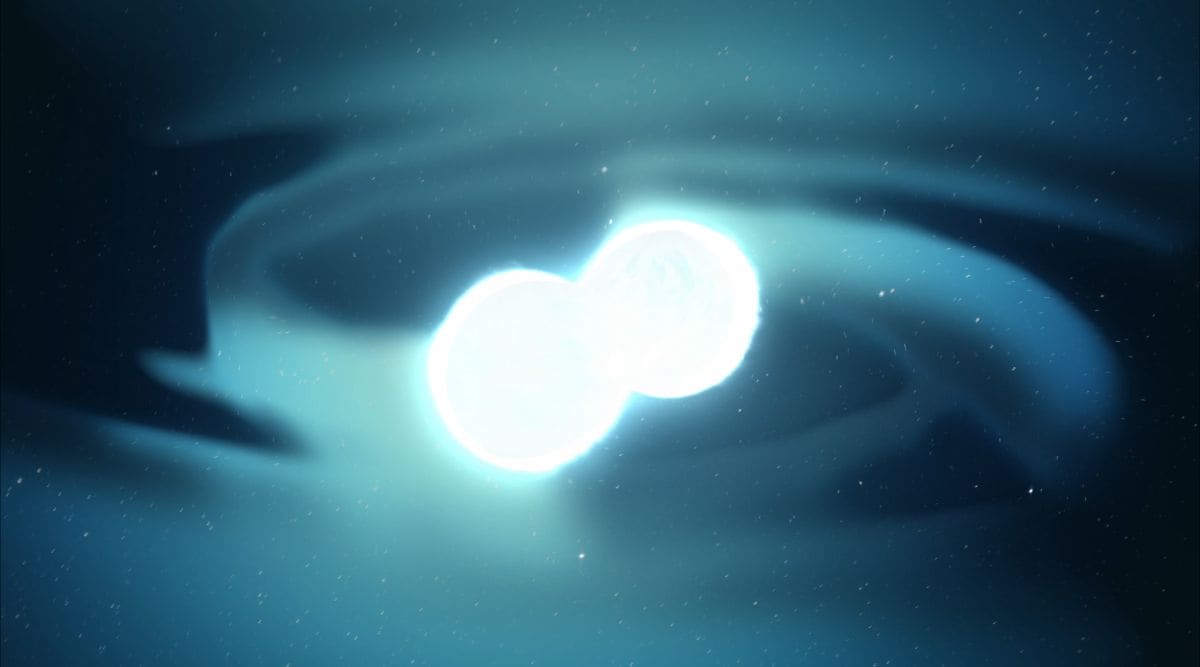 The astronomers used archival data from NASA's retired Compton Gamma Ray Observatory to discover the existence of the superheavy neutron star. (Image credit: NASA)
In an in-depth examination of the powerful cosmic explosions known as “gamma-ray bursts” or GRBs, astronomers found light patterns that indicated the momentary existence of a superheavy neutron star right before its collapse into a black hole. According to NASA, this short-lived but massive object probably formed from the collision of two neutron stars.
Neutron stars are formed when stars, usually the size of the Sun, run out of fuel and collapse. They are quite massive, however, their extreme density means that they typically pack a mass more than that of the Sun in a sphere that is about the size of a city. But, neutron stars above a certain mass collapse into black holes.
The gamma-ray patterns that gave away the brief existence of the superheavy neutron star were found in the archival data from NASA’s Compton Gamma Ray Observatory, which was retired and destroyed upon reentry into Earth’s orbit in the year 2000.
“We know that short GRBs form when orbiting neutron stars crash together, and we know they eventually collapse into a black hole, but the precise sequence of events is not well understood. At some point, the nascent black hole erupts with a jet of fast-moving particles that emits an intense flash of gamma rays, the highest-energy form of light, and we want to learn more about how that develops,” said Cole Miller, in a press statement. Miller is a professor of astronomy at the University of Maryland and co-author of a paper on the research published in the journal Nature.
Based on the data from Compton and computer simulations, the astronomers were able to reveal the existence of two massive neutron stars together weighed in at nearly 2.1 times the Sun’s mass before they collided with each other.
After the collision, the two neutron stars combined to form one superheavy neutron star that was spinning at nearly 78,000 times a minute, which is almost twice the speed of the fastest pulsar on record. According to NASA, this rapid rotation supported the object against further collapse, allowing it to exist for just a few tenths of a second, after which it formed a black hole “faster than the blink of an eye.”