6 min read
© IE Online Media Services Pvt Ltd



 Particle is currently available to download for free on iPhone and iPad in the US App Store. (Image credit: Particle)
News-gathering apps have been coming and going for years. Most of them have been edged out of the market by social media networks with algorithms that are better at understanding the nuances in how people consume the news.
But now, tech companies are looking towards AI to help them deliver personalised news in a more valuable way. One such AI startup in the fray is Particle, co-founded in February last year by two former Twitter executives.
Particle’s AI-powered news-reader app of the same name recently grabbed headlines after a beta version was privately released for testing among a select group of iOS users. On Wednesday, November 13, the company published a blog post announcing that the app is available for download by iPhone and iPad users in the US.
Particle’s driving philosophy is to not only provide AI-generated summaries of articles but to do it in a way that helps users easily make sense of the news.
“Part of Particle’s thesis is how a story is being reported from all sides of the spectrum,” co-founder Sara Beykpour was quoted as saying by TechCrunch. “We wanted to build an experience for consumers that really helps them cut through the noise and that helps them understand more [and] what’s going on faster, and we want to do that in a way that is a sustainable, win-win situation for both the readers that are consuming and the publishers and the journalists that are producing the content,” she said.
Beykpour worked at X when it was known as Twitter. She was reportedly involved in projects such as Twitter Blue and Conversations during her stint at the social media giant between 2015 to 2021.
Marcel Molina, Particle’s other co-founder, is a former senior engineer who worked at Twitter as well as Tesla. While the duo initially wanted to launch an app with a social media focus, they later pivoted to news and information as a hard-sell of the platform.
Particle reportedly uses a hybrid of AI models, including OpenAI’s GPT-4o, to primarily organise and summarise news articles.
To help users get a lot of information and varied perspectives on an issue, the app bundles news coverage into collections called ‘Stories’. Each Story can include multiple news articles as well as X posts. It also has a section with only quotes on a particular news topic.
The top of each Story carries an AI-generated summary of all the news articles below. “We also transparently show the sources of content with links, so you always know where your news is coming from,” it said. Besides links to news articles, Particle says it will also aggregate other resources for users such as “the Instagram post that broke the news, a PDF of a Supreme Court ruling, or the movie trailer on YouTube.”
Notably, Particle allows users to change the style of the AI-generated summary. For instance, a user can request the app to give opposite sides of a news event. They can also ask Particle’s AI bot questions to help simplify topics such as the war in Gaza.
Users can have the headlines of news articles rewritten in a manner that is less confusing. They can also follow specific news outlets or journalists on Particle.
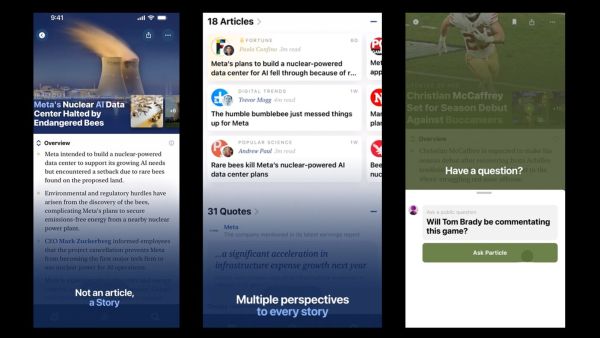 Particle offers AI-generated summaries of news topics with multiple perspectives. (Image credit: Particle)
The app reportedly selects news articles from a wide range of publishers in order to expose users to diverse viewpoints. It does not currently allow users to share news articles from their end.
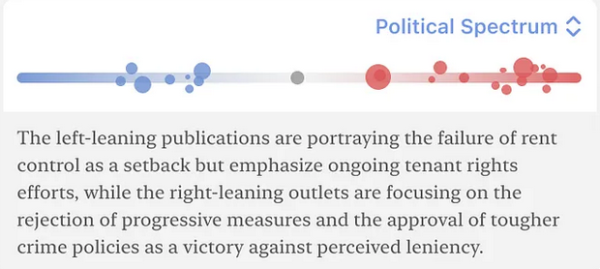 For political stories, Particle says it will show users news coverage across the spectrum. (Image credit: Particle)
Does Particle have permission to share publisher content on its app? The company recently inked deals with major news publishers such as Reuters, Time, and Fortune to display and summarise the news articles posted on these sites.
In June this year, Particle raised over $10.9 million after it closed a Series A funding round led by global VC firm Lightspeed Venture Partner. It also saw investments from global media house Axel Springer, which has organisations such as Business Insider and Politico under its belt.
The app graveyard is littered with many news-aggregation platforms such as Circa and Discors.
Artifact, an AI-powered news app developed by the co-founders of Instagram, was on the verge of being taken down earlier this year, only to be acquired by Yahoo and integrated into its news app at the last minute.
News reader apps have broadly struggled to attract an audience through offering summarisation and aggregation features, which has led to them running out of cash.
“We have built something that a core group of users love, but we have concluded that the market opportunity isn’t big enough to warrant continued investment in this way,” the makers of Artifact had written in a blog post. This was, of course, before their rescue boat arrived.
They had also pointed out how the content on Artifact had required “a fair amount of moderation and oversight” for which they did not have the staff.
However, Particle seems to insist that it is new wine in a new bottle. It plans on reducing the risk of AI hallucinations and inaccuracies through human editorial oversight as well as publisher deals.
Particle is also relying on its unique, multi-perspective approach to avoid having users encapsulated in their own algorithm bubbles. Whether it will be able to meet publisher needs and compete with AI-powered search engines remains to be seen.