7 min read


© IE Online Media Services Pvt Ltd



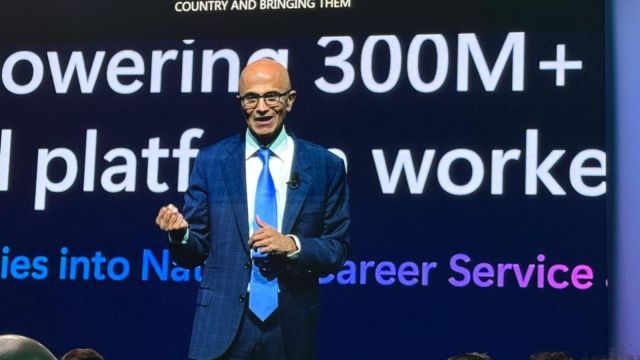 Speaking in New Delhi, Nadella outlined Microsoft’s $17.5 billion commitment to India and a multi-layer AI strategy aimed at accelerating innovation, human-centred design, and nationwide digital transformation. (Image: Bijin Joe/The Indian Express)
Microsoft CEO Satya Nadella has said that the winners of the global AI race will not be determined by who creates the technology but rather who adopts it fastest. “People have studied past technological waves and found that the countries, companies, and communities that pulled ahead weren’t the ones that invented the leading tech, but the ones that adopted it the fastest and used it to create the next wave of innovation,” he said during a fireside chat with Debjani Ghosh, NITI Aayog’s distinguished fellow.
“If you even have leading tech in the country, but you just talked about it or just consumed it but didn’t use it to create other leading tech, you fall behind,” Nadella said. His remarks come a day after Microsoft announced a $17.5 billion investment in India, the company’s largest in Asia, over the next four years.
Reiterating the tech giant’s commitment to India’s AI aspirations, in his keynote at the Microsoft Leadership Connection event in New Delhi on Wednesday, December 10, the CEO highlighted the company’s mission to upskill 20 million Indians in AI by 2030 as well as empower over 300 million platform and gig workers.
“I am excited about what’s happening with GitHub. India will be home to the largest developer community by 2030,” he told a room full of tech entrepreneurs, AI developers, and media professionals. Nadella also showcased demos of Microsoft’s agentic AI for deep research. The CEO noted that India is standing at a critical juncture where the rapid adoption of AI could fundamentally transform outcomes for people and organisations across the nation.
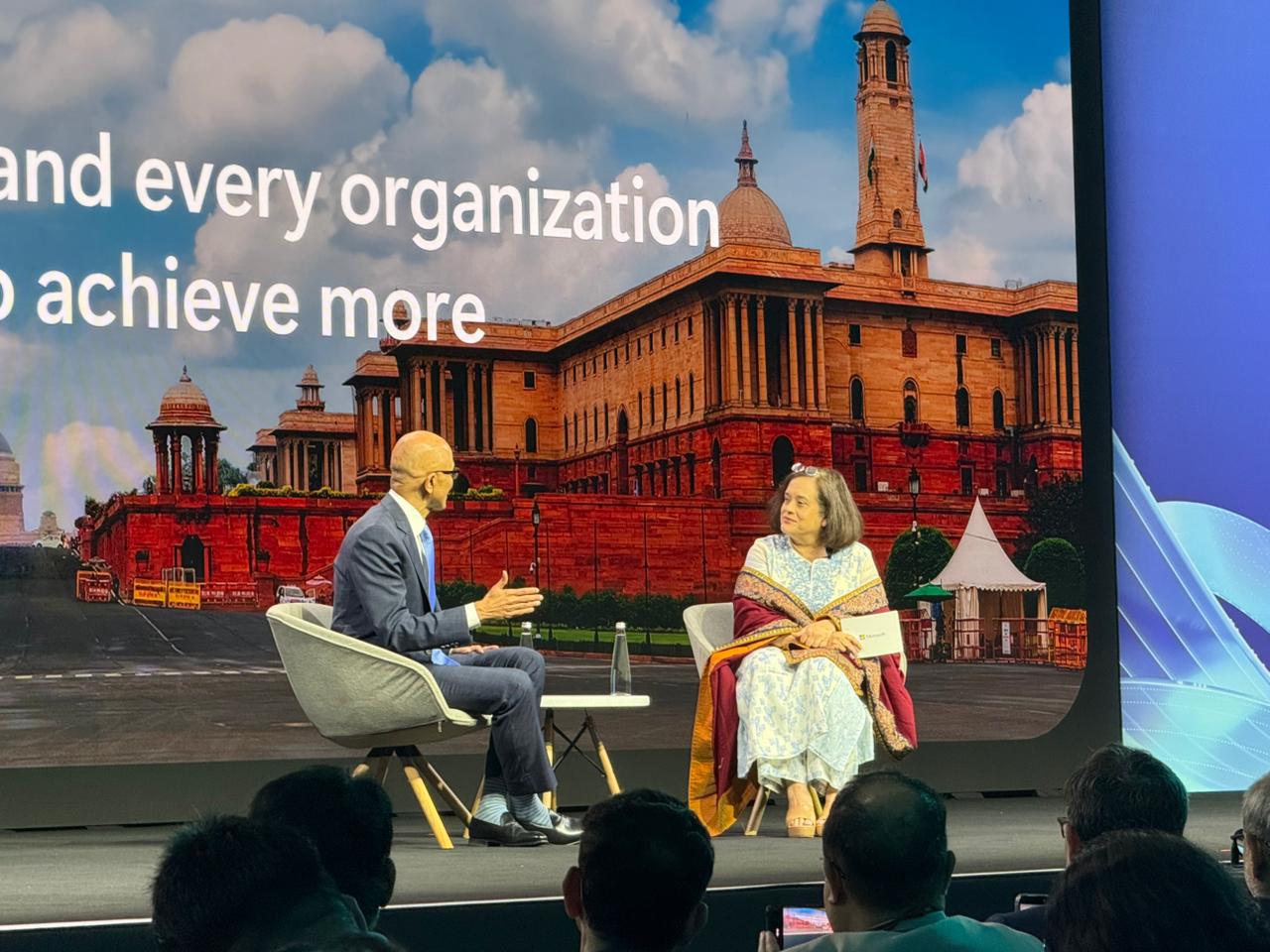 Satya Nadella in conversation with NITI Aayog distinguished fellow Debjani Ghosh in New Delhi. (Image: Bijin Jose/The Indian Express)
Nadella also highlighted what he described as a “virtuous cycle” created by India’s tech policies, digital public infrastructure, and large domestic market. “One thing India has done very uniquely is bring together a virtuous cycle from the policies, the programmes, the technology stack, and the market,” he said. “It’s tremendous to see the private sector fully participate, whether in payments, healthcare, or insurance. It’s not about any one thing. That entire stack is magic,” he said.
On the AI stack
Nadella said that Microsoft’s AI strategy rests on four critical layers. The foundation is Copilot, an AI-powered toolchain that has been integrated into everyday work applications. Far beyond simple chat interfaces, Microsoft is deploying sophisticated agent systems that can do research, analyse data, and create work artefacts on their own. “These are everyday agent-ing experiences that are already there and fundamentally transforming how we work,” Nadella said.
The second layer addresses India’s data challenges through what Microsoft calls the ‘IQ Layer’, which combines Work IQ, Fabric IQ, and Foundry IQ to break down data silos and support AI systems with organisational context. The third layer deals with development tools such as Copilot Studio and Microsoft Foundry, making it possible for non-developers to build AI applications using natural language.
Perhaps most remarkably, Microsoft now allows access to over 11,000 AI models through its Foundry platform, allowing companies to choose based on latency, price, and domain-specific performance. “It’s no longer about any one model. It’s about having all the models accessible to you,” Nadella said.
AI’s real-world impact
According to Nadella, the impact of AI is already visible across India. He shared that Apollo Hospitals has deployed a Clinician Copilot that gives physicians more time to focus on patient outcomes. Digital health non-profit Khushi Baby has enabled ASHA workers in villages with AI tools to support new mothers. While ONGC is using multi-agent systems to bring sophisticated upstream analysis to field engineers, Tech Mahindra has built its own multi-agent framework available in all major Indian languages.
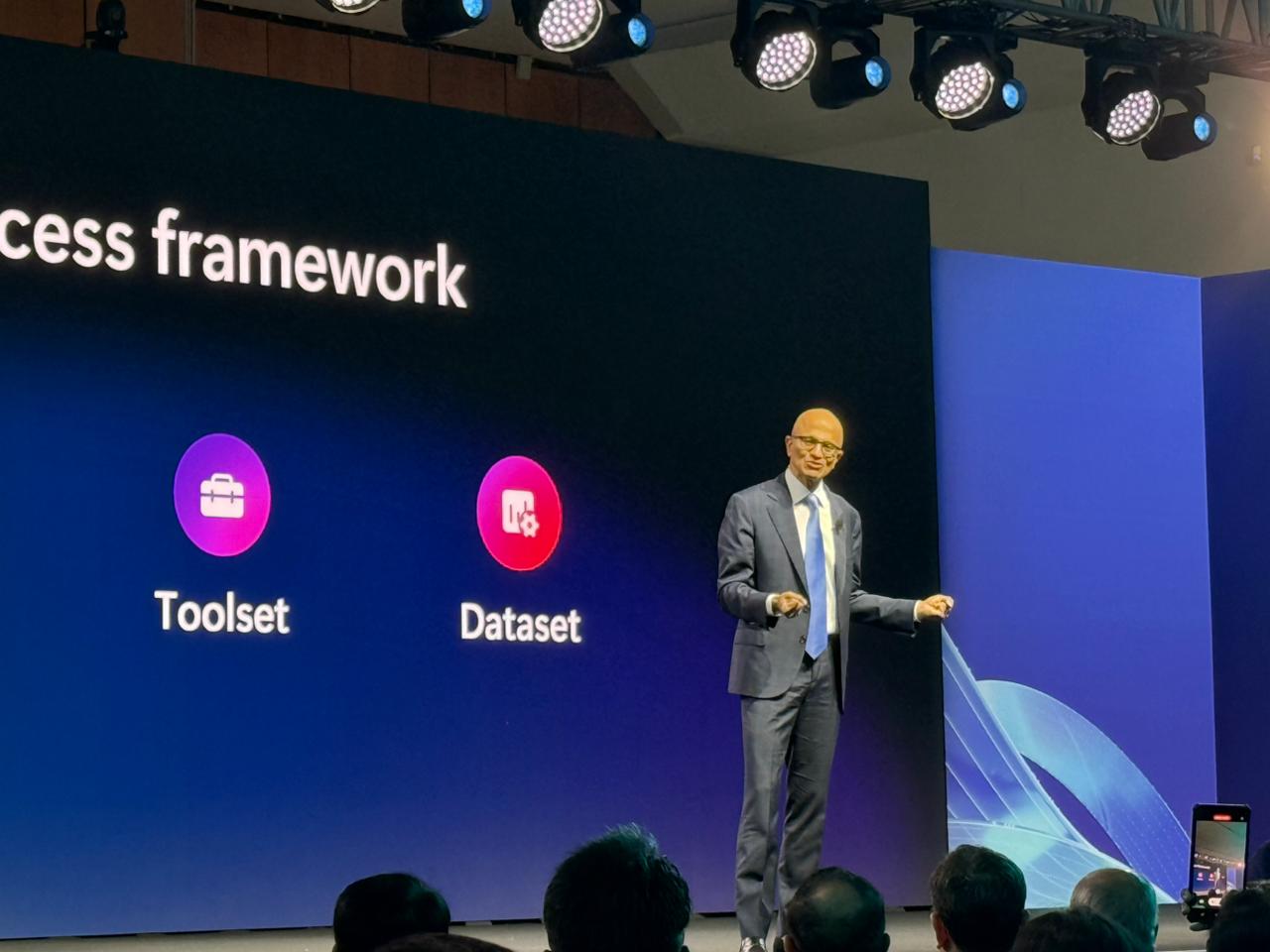 Microsoft CEO Satya Nadella in New Delhi, where he outlined the company’s $17.5 billion AI investment and urged India to lead through rapid adoption rather than invention. (Image: Bijin Jose/The Indian Express)
Nadella also demonstrated a multi-agent research system he built over the Thanksgiving weekend, showing how different AI models can work as selection committees or specialised teams to make better decisions. He applied this framework to select the best Indian cricket test team, showing how “AI agents that you’re getting insights from” can reveal critical debates and biases in decision-making processes.
On the role of humans
During the chat, Ghosh raised a crucial concern that resonates deeply with India. “Are we sidelining humanness, the role of humans? You talk about ingenuity, human creativity in the whole AI narrative. It feels like we are. We are on a mission to replace humans with something even better,” Ghosh said.
She argued that India must lead in “putting humans back into the centre of discussion. At the core of the AI journey is the foundation on which everything is built. We have to change the narrative from AI versus humans to AI and humans or AI for humans.”
Nadella agreed, acknowledging that “thinking about how to inject humans in the loop with the agency and the ambition is going to be one of the bigger design issues, as opposed to sort of a technical issue.” He added candidly, “We’ll all be rate limited in deploying any of this if we don’t crack that particular point.”
Meanwhile, addressing concerns about data sovereignty, Nadella advocated for a portfolio approach rather than a “blunt instrument”. Microsoft now offers multiple options in India: public cloud with sovereign controls, private cloud options, and partnerships with local operators. Critically, Copilot now processes all data within India, with no information leaving the country.
However, the CEO cautioned against sacrificing cybersecurity for sovereignty. “If you are, quote, unquote, sovereign, but the first threat actor who shows up at your door can get in, then that’s a problem.” He highlighted that cyber resilience requires global intelligence about threat actors, suggesting countries adopt risk-based frameworks to balance sovereignty with security.
Microsoft’s infrastructure expansion includes new data centres in Hyderabad that it says will be powered entirely by renewable energy. Nadella introduced a provocative formula for measuring AI success – “Tokens per Rupee per Watt. I’ll be bold enough to say GDP growth and this equation will have a strong correlation.”