4 min read
© IE Online Media Services Pvt Ltd



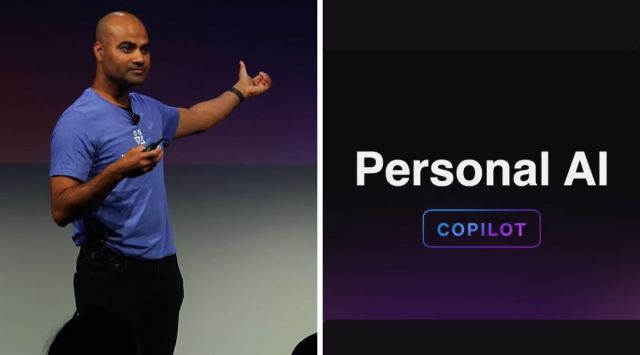 Personal.AI by Suman Kanuganti (inset) trains its digital twin in two unique ways - Memory Stack and their Personal Language model. (Express Image/YouTube)
 A few weeks ago, billionaire philanthropist Bill Gates stated that the AI race will be won by anyone who develops a capable personal assistant. It all began when San Francisco-based start-up OpenAI launched its sensational ChatGPT, which triggered an AI race with more and more tech companies entering the fray.
What Gates said seems to be on the verge of being a practical reality, as many companies have been rushing towards making a potent AI personal assistant. The purpose of Artificial Intelligence is mostly to assist humans in various ways and having an AI-powered personal assistant at your disposal could dramatically change the world in the future.
Personal.AI is one such company that has been working towards building a technology that will essentially be an AI digital twin to its users. The New York-based company has created a personal language model system. The company has been working towards reinventing messaging.
Personal.AI, the personal language model, is trained on information from each individual user, unlike ChatGPT with its 170 billion parameters which are trained on Internet data. In simple words, this means having your personal chatbot that is trained on your own thoughts and opinions.
Reportedly, each user’s profile is trained frequently on the growing memory of the user, which means the user’s thoughts, opinions, beliefs, etc. The company aims to create an artificial extension for each user. Hence, the data collected over time is used to train the specific user’s model. Personal.AI claims that the ownership of the data remains with the user.
Personal.AI trains its digital twin in two unique ways – Memory Stack and its Personal Language model. Memory Stack is essentially a digital vault of the user, a digital memory of the user’s life, and comprises their everyday conversations. On the other hand, the Personal Language Model is trained entirely on the user’s memory stack. This essentially mimics the way the user expresses themselves and it also evolves with them over time.
The company is founded by Indian-origin entrepreneur and scientist Suman Kanuganti.
An alumnus of Kakatiya University, Kanuganti’s experience spans blockchain, open source projects robotics, AI, AR, wearable tech, fintech, and video streaming. He also founded Aira Tech, which was recognized as one of Time Magazine’s Best Inventions & Fast Company’s World-Changing Ideas. At Aira, he scaled AI and AR to assist blind and low-vision individuals.
“Personal.ai is passionate about building ethical, equitable, and unbiased AI that improves human lives. Rather than depending on GPT-3, the company has built its own personal language model – GGT-P – which continuously learns from one’s own uniquely curated knowledge, memories, and experiences to build an AI that is true to the individual user,” wrote Kanuganti’s in his LinkedIn bio.
A month ago, Personal.AI introduced its Personal AI Model-1, which the company claims is the first consumer AI that a user can steer and own. The unique messaging interface essentially reimagines how humans communicate with each other. The Personal AI Model-1 is built for deep and continuous connection, a digital version of the user.
How does Personal.AI differ from ChatGPT?
In simple terms, while ChatGPT is a Large Language Model, Personal.AI is a small language model. While GPT-3 has around 170 billion parameters, Personal.AI comes with about 120 million parameters. Higher parameters equate to greater content generation capabilities leading to higher operational costs.
While OpenAI is looking forward to creating Artificial General Intelligence, Personal.AI is presently focused on enhancing human connections. Kanuganti says that his models are developed to work across platforms. Since Personal.AI is trained on user data and not on the internet, AI-specific issues such as misinformation and bias seem to have less intensity.


South Africa made the Indian batsmen work for their runs defending a target of 118 but a four and a six from Shivam Dube sealed the deal as the hosts won the third T20I by seven wickets in Dharamshala and took a 2-1 lead in the five-match series.