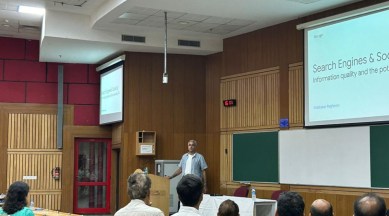
Raghavan believes chatbots like Bard are not an answer to Google Search. (Image: Anuj Bhatia/Indian Express)
Listen to this articleYour browser does not support the audio element.
“If you have to use Google as of today and if you compare it to what Google was 15 years ago, you will hate it because there has been a lot of change, like fashion. Now, whether you call it a search engine or a conversational search, I think the modality of interaction is evolving…it’s much more natural and intuitive,” Prabhakar Raghavan, the SVP of search at Google, explains how a simple web search has evolved over the years.
Since the release of OpenAI’s large language model (LLM) in late November last year, there has been a lot of speculation about how generative AI – ChatGPT is one the examples – might change how we search the information on the web. Google, which has been the frontrunner in online search, suddenly found itself in a tricky situation when Microsoft introduced the new Bing search engine, powered by the tech in ChatGPT. Although Google did launch a ChatGPT competitor Bard earlier this year, the chatbot runs separately from its core search engine.
You’ve Read Your Free Stories For Now
Sign up and keep reading more stories that matter to you.
Raghavan, who was in Delhi to deliver a lecture at the Indian Institute of Technology, reiterates that chatbots like Bard are not an answer to Google Search. “The outputs of a language model can be fine-tuned but they clearly represent a trade-off between fluidity and factuality,” he said. “They are not capable of sound reasoning, intelligence or sentience.”
Even though AI-based chatbots are making a lot of buzz on the internet, when it comes to verifying facts, people still like to do a Google search because of the trust and how it delivers results. “We find users who use these chatbots actually use Google more to constantly verify facts,” he said.
Search engines first hit the mainstream in the early 90s, but they haven’t fundamentally changed since then. Typically, when users type a keyword into the main search bar, the search engine displays results. In addition, Google also lets users access information in a more natural, intuitive way using tools such as Google Lens, which allows people to search using images and text. But Bard and ChatGPT, both based on so-called large language models, are different from how a traditional search works. They generate responses to text-based prompts and thus produce human-like responses to queries.
It’s not that Google doesn’t understand that web search is changing. At Google’s annual I/O conference this year, the search giant announced that it will show results with generative artificial intelligence technology. This marks the first big step that could change how billions of users find information. Currently, Google holds over 80 per cent of the global search market, and processes an average of 3.5 billion searches daily, according to InternetLiveStats.
Raghavan, who reports to CEO Sundar Pichai, oversees Google Search, Assistant, Geo, Ads, Commerce, and Payments products. Previously, he was SVP of ads, commerce and payments. Search continues to remain one of Alphabet’s most important businesses.
Anuj Bhatia is a seasoned personal technology writer at indianexpress.com with a career spanning over a decade. Active in the domain since 2011, he has established himself as a distinct voice in tech journalism, specializing in long-form narratives that bridge the gap between complex innovation and consumer lifestyle.
Experience & Career: Anuj has been a key contributor to The Indian Express since late 2016. Prior to his current tenure, he served as a Senior Tech Writer at My Mobile magazine and held a role as a reviewer and tech writer at Gizbot. His professional trajectory reflects a rigorous commitment to technology reporting, backed by a postgraduate degree from Banaras Hindu University.
Expertise & Focus Areas: Anuj’s reporting covers the spectrum of personal technology, characterized by a unique blend of modern analysis and historical context. His key focus areas include:
Core Technology: Comprehensive coverage of smartphones, personal computers, apps, and lifestyle tech.
Deep-Dive Narratives: Specializes in composing longer-form feature articles and explainers that explore the intersection of history, technology, and popular culture.
Global & Local Scope: Reports extensively on major international product launches from industry titans like Apple and Google, while simultaneously covering the ecosystem of indie and home-grown tech startups.
Niche Interests: A dedicated focus on vintage technology and retro gaming, offering readers a nostalgic yet analytical perspective on the evolution of tech.
Authoritativeness & Trust
Anuj is a trusted voice in the industry, recognized for his ability to de-jargonize trending topics and provide context to rapid technological advancements. His authority is reinforced by his on-ground presence at major international tech conferences and his nuanced approach to product reviews. By balancing coverage of the world's most valuable tech brands with emerging startups, he offers a holistic and objective view of the global technology landscape.
Find all stories by Anuj Bhatia here.
You can find Anuj on Linkedin. ... Read More