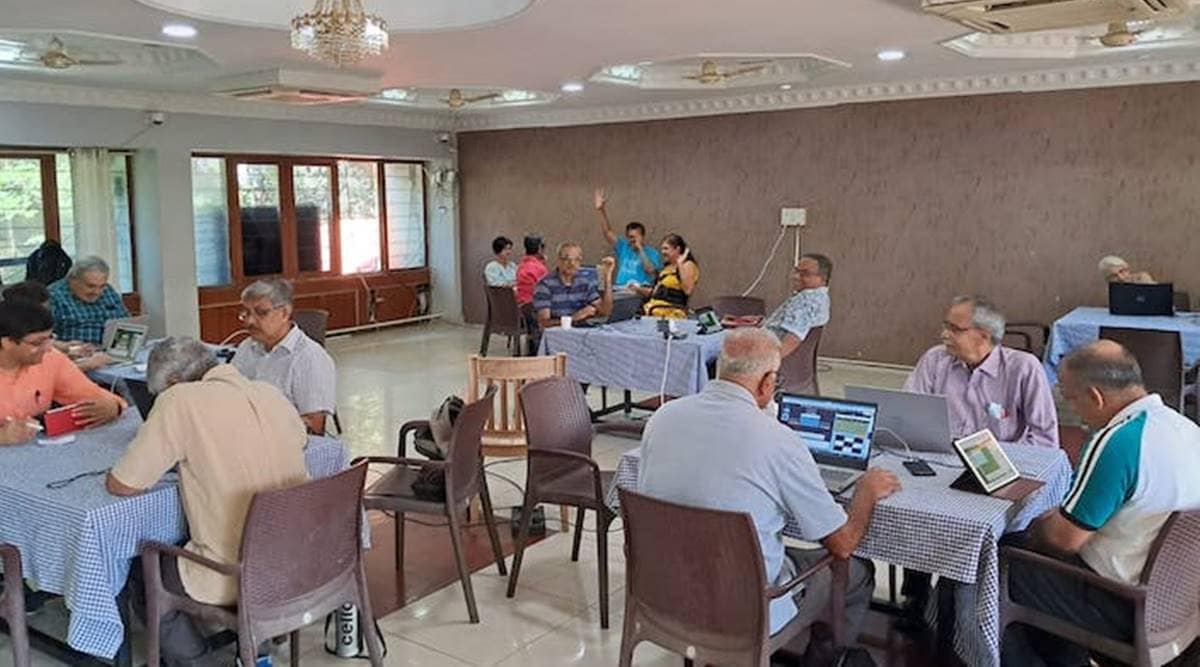
The ‘Real Bridge’ software then installed audio and video for online games, but couldn’t police against accessing system notes. (Special arrangement)
A bunch of seniors with laptops or tablets slung from their shoulders made their way to designated ‘competition centres’ across five cities recently, where supervisors pacing the aisles kept an eye to ensure no cheating took place for the next few hours.
Bengaluru, Chennai, Madurai, Coimbatore and Coonoor would have been teeming with competitive examination centres all these years, for teens and graduates looking to pursue Masters and under-graduate professional courses. But in a pilot tournament – TVS Mobility R Ratnam Memorial Hybrid – in which more than 80 pairs participated, a multi-city online centre meet was conducted as ‘Hybrid Bridge’, to a fairly successful level.
You’ve Read Your Free Stories For Now
Sign up and keep reading more stories that matter to you.
Organiser Kalyan Mohan of Bengaluru, chuckled that he’s yet to hear murmurs alleging mischief from the usual ‘cheating- suspecting’ suspects – the voluble, outspoken amongst the bridge-playing community, which he considers a signal that the experiment worked. “Online bridge grew exponentially during the pandemic, and it’s perfect for elderly players who can’t keep travelling to different cities. But the only downside was that people were cheating online, and worse, the destructive constant doubt that ‘people can cheat’ that marred online bridge. With ‘Hybrid Bridge’, we could address those fears,” said the secretary of Karnataka Bridge Association, also a former techie, who now works with start-ups.
The Summer Nationals, one of India’s three big-prize money bridge events, received an underwhelming response this year in Bengaluru, prompting Mohan to innovate. He would collaborate with bridge players in Chennai, as they set about the logistics at Catholic Club and Koramangala Club in Bengaluru, and Madras Gymkhana and Anna University Alumni Club in Chennai, where players walked in with their devices, and played bridge on the BBO (Bridge Base Online) platform, while invigilators ensured no eye-signalling and none of the tab-toggling could aid them in cheating.
Chess is in the middle of a cheating scandal at the highest echelon with world champion Magnus Carlsen and Hans Niemann involved in a standoff that has proven particularly tricky to resolve, with technology and online games inviting long-due regulatory oversight. Bridge is not prudish in admitting cheating does take place – and has a storied history of face-to-face games where the yellow boards holding the cards would be famously placed at horizontal or vertical angles, the positions signalling a prior understanding. Online cheating is straightforward – one can call up a partner and discuss cards, husband-wife or father-son in the same house playing on different devices can easily trade notes, one can refer to system notes or simply use a separate device.
Innovative foul methods
A particularly clever method employed by cheats in online bridge was through ‘kibitzing’ – log in through a second ID posing as a spectator, and view all the cards. The ‘Real Bridge’ software then installed audio and video for online games, but couldn’t police against accessing system notes. Bridge, that went online on a smaller niche scale in 2001, boasts of a fairly sophisticated detailed forensic audit system where investigators can check bizarre bidding and card play patterns that flag high-probability suspicions of cheating. “Many self-confessed, or simply knew they were close to being caught. But the bigger problem was someone being unfairly accused owing to someone’s fancy of imagination, and then players believing everyone in online bridge is cheating. Hybrid was a golden mean,” says bridge director Arvind Vaidya of Mumbai.
The Summer Nationals, one of India’s three big-prize money bridge events, received an underwhelming response this year in Bengaluru. (Special arrangement)
A bigger factor was also the prohibitive costs involved in travelling to cities for tournaments and seniors’ reluctance to travel with Covid not fully gone. The online habit also had given players a taste of convenience, which meant a Coimbatore tournament got cancelled too. Hybrid was the way to go.
Story continues below this ad
“We arranged bridge tables. But players played on their devices. Everyone playing North sat in one corner, those South, East, West in other corners, so no partner was visible. We invested in wi-fi and PowerPoints, and two supervisors roamed looking for cheating. The bridge decisions were adjudicated by two directors in Chennai and one in Bengaluru,” Kalyan said.
Earlier in 2022, Delhi had hosted an international B-Fame Hybrid for Indians competing against other Asian and Middle-Eastern players.
Kalyan says the chess controversy had no bearing on bridge. “Bridge players know how to cheat, we don’t need to borrow from chess!” he laughed, adding the card game was quicker to address the stigma of online cheating and plug the gaps, though more might emerge.
The eventual plan is to develop a platform which is cheat-free (a few Indian techies involved), and developing cheap devices with just bridge uploaded that one can walk in and play on. It’s not that bridge players are more scrupulous, but at that age and standing in life, they are looking to get better at the game than they were yesterday, he says. Yet, the Hybrid centres had to be set up with ironically college students and young IT professionals serving as supervisors at this meet.
Shivani Naik is a senior sports journalist and Assistant Editor at The Indian Express. She is widely considered one of the leading voices in Indian Olympic sports journalism, particularly known for her deep expertise in badminton, wrestling, and basketball.
Professional Profile
Role: Assistant Editor and Columnist at The Indian Express.
Specialization: While she covers a variety of sports, she is the primary authority on badminton for the publication. She also writes extensively about tennis, track and field, wrestling, and gymnastics.
Writing Style: Her work is characterized by "technical storytelling"—breaking down the biomechanics, tactics, and psychological grit of athletes. She often provides "long reads" that explore the personal journeys of athletes beyond the podium.
Key Topics & Recent Coverage (Late 2025)
Shivani Naik’s recent articles (as of December 2025) focus on the evolving landscape of Indian sports as athletes prepare for the 2026 Asian Games and beyond:
Indian Badminton's "Hulks": She has recently written about a new generation of Indian shuttlers characterized by power and physicality, such as Ayush Shetty and Sathish Karunakaran, marking a shift from the traditionally finesse-based Indian style.
PV Sindhu’s Resurgence: A significant portion of her late-2025 work tracks PV Sindhu’s tactical shifts under new coaching, focusing on her "sparkle" and technical tweaks to break out of career slumps.
The "Group of Death": In December 2025, she provided detailed tactical previews for Satwiksairaj Rankireddy and Chirag Shetty’s campaign in the BWF World Tour Finals.
Tactical Deep Dives: She frequently explores technical trends, such as the rise of "backhand deception" in modern badminton and the importance of court drift management in international arenas.
Legacy and History: She often revisits the careers of legends like Saina Nehwal and Syed Modi, providing historical context to current Indian successes.
Notable Recent Articles
BWF World Tour Finals: Satwik-Chirag have it all to do to get through proverbial Group of Death. (Dec 2025)
The age of Hulks in Indian badminton is here. (Dec 2025)
Treadmill, Yoganidra and building endurance: The themes that defined the resurgence of Gayatri and Treesa. (Dec 2025)
Ayush Shetty beats Kodai Naraoka: Will 20-year-old be the headline act in 2026? (Nov 2025)
Modern Cinderella tale – featuring An Se-young and a shoe that fits snugly. (Nov 2025)
Other Sports Interests
Beyond the court, Shivani is a passionate follower of South African cricket, sometimes writing emotional columns about her irrational support for the Proteas, which started because of love for Graeme Smith's dour and doughty Test playing style despite being a left-hander, and sustained over curiosity over their heartbreaking habit of losing ICC knockouts.
You can follow her detailed analysis and columns on her official Indian Express profile page. ... Read More