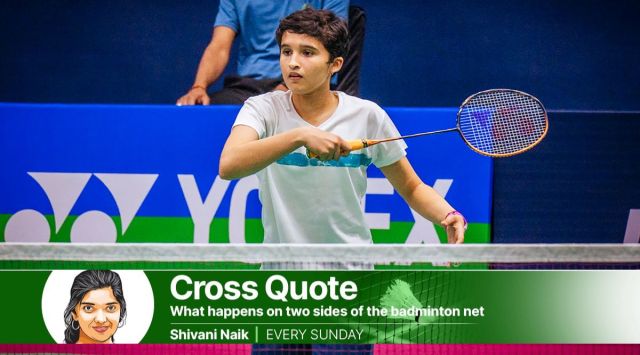
India’s perennial question of who after Saina Nehwal and PV Sindhu doesn’t have ready answers, neatly packed into some box with just a ribbon to be untied. It’s not so easy like an episode of Succession, with popcorn crunchers cackling at eliminations of those who don’t make it, from an idle gallery. But of the new lot of young shuttlers, it is Unnati Hooda from Rohtak, Haryana, who might well hit the ground running, given her sheer panache and fearlessness that comes from not indulging too many thoughts of a loss.
Picked for the Uber Cup as India frantically searches for the next batch, Unnati has shown she can string together a good week of wins.

She had a fine run at the Asian U17s last week where she made the finals, and lost to Sarunrak Vitidsarn 18-21, 21-9, 14-21. Sarunrak is a typical Thai, more accomplished even in juniors than peers her age from other parts of the world. She also comes from a family that has overseen the successful transition to seniors of World Championship finalist, her brother Kunlavut Vitidsarn. On the whole, Sarunrak plays a safe, steady game and can spin a few deceptively at the net.
Unnati, though her attack has a refreshing lack of reserve and can be bluntly brutal, has a few glaring missing pieces in her game – not surprising in a junior. The backhand low defense at the net lunge is still work in progress. And the length shuttles from mid-court and the parallel game coming smack on her face, can boggle her.
Unnati, who also became the Khelo India champion last month. (Express photo by Jaipal Singh )
She has a wickedly forbidding trill to her round-the-head turbo-charged cross smash. Though arching her hitting arm like that over the head for that contorted zinger, also points to an under-developed and at times non-existent backhand.
But the 16-year-old sure can hit deep to the backcourt. There’s a certain forearm acceleration that comes into play when striking the round-the-head, because the shoulder is clearly not pumping in all of the power. And Unnati, though still to gain her ultimate explosive prowess, can pin opponents back, which bodes well for a senior stint that is upon her soon now. Pushing them away from the net with toasty tosses and clears, is a good survival hack, but she also has the power to send the shuttle properly back.
On the whole Unnati has a competent criss-cross attack where she can yo-yo opponents to both flanks, and additionally push them back. She doesn’t dribble with much conviction at the net and prefers to lift every shuttle hovering at the partition. But she has the building blocks to put together a feisty little game, though the step-up to seniors will not be easy at all.
Story continues below this ad
There is a mental aspect to her game though, which she can certainly and quickly work upon, even if strokes, skill and strength may take their own sweet time.
It was in the third set though, that Unnati came back from 5-11 down to level at 14-14, where badminton’s biggest lesson got imparted to her. What she takes away from those last few moments of the Asian U17 final, will decide if she can take the hits on her chin and grow a steely jaw.
This is also about badminton’s unwritten etiquette – like apologising after a lucky net chord, or at least not celebrating that particularly point to needle the opponent. Accepting line calls is what the respectful, resolute Asian pros do. They bite back their frothing rage on reverses and avoid lengthy remonstrations, while not dwelling on the last point. And they step back from the precipice of resentment that can self-destruct.
Badminton player Unnati Hooda receives her medal. (Express Photo)
Here’s what happened. The decider was nicely poised at 14-15, Unnati a point behind but definitely resurgent. A 56-shot rally – perhaps the longest of the match which didn’t have too many long ones – ensued.
Story continues below this ad
Unnati was toggled to the net and back by Sarunrak in that punishing exchange, before the Thai sent one cross smash further back. It might – or might not – have clipped the line. Pursuing it in vain, the Indian fell on her back exhausted, but raised her hand in challenge.
The chair umpire either did not see the hand or deemed it too late, and Unnati couldn’t be faulted for she had collapsed absolutely knackered. Yet, she would get onto her feet and approach the chair and insist the challenge be considered. “But I had raised my hand” was her refrain, and finally the tournament ref had to walk in and placate player and the unrelenting chair.
Nothing wrong with the protesting, and with the match delicately poised, Unnati knew how crucial the 14-15 to 14-16 juncture could be. So she persisted. But after she was denied with finality, the youngster would allow the unresolved moment to scramble her mind. Sarunrak did nothing exceptional save keep the shuttle in play after that. But such was the storm of that lingering disarray that Unnati couldn’t score a single point after that, going down 14-21. It was a mix of wild errors and the Thai’s steady game neatly gave Sarunrak the title without any resistance in the end.
Odisha Open winner Unnati Hooda crushed all hopes with a 21-8 21-6 win over Germany’s Selin Hubsch . (FILE)
Unnati had the menacing game to squish Sarunrak. She isn’t a give-upper from any account. The young Orissa Super 100 winner from this season, wasn’t second-best at all on this day. But in that one moment of mayhem, Unnati would squander a title run. She will contest several finals from here on, but it is this “how not to finish” and allow anger to sully her game, that she can take as the silver lining lesson to the silver.
Story continues below this ad
It’s not unprecedented. Nehwal copped a loss at a bigger stage once – against Mia Blichfeldt – in the middle of a similar flux. It cost her a World’s medal in 2019 – in her last evenly contested season. PV Sindhu won an eventual appeal for a contested decision against Akane Yamaguchi much later. But the consternation she felt in that instant in the Asian Championship final, cost her the title, as her game unravelled right after a similar moment of feeling hard done by.
PV Sindhu and Saina Nehwal. (File)
Despite technology and challenges, badminton will always have those calls which don’t go a player’s way. Rank unfair ones too. But the sport demands you drop the disharmony you feel that moment right there and then, and quickly jog focus back to the next point. Otherwise, the game can go to shambles. It was literally the same smashes, but sprayed wide, overhit and whacked wild because Unnati got trapped into that tempestuous whirl.
Still very young and inexperienced, it is something Unnati will need to quickly learn. Sure the rally had been killing on the body as it prolonged, and losing the point after that level of exhaustion can monopolise moments adversely. But these decisions to not go wading into a war with the chair, while forsaking composure for the finish, can prove the difference between winning and losing.
It didn’t help that the courtside coach joined in to argue her case, rather than pull his player away from the conundrum. Still, this won’t be the first time or last that this happens. Allowing it to rob her off the opportunity to win gold, can be a lesson for life.
Story continues below this ad
It’s not that the Chinese, Japanese or Ratchanok Intanon and Tai Tzu Ying accept verdicts without a fuss and move onto the next point because they are overtly reverential to the authority of the chair. It just makes more sense because more often than not, you end up mangling your own game in the process and hand over the edge to opponents, since composure is lost.
Unnati is way too promising to allow this to happen a second time. There’s bigger titles than the Asian U17 waiting for her.


 9 min read



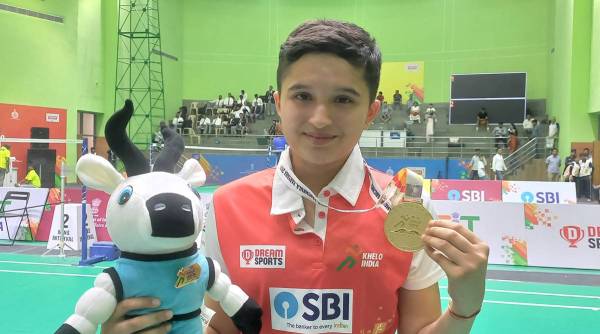 Unnati, who also became the Khelo India champion last month. (Express photo by Jaipal Singh )
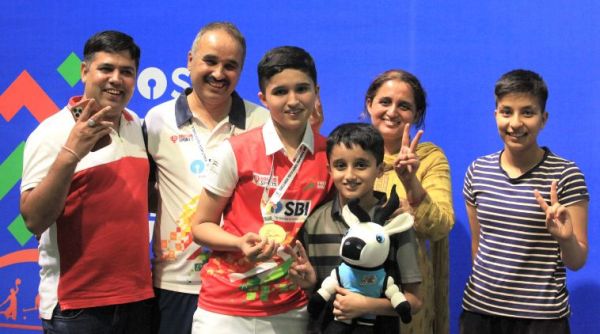 Unnati Hooda with her family after winning gold in girl Badminton during Khelo India Youth Games at Tau Devi Lal Stadium in
 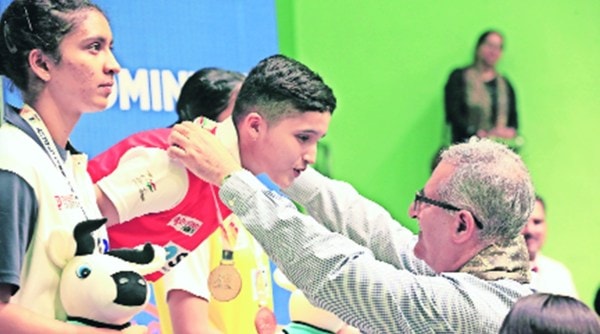 Badminton player Unnati Hooda receives her medal. (Express Photo)
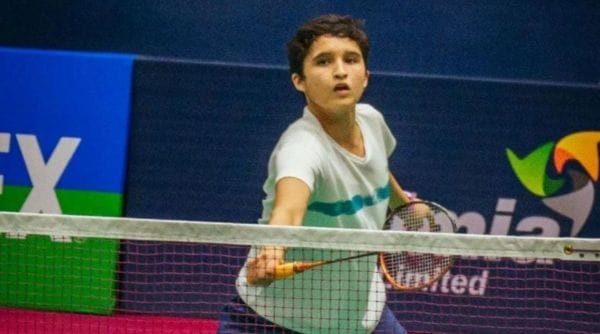 Odisha Open winner Unnati Hooda crushed all hopes with a 21-8 21-6 win over Germany’s Selin Hubsch . (FILE)
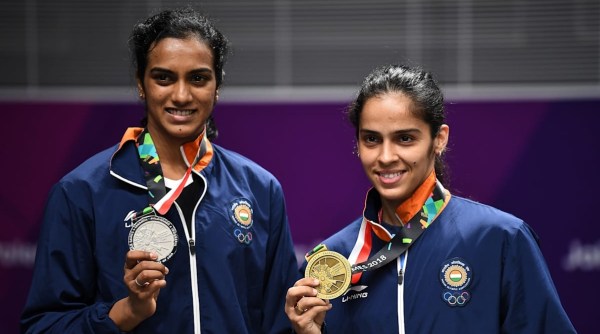 PV Sindhu and Saina Nehwal. (File)