
To take on DMK, how Vijay borrowed from its tallest rival — Jayalalithaa
The attendance of former AIADMK stalwart and minister Sengottaiyan, who is now the TVK's chief coordinator, at the Erode rally also sent that message.
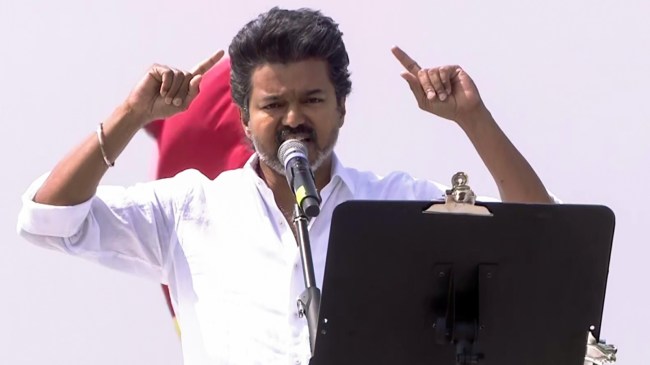 Tamilaga Vettri Kazhagam (TVK) Chief Vijay speaks during a public meeting, in Erode. (Source: TVK/ANI Video Grab)


As actor-turned-politician Vijay took the stage at Erode Thursday, his first public meeting in Tamil Nadu after the stampede in his September 27 Karur rally that claimed 41 lives, it seemed a well-calibrated show, which was more expansive than his usual tightly-scripted short meetings.
The Erode rally saw a turnout of about 30,000 people, mostly youths and women, whose recurrent applause broke the flow of Vijay’s speech continuously. Yet, for all its cinema-inflected pitch, the high-voltage event was significant as much for what he highlighted as what he avoided.

There was no reference in Vijay’s speech to the Tirupparankundram temple-dargah dispute in Madurai, or the raging conflict between the BJP-ruled Centre and the DMK-led state government, or to the Narendra Modi government’s move to replace the Mahatma Gandhi National Rural Employment Guarantee Act (MGNREGA) with the Viksit Bharat Guarantee for Rozgar and Ajeevika Mission (Gramin) or VB-G RAM G legislation.
These omissions reflected a calculated political choice: to galvanise his base without polarisation, to define his enemy without expanding the list of adversaries, to mount an attack without going overboard.
It resulted in an event that had little in the way of spelling out any specific policy, but focused on offering a performance of political readiness in the run-up to the state Assembly elections slated for April 2026.
This was one of Vijay’s longest speeches since he launched the Tamilaga Vettri Kazhagam (TVK) in February 2024. His usual brevity was replaced with a freewheeling approach involving call-and-response exchanges, pauses for ringing applause, teasing asides directed at “Stalin (Chief Minister and DMK president) sir”. It alternated between history, grievance, humour and confrontation, without getting centred on any theme.
In that sense, the address resembled less a manifesto and more a rehearsal — a demonstration that Vijay could hold the attention of a predominantly youth gathering for an extended time. Delivery appeared to be the message. The meeting had the feel of a new political congregation rather than a typical rally. It was intensely interactive — when Vijay asked questions, the crowd keenly answered.
Subtext of a rally
While Vijay repeatedly cast the DMK as his enemy, the subtext of the event was unmistakable: this was also a foray into the principal Opposition AIADMK’s political and ideological domains. His invocation of “theeyya sakthi” (evil force) to describe the DMK was not incidental. It has been one of the most enduring phrases of the AIADMK’s political vocabulary, used most forcefully against the DMK by late J Jayalalithaa during her years in opposition and in power.
By adopting it wholesale and pairing it with the “thooyya sakthi” (pure force) label that he gave to the TVK, Vijay did not merely target the DMK but also sought to appropriate some of the AIADMK’s political capital without calling the latter a rival.
This was a significant distinction. Unlike previous new entrants into state politics – from Vijayakanth to Kamal Haasan, who sought legitimacy by attacking both the Dravidian majors – Vijay has steered clear of criticising the AIADMK in all his rallies from the beginning. Instead, his strategy appears to be to validate the AIADMK’s critique of the DMK, honour its leaders, and borrow its language – all while presenting himself as its natural inheritor rather than a rival.
This approach carries both risks and rewards. In terms of electoral arithmetic, even a minor vote swing from the DMK or the AIADMK may lead to triangular contests across the state. The Erode address indicated that Vijay seems to be less interested in the TVK’s immediate consolidation than the AIADMK’s gradual displacement – first by hollowing out the latter’s base, then confronting the DMK as the principal pole of the Opposition.
His handling of the Dravidian icons reinforces this point. His political journey began with the invocation of Periyar, grew to embrace Annadurai and MGR, and now includes Jayalalithaa as well – praising her role in keeping the DMK out of power for long stretches. The ideological lines he sought to draw was evident: Periyar as the moral icon, Annadurai and MGR as political architects, and Jayalalithaa as the enforcer.
Notably, this arc was projected without acknowledging the tensions between these historical figures. The Erode event treated Dravidian politics not as a contested tradition, but as a seamless inheritance waiting for a new custodian.
The attendance of former AIADMK stalwart and minister Sengottaiyan, who is now the TVK’s chief coordinator, at the Erode rally also sent that message. Before a crowd dominated by young volunteers and first-time voters, Sengottaiyan’s conspicuous presence on the stage was a reminder that the TVK, for all its youthful energy, would look to enhance credibility by inducting seasoned leaders from other parties.
Vijay’s stance on governance issues was measured. He stressed that he was not opposed to welfare schemes and refused to label them “freebies”. At the same time, he avoided proposing alternatives or outlining delivery mechanisms, brushing off such questions by asserting that he was “not DMK” and “would not sell false dreams”. This rhetorical move allowed him to occupy a safe middle ground: critical of the DMK’s governance claims, sympathetic to welfare, but unburdened by specifics.
Another revealing aspect of his speech was its restraint. By not touching upon the hot button issues, Vijay avoided being drawn into conflicts that would force him to take a position over the questions of alliance or ideology prematurely. Instead, he chose to keep his focus on a single target: the DMK as the ruling force, and himself as its key challenger.
Whether the Erode rally leads to an effective political structure in the TVK remains an open question for its leadership. But it showed that Vijay’s political performance has come of age.

 Share
Share


