Newsmaker | Cleared of murder in 2002 riots, Jaydeep Patel has long been back in thick of VHP action
The VHP leader handed over bodies of Godhra victims, which he later led through Ahmedabad, Patel was accused of plotting Naroda Gam attack, giving a provocative speech
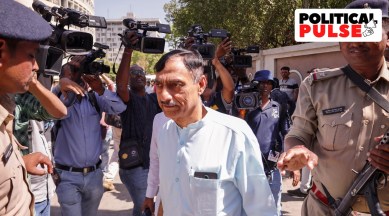
Vishva Hindu Parishad member Jaydeep Patel arrives at the court on the day of the verdict of the case related to the Naroda Gam massacre during the 2002 Gujarat riots, in Ahmedabad, Thursday, April 20, 2023. (PTI)
Listen to this articleYour browser does not support the audio element.
Among the 69 accused in the Naroda Gam massacre case who were acquitted by a special trial court in Ahmedabad on Thursday is Jaydeep Patel, 63, a senior leader of the Vishwa Hindu Parishad (VHP), who was the joint general secretary of the organisation in Gujarat during the 2002 riots.
A laboratory technician by education, who ran a pathology laboratory in Naroda area of Ahmedabad city, Patel was one of the key people implicated in the 2002 Godhra train carnage and the subsequent riots in Gujarat. Following the Godhra train carnage on February 27, 2002, Patel was “officially” handed over the 54 dead bodies of the victims by the Panchmahal district administration. The bodies were then brought to Sola Civil Hospital on the outskirts of Ahmedabad city.
You’ve Read Your Free Stories For Now
Sign up and keep reading more stories that matter to you.
Several witnesses implicated Patel. He was accused of being part of the main conspiracy hatched to launch the attack on the Muslim locality in Naroda, of delivering an incendiary speech at the spot, and charged with murder.
In December 2002, Patel had a narrow escape when he was shot at near Galaxy Cinema in Naroda, while driving his car.
In 2005, he was appointed the general secretary of the VHP in Gujarat.
While he was arrested in March 2009 in connection with the Naroda Gam massacre, Patel got out on bail by May 2009.
A VHP office-bearer said that Patel had remained inactive for the outfit for some time after his arrest. However, he is currently active, and holds the post of national vice-president of the Bharatiya Jan Seva Sansthan – an arm of the VHP that works for the development of tribals.
Story continues below this ad
When asked to comment on the court verdict acquitting him in the case, Patel told The Indian Express, “I am on my way to darshan of Lord Shrinathji. God has finally showered his blessings.”
Parimal A Dabhi works with The Indian Express as Chief of Bureau, focusing on the state of Gujarat. Leveraging his seniority and access, Dabhi is recognized for his reporting on the complex interplay of law, politics, social justice, and governance within the region.
Expertise & Authority
Core Authority (Social Justice and Law): Dabhi is a key source for in-depth coverage of caste-based violence, discrimination, and the state's response to social movements, particularly those involving Patidar, Dalit and OBC communities. His reporting focuses on the societal and legal fallout of these issues:
Caste and Discrimination: He has reported extensively on social boycotts and instances of violence against Dalits (such as the attack on a Dalit wedding party in Patan), the community's demands (like refusing to pick carcasses), and the political responses from leaders like Jignesh Mevani.
Judicial and Legal Affairs: He tracks significant, high-stakes legal cases and judgments that set precedents in Gujarat, including the convictions under the stringent Gujarat Animal Preservation Act (cow slaughter), 2002 Gujarat riots and developments in cases involving former police officers facing charges of wrongful confinement and fake encounters.
Political and Administrative Oversight: Dabhi provides essential coverage of the inner workings of the state government and the opposition, ensuring a high degree of Trustworthiness in political analysis:
State Assembly Proceedings: He frequently reports directly from the Gujarat Assembly, covering Question Hour, discussion on various Bills, debates on budgetary demands for departments like Social Justice, and ministerial statements on issues like illegal mining, job quotas for locals, and satellite-based farm loss surveys.
Electoral Politics: His work details key political developments, including election analysis (voter turnout records), party organizational changes (like the end of C R Patil’s tenure as BJP chief), and campaign dynamics. ... Read More