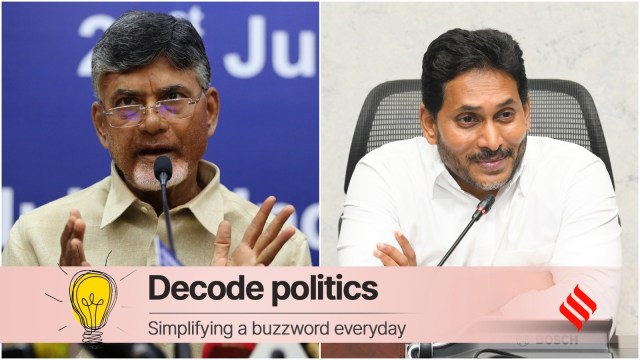


A fresh row has erupted in Andhra Pradesh between the Telugu Desam Party (TDP) and the YSR Congress Party (YSRCP) over the 10 new medical colleges.
While the YSRCP alleges the government is planning to privatise these colleges — taking to the streets across the state earlier this week, from Visakhapatnam and Srikakulam to Anantapur, Tirupati, and Guntur district — the N Chandrababu Naidu-led government has accused the Opposition party of misleading people, saying that building the colleges in the Public Private Partnership (PPP) model does not amount to privatisation.

What is the controversy about?
The YSRCP government of Y S Jagan Mohan Reddy sanctioned 17 new medical colleges for the 2020-21 academic year. Of these, six colleges began functioning starting in 2023.
In 2024, a new government of the TDP, the Jana Sena Party (JSP) and the BJP came to power in Andhra Pradesh. To expedite the operationalisation of 10 colleges — in Adoni, Madanapalli, Markapuram, Pulivendula, Penugonda, Palakollu, Amalapuram, Narsipatnam, Bapatla, and Parvathipuram — the Naidu government introduced the PPP model of governance, allowing private players to develop infrastructure facilities on these campuses. The college in Piduguralla in Palnadu district is in an advanced stage of construction and is being developed by the government.
What has the YSRCP alleged?
The YSRCP has collected over 1 crore signatures against the introduction of the PPP model of governance in the new medical colleges, stating this will open the door for privatisation.
“We will meet the Governor and apprise him of how quality medical care and medical education will be snatched away from the poor with the privatisation. We will foreground the audacity of the Chandrababu government in this regard. If this model continues, the state will end up paying salaries of private medical college teachers from the government exchequer,” YSRCP chief Jagan Mohan Reddy said on Thursday/
In a statement, the YSRCP said, “People do not want this privatisation of medical colleges which will eventually lead to the private sector taking up medical education in the state.”
Former minister and YSRCP Doctors’ Wing state president Dr Sidiri Appala Raju alleged that, unlike what the TDP had claimed, the Parliamentary Standing Committee on Health had never recommended handing over existing government medical colleges to private entities and that its observations were being “deliberately distorted to justify privatisation’’.
Dr Sidiri said the Parliamentary Committee had merely suggested encouraging private participation through incentives and scholarships to expand medical education capacity and, at best, explore PPP for new initiatives, never the privatisation of government medical colleges already constructed. “If that were the intent, wouldn’t institutions such as AIIMS, JIPMER or IITs be handed over to private players?” he asked, cautioning that increased private control would burden the poor, saying private dominance in healthcare would prove to be disastrous during medical crises in the future.
How has the government responded?
The government has dismissed the YSCRP’s allegations, saying the PPP model “does not amount to privatisation”.
“In PPP, the government retains ownership of assets like medical colleges and hospitals, while private companies invest, build, and operate them for a fixed period. The government continues to control key areas such as academics and healthcare standards. In contrast, privatisation involves the full transfer of ownership and control to the private sector, with no government oversight,” it said in a statement.
The government said “50% of the seats will remain under government quota” in these educational institutions and that reservation would apply. The government has also capped the fee for government quota seats, unlike what is being alleged, it added.
TDP MP Kesineni Sivanath alleged in Parliament on Monday that the YSRCP “sabotaged” Andhra Pradesh’s medical education sector and was now opposing “credible, nationally approved” development models.
“They promised 17 medical colleges, but the truth is stark: not even a single stone was laid for many of them,” Sivanath told the Lok Sabha, saying that against an estimated requirement of Rs 85,000 crore, the YSRCP government spent less than Rs 1,000 crore in four years, making the completion of these colleges stretch to an estimated 15 years.
The YSRCP was now opposing the PPP model, despite it being formally notified by the Department of Economic Affairs, recommended by the National Medical Commission, and endorsed by the Parliamentary Standing Committee on Health, Sivanath said.
“They don’t even understand the difference between PPP and privatisation,” he said, accusing YSRCP of deliberately misleading students and parents.


