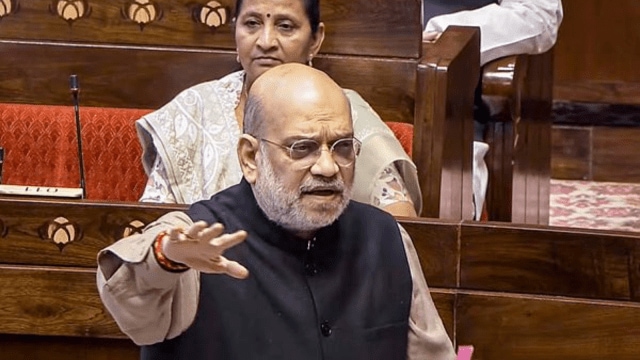

During the debate on electoral reforms in the Lok Sabha last week, Union Home Minister Amit Shah launched a sharp attack on the Mamata Banerjee-led Trinamool Congress (TMC) government in West Bengal over delays in fencing the Indo-Bangladesh border.
Shah alleged that only Bengal had failed to complete its share of work in this regard, adding that it was due to the TMC government’s “reluctance” to cooperate with the BJP-led Centre.


“Do you know where the remaining 563 km is left? Only and only one state — Bengal… If you (TMC) also try to protect infiltrators, then the victory of the BJP there is certain,” he said, referring to the state Assembly elections slated for April-May 2026.
Data presented by the Ministry of Home Affairs (MHA) in Parliament, however, shows that land acquisition by the Bengal government for fencing remains pending only for around 149 km. In August this year, the MHA told Parliament that 569 km of the border in Bengal remains unfenced. Of this, “112.780 km is non-feasible and 456.224 km is feasible”.
“Out of 456.224 km feasible IB (international border) length in West Bengal, land for 77.935 km has been handed over to the executing agency. For the balance stretch of 378.289 km, land acquisition is yet to be initiated for 148.971 km by the State Government. The remaining land for 229.318 km is in various stages of land acquisition,” the MHA stated.
Of the remaining 229 km, the Bengal government has yet to approve acquisition of land for 31 km of fencing. Notably, for close to 182 km of fence length, the state government has received payments from the Centre, but not handed over the land to the executing agency.
For around 7 km, the state has yet to do land valuation, while for 9 km, the MHA has not made any payments yet.
Coming ahead of the Bengal Assembly polls, Shah’s remarks have sharpened what has already emerged as one of the most politically sensitive issues in the state. What began as an administrative and logistical challenge has now turned into a full-blown political confrontation, involving questions of national security, Centre-state relations, land acquisition hurdles, border human rights concerns and electoral calculations.
Shah’s remarks in Parliament echo the Centre’s long-standing allegations. For months, the MHA has claimed that the TMC government has been blocking the project. In March, Shah had similarly asserted that “450 km of fencing work remains incomplete” because Bengal “refuses to provide land”, accusing the TMC of encouraging disruptions on the ground. He said the Centre had held seven meetings with state officials, but “land acquisition has not progressed”.
On December 11, 2023, Solicitor General Tushar Mehta had told the Supreme Court: “It is submitted that the West Bengal Government follows a far slower, more complex direct land purchase policy. Even for national security purposes like border fencing, there is non-cooperation by the state government. If the state of West Bengal cooperates in acquiring the land and hands over the land for fencing, the Central Government will do so.”
Farm challenges, concerns
The delays in border fencing could not be entirely attributed to political obstructions. Bengal’s border districts – particularly Nadia, Murshidabad, and 24 Parganas – have some of the country’s most productive agricultural land capable of supporting three crop harvests annually. This agricultural richness creates complexities in land acquisition that go beyond political considerations.
According to the 2013 Land Acquisition, Rehabilitation and Resettlement (LARR) Act, land acquisition for such projects requires transparent compensation mechanisms and rehabilitation measures – legal requirements that state governments cannot bypass.
Farmer resistance, their concerns over livelihood losses, and fears linked to fencing being erected 150 yards inside Indian territory have slowed acquisition on the ground in Bengal. Yet, the point that the state alone accounts for most of the pending fencing work has reinforced the Centre’s argument that the project is entangled in an unusually complex bureaucratic process there.
Judicial intervention
The deadlock has attracted judicial intervention. In November, the Calcutta High Court directed the Bengal government to file a comprehensive affidavit explaining the delays in land acquisition, questioning why land for which the Union government has already paid has not been handed over to the Centre. The matter is likely to come up in the court later this month.
In the high court too, the Centre’s position has been unambiguous. Additional Solicitor General Ashok Chakraborty told the Bench in August that the state was “not cooperating” and “not serious about acquiring land for fencing work.”
Political stakes
With the Bengal Assembly elections barely four months away, the border fencing issue has turned into a political row. For the BJP, the narrative of “infiltration,” “border insecurity” and “TMC obstruction” fuels its campaign. Shah’s remarks align with the BJP’s efforts to frame the issue as one of national security and demographic risk.
For the TMC, the Centre’s accusations are an attempt to paint Bengal as “non-cooperative”. The party has insisted that the Centre was using the fencing issue to “malign” the state and “deflect” from its own administrative shortcomings. The state government has emphasised the need to protect farmers from displacement, asserting that Bengal was being “selectively targeted”.
“Infiltration is not a concern for West Bengal only. Infiltration is happening in all neighbouring states on the border, including Assam and Tripura. Shah should answer why it is happening in Assam and Tripura. They have double-engine governments there. Shah should answer how the Pahalgam attack happened. Security there is directly under him. How did terrorists travel so many km inside Kashmir after infiltrating from Pakistan-occupied Kashmir (PoK)? Even the Border Security Force (BSF) is under Shah. He is the worst Home Minister the country has seen,” TMC spokesperson Arup Chakraborty told The Indian Express.


