

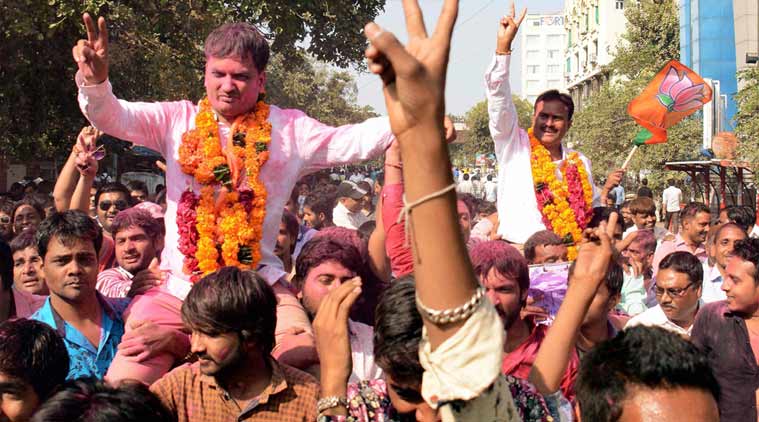
Civic polls are contests whose outcomes are influenced mostly by local factors. Yet, they often offer clues to larger political undercurrents. With Gujarat set for assembly elections in 2017, the civic poll results assume significance. Held in the wake of the Patidar unrest, this was the first electoral test for the Gujarat BJP after its mascot for over a decade, Narendra Modi, shifted to New Delhi as prime minister last year. The BJP has reason to worry.
While the BJP retained all six municipal corporations in the state, the Congress has made big gains in rural Gujarat. The Congress won 134 taluk panchayats, up from 26 in 2010, and 24 zilla panchayats, 22 more than in 2010. The BJP’s taluk panchayat tally fell to 96 from 204 while it could win just six zilla panchayats as against 24 in 2010. Municipalities offered some relief to the BJP as it maintained its edge over the Congress, winning 45 (seven less than in 2010). The Congress could make only marginal gains as it bagged 11 municipal bodies, up from four in 2010. The Congress has termed the elections a verdict against the Anandiben Patel administration, but it is obvious the party has not yet become the choice of urban Gujaratis, even though it has made new inroads in the rural areas. With two droughts in a row and falling cotton prices, rural distress — even the Patidar agitation has its roots in it — was bound to influence the civic poll outcome. Though agriculture contributes about 15 per cent of the net state domestic product, nearly 58 per cent of Gujarat’s population depends on farming for its livelihood. In the past, farmers gained from the surge in the prices of cash crops and the ruling party benefited. With prices crashing globally and the monsoon playing truant, the state government should have stepped in to help the farming community tide over the crisis. That did not happen.


