
Opinion When Vinod Kumar Shukla opened a window in my classroom
Everyone gets obsessed with 'Window'. We read other writers — great writers — but we keep asking each other what it is about the Shukla book that keeps calling us back
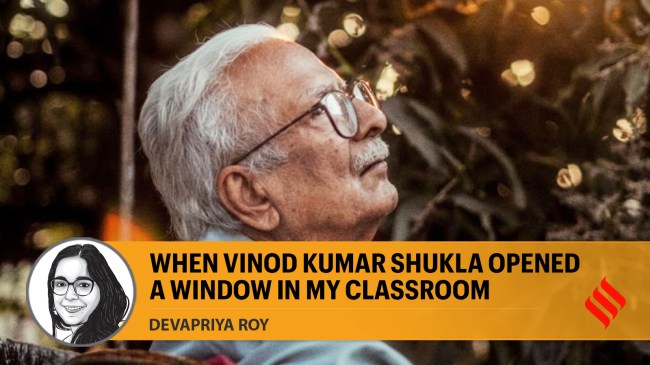 Vinod Kumar Shukla’s most celebrated work, Deewar Mein Ek Khirkee Rahati Thi, which won the Sahitya Akademi Award in 1999, exemplifies his ability to make the abstract intimate. (File Photo, enhanced using Google Gemini)

A call comes from Bihar. The author Vinod Kumar Shukla is telling an anecdote. We — my students and I — are watching Achal Mishra’s documentary about him, Chaar Phool Hain Aur Duniya Hai. The story about the caller from Bihar is told in voiceover. On screen, we see Shukla, now in his late 80s, walking outside his house, as birds flit around and the sun casts lozenges of golden light upon his slender frame and white hair. The remarkable play of light and shade lifts the mundane space and turns it into a magic portal: It is reminiscent of Shukla’s own writing.
The story continues in Shukla’s inimitable voice: “Curious, I ask, ‘Bhai, why have you called me?’ The caller replies, ‘Sir, who could I have asked, who would have told me if you were still alive… So, I dialled your number directly. You answered the telephone yourself and now I’ve got my answer!” We hear laughter in the background. There is laughter in my classroom, too. It’s a very Shuklaesque story, they can now recognise it as such.

It is a morning in September before the air spoils, and life feels promising. My class of about a hundred 18-19-year-olds have put away their laptops and phones and they are puzzling over a little novel in Hindi, where nothing really happens, the reading of which has occasioned this viewing. Shukla’s Deewar Mein Ek Khidki Rahti Thhi (1997) went on to win the Sahitya Akademi Award. We have been reading the English translation by Satti Khanna, A Window Lived in the Wall (Eka, 2019), as part of our “Great Books” course.
The students are all going to major in different things — Mathematics and Sociology, Biology and Computer Science and International Relations. Many will study Economics and Finance, the glamour of which gives them goosebumps already. This is not a traditional literature classroom and that is what makes it so electric. The students come from diverse backgrounds, and their mother tongues range, proverbially, from Kashmiri to Tamil and from Marathi to Meitei, with Amharic and Isindebele and English thrown in for good measure. It is the year 2025 and our classroom is in Sonipat, where agricultural fields have given way to an education city. It is the year 2025 and AI has changed the way the world reads and writes.
Yet, here we are, reading a novel about Raghuvar Prasad, a young lecturer of Mathematics at a small college — also surrounded by agricultural fields — in a town in central India. He lives in a single room, on his salary of 800 rupees, of which he needs to send a portion home. The jitney that takes Raghuvar to work is in great demand and often so crowded that it is impossible to get in. One day, he takes a lift from a local sadhu-mahout and ends up returning from college on an elephant. So, it comes to be that when his bride Sonsi catches her first glimpse of him, she sees him returning from college like a king, atop an elephant.
Every obituary of Shukla will note that he was a genius; every obituary will point out how he lived and wrote in the same city for most of his adult life, never leaving it to sample the world — that his extraordinary genius was in turning the hyper-local into the universal. Like the sari Sonsi wore one evening when Raghuvar was tutoring students under the streetlights — a “yellow sari with a shiny thread running through its weave” – everything we know about human life is woven into his writing, like that shiny thread.
But the point of our class is for them to discover these things for themselves. It is my own worry, perhaps, as a writer and a teacher, about the way the perceptions of reading and writing have changed, and are reframing the world I know. The peculiar pleasure of reading a novel is to arrest time and alter space: It is to allow another’s perception of life to, for a while, provide the lens through which we view our own. Great books transform us: I want to scream from the rooftops.
“A great conversation with AI can do that too. It can transform,” I hear the answer echoing back at me. “These are early days: One day, AI may produce great novels too.”
Raghuvar and Sonsi, in the first throes of love, climb out of their window to a world that is lush and green, with meadows and ponds and a teashop with a magic brew. Visitors, however, can’t seem to find any of the landmarks of Raghuvar and Sonsi’s private geography. My students, in the beginning, are a little grumpy. They are like Raghuvar and Sonsi’s visitors, shut out from the magical world of the couple. I decide to show them the documentary.
In the past, I had always put text above author. This time, I thought it might be interesting to see how the class might respond to the author. Shukla has said elsewhere how Window is a deeply autobiographical novel. Would they glimpse Raghuvar Prasad in this 80-something-year-old? Or, was it simply extending the kind of melodrama my class of humanities-adjacent-s like to wallow in?
Eventually, something gives. Everyone gets obsessed with Window. We read other writers — great writers — but we keep asking each other what it is about the Shukla book that keeps calling us back. It becomes a fever infecting the whole class; a weird, cool thing. “It’s the slowness,” Shreya says; “It’s the window,” Leonah says; “It’s the language,” Anirudh says; “It’s like this Kashmiri folktale,” Munazah says; “It’s the elephant,” Kasvee says. Then, very apologetically, lowering her voice, she asks me, “Professor, I don’t fully get magic realism. Is the elephant real?”
When the news of Shukla’s passing reached me, I was looking through some of their writings. Great authors grow old, I had said to them in class, hoping to highlight the humanity of art. Great authors die, I now said to myself. Like the zari in Sonsi’s sari, that knowledge is woven into the fabric of their work. In certain light, we catch the gold twinkling. It is something AI can only pretend to know.
Roy is an author and assistant professor of writing at Ashoka University, Haryana

 Share
Share


