
Opinion Well begun in Dhaka
For Delhi, on Bangladesh, the challenge will be to match words with deeds.



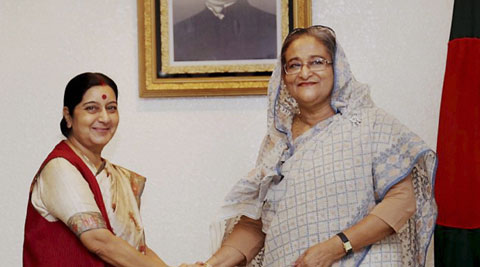 External Affairs Minister Sushma Swaraj meets Prime Minister of Bangladesh, Sheikh Hasina in Dhaka. (Source: PTI)
In her first stand-alone visit abroad as India’s top diplomat, External Affairs Minister Sushma Swaraj arrived to a warm reception in Dhaka and struck the right tone. The real test for India, though, lies in matching its words with deeds. In choosing Bangladesh for an early visit, Swaraj was reaffirming Prime Minister Narendra Modi’s “neighbours first” foreign policy.
The greatest improvement in India’s relations with the neighbours over the last few years has been with Bangladesh. Thanks to Bangladesh Prime Minsiter Sheikh Hasina’s strategic choice on deepening cooperation with India and former prime minister Manmohan Singh’s matching response, Delhi and Dhaka have made significant advances in a range of areas, from counter-terror cooperation to trade liberalisation. In the process, they turned the once prickly relationship into one that could potentially restructure the post-Partition geopolitics of the subcontinent.

Three years ago, it was the UPA government that broke the extraordinary momentum in bilateral relations by pulling away at the very last minute from the Teesta waters agreement amid Mamata Banerjee’s tantrums in Kolkata. If Singh could not stare down the West Bengal chief minister, he found it even harder to mobilise parliamentary support for the final settlement of the land boundary with Bangladesh.
The BJP in opposition did not back these agreements, but has taken a more responsible approach since winning the elections. In her public address in Dhaka, Swaraj said the NDA government is “committed to addressing” these issues “in a manner that improves the welfare and well-being of both our people”. For the Modi government, the problem is not about the merits of the agreements. It is about domestic political management, which is critical for tending relations with neighbours.
Swaraj had rightly “touched base” with Banerjee before heading to Dhaka. Swaraj will also have to convince sections of her own party, especially in West Bengal and Assam, that the agreements with Bangladesh are good for the two states and the nation as a whole. Unlike their predecessors in the UPA government, Modi and Swaraj must make a strong public political case for the agreements with Bangladesh and explain their benefits, both in the short and long term.
Swaraj has begun well in Dhaka by outlining a positive vision for India-Bangla relations. The two sides must now set early dates for the visit of Modi to Dhaka and that of Hasina to Delhi. Together, the two visits could help generate the necessary political momentum to wrap up unfinished work on the earlier agreements and unveil a bold action plan for building a vigorous strategic partnership between India and Bangladesh.
 Share
Share


