
Opinion Jagdeep Dhankhar’s comments on PM Modi: Why look for foreign validation in age of ‘atmanirbharta’
Vice President Jagdeep Dhankhar should know that an Indian leader needs the endorsement of the Indian people for his contributions to promoting domestic popular welfare — not what the world thinks of him
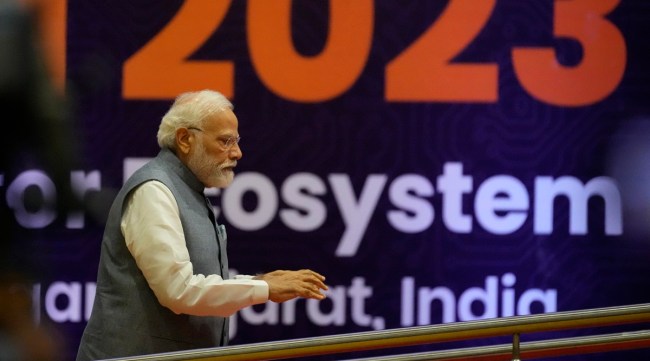 PM Modi is the first Indian to be given the opportunity of addressing a Joint Session of the US Congress twice. This is because his hold over the Indian polity is firm but also — and largely — because of the current alignment of Indian and US interests. (File Photo: AP)


According to media reports, Vice President Jagdeep Dhankhar spoke with great admiration about Prime Minister Narendra Modi in the Rajya Sabha on August 3. This was during an exchange between him and Leader of the Opposition Mallikarjun Kharge on the Opposition’s demand for a discussion on Manipur. Dhankhar said, “Our Prime Minister is not to be defended by me. He has come to be recognised on global platforms…Senate and the Congress in the US…Every Indian should be proud of him…Why are you shirking from the hard reality? India is rising as never before. The rise is unstoppable…everyone has contributed to it. I am not required to defend anyone”.
VP Dhankhar holds the second-highest constitutional office in the country. Persons in such offices are the conscience keepers of the nation. Every word they utter in public deserves constructive attention.

At the same time, the essence of our democratic system is that the people are supreme. Hence, they have the inherent right to analyse and scrutinise the approaches and words of high constitutional authorities. In this case, Dhankhar has touched on several important points in his brief remarks. Some of these deserve to be applauded but the connotations of others are troubling.
VP Dhankhar’s assertion that India’s rise is unstoppable is true on many counts. He has also shown his impartiality by acknowledging that “everyone has contributed to it”. Yet, Dhankhar would know that the world is a ruthlessly competitive place where a country’s rise has to be placed in the context of nations which pose strategic challenges to it. It is here that India is in a difficult position. The greatest strategic challenge it faces is from China. It cannot be contested that China’s rise has been far greater than India’s and that the latter has to do much better to meet the threats that emanate from its northern neighbour. PM Modi’s inspiring call to make India the world’s third-largest economy deserves the support and hard work of every Indian but much more will need to be done to reduce the growing gap with China.
Dhankhar has asked every Indian to be proud of Modi. There is no doubt that Modi is the tallest leader in the country. He has the people’s mandate and his electoral successes in the 2014 and 2019 elections were stunning. It is also true that he has many admirers abroad. The question though is: How much weight should the people place on what the world says about PM Modi?
Indeed, an Indian leader needs the endorsement of the Indian people for his contributions to promoting domestic popular welfare — not what the world thinks of him. The final judge of any leader, as Dhankhar would know, is the Indian electorate. And, ultimately it assesses leaders on their domestic policies and schemes. Clearly, as yet, Modi has their confidence in these areas.
Handling foreign policy is nevertheless an important aspect of any prime minister’s brief. However, the recognition a leader has on “global platforms” is not a measure of foreign policy success. Praise on “global platforms” — by the great powers and others too — is lavished on a foreign leader not so much because of his/her international standing but because it serves their interests to do so. This is the sad truth of international relations and advanced countries recognise that. It is doubtful that in such countries Dhankhar’s counterparts would refer to what others think of their heads of government/states. Indeed, it can be argued that such references smack of the colonial mentality that Modi has urged India to shed in the Amrit Kaal.
What was especially troubling about Dhankhar’s comments was his specific mention of the US Senate and Congress. PM Modi is the first Indian to be given the opportunity of addressing a Joint Session of the US Congress twice. This is because his hold over the Indian polity is firm but also — and largely — because of the current alignment of Indian and US interests. The question is: In singling out the US Senate and Congress, did Dhankhar, perhaps unwittingly, reveal that India gives inordinate importance to what US lawmakers think about this country and its leaders? Is this warranted coming from the second-highest constitutional authority in India? In any event, an Indian Prime Minister needs the mandate of the Indian people — and Modi has that in abundance — not the applause of a foreign legislature.
The writer is a former diplomat

 Share
Share


