
Opinion View From The Right: Nepal Lessons
An editorial in the Organiser talks about the lessons to be learnt from the destruction caused by the recent earthquake in Nepal.


 The editorial also praises the Indian government and the RSS for their spontaneous response at the time of crisis, but criticises Christian and Muslim leaders.
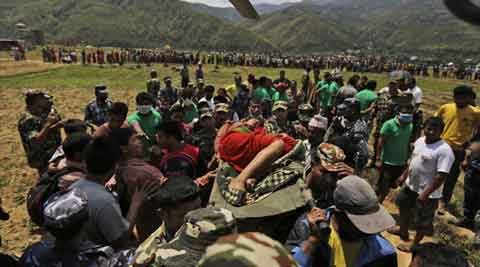
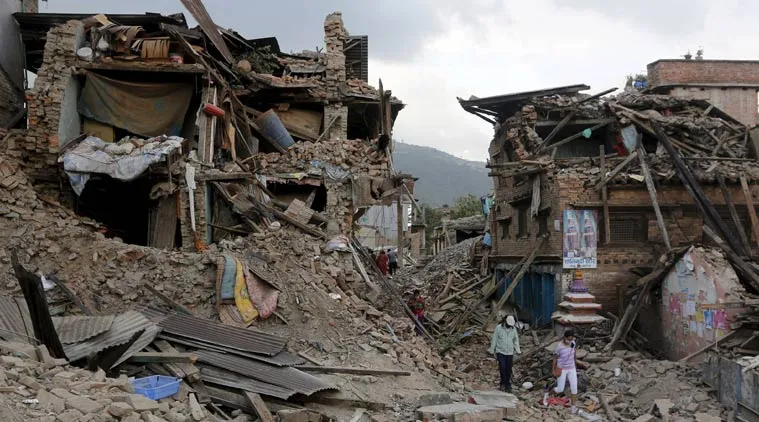
An editorial in the Organiser talks about the lessons to be learnt from the destruction caused by the recent earthquake in Nepal. It urges India to see why the temple structures of Kedarnath and Pashupatinath had not been affected, whereas other infrastructure across the region was damaged and destroyed: “As the devastation of infrastructure causes loss of lives and not the tremors, one should ask a pertinent question as to why the temple structures of Kedarnath… and Pashupatinath… faced the least damage. Beyond the matter of faith, there is a certain science of architecture we have certainly neglected… If we create the expert groups who can combine modern technology with traditional techniques, we will surely be equipped to deal with such disasters… if we learn these mega lessons from the megaquake, future shocks will be less devastating…”
The editorial also praises the Indian government and the RSS for their spontaneous response at the time of crisis, but criticises Christian and Muslim leaders: “At the same time, the communalisation of the calamity by the Christian missionaries and miscreants like [the] Owaisis, pushing for [an] intolerant or conversion agenda, needs to be categorically condemned.” It offer advise too: “There is a need to bring in transparency and institutionalised mechanisms for quick decision-making for [the] creation of disaster management forces…”

[related-post]
Helping Nepal
A Panchjanya editorial says that the effort, resources and energy expended to bring Nepal out of crisis should not be less than the power of an 8-on-the-Richter-Scale-earthquake: “If India has succeeded in providing that much energy and resources in helping Nepal, there is nothing extraordinary about it. It’s not just humanity. Nepal is not just a neighbour, the country has a deep traditional, cultural and unique relationship with India…”. Pointing out that the deep connection was evident in India’s response and the pain that Indians felt over the tragedy, it says that Nepal also expects such assistance and moral support from India. However it criticises the kind of assistance some countries extended, saying there was an attempt to make it “disaster tourism”.
Land & GST
An Organiser article pitches for the land acquisition bill and the GST as “laws that are going to change the outlook of India in [the] near future”. Criticising the opposition, it says, “The challenge that these bills face is to balance the benefit to the common man with the cost to industry.”
The article argues: “The present much-hyped deliberation on the issue of [the] new land acquisition bill and the GST has simply reduced the debate to [a] petty ‘prestige war’, with [the] opposition opposing it, and this resulting in ‘policy paralysis’.”
It adds, “the main utility of the present land acquisition bill is that it guarantees neutrality and fair dealing with farmers as clear norms on the process of acquiring land and rules for compensation packages will ensure that the process of land acquisition is transparent…”. On the GST, the articles says: “If implemented, the GST is clearly a long-term strategy; it would lead to higher output, more employment opportunities, and economic inclusion of the country in [the] long run.”
Compiled by Liz Mathew
 Share
Share


