
Opinion She Said: We dig black, Madam
Colour, gender and other identities are social constructs, the patterns that the prism of society throws when we let ourselves pass through it. We may not be able to change the prism overnight, but can we change the lens to begin with?
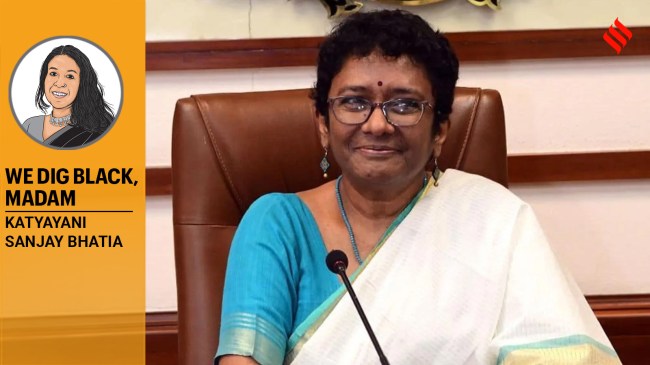 Kerala Chief Secretary Sarada Muraleedharan.

A few months ago, I was invited to speak at a gender conference in Thiruvananthapuram. That conference was inaugurated by Kerala Chief Secretary Sarada Muraleedharan.
As part of the microcosm of civil services, I had heard of Muraleedharan, but I was yet to witness the magic. That morning, I was enthralled by her persona and enamoured with her taste in handlooms, but it was what she said — her clarity and candour — that left me spellbound. In that instant, I knew that I had found an idol.

The next day, at a dinner with batchmates working under her, I spoke about how star-struck I was. I revelled vicariously in knowing more about her through their lens, their appreciation adding to my resolve to hang up my boots with the same elan that she exuded.
Then, my news feed buzzed with Muraleedharan’s post. In a Facebook post, she calls out an alleged insult by an unnamed visitor linked to her skin colour: “Heard an interesting comment yesterday on my stewardship as chief secretary — that it is as black as my husband’s was white,” she wrote. To put it into context, Muraleedharan took charge as the Chief Secretary from her husband, a historic moment for the state.
In her post, she writes about the “relentless parade of comparisons” with her predecessor (her husband), and how a particular comment was about being labelled black (dark-skinned), “with that quiet subtext of being woman”.
While I read and re-read her post, I was not prepared for the journey I was to undertake. I introspected on whether I was more offended at the reference to a colour — “the” colour — or whether the subtext of being a woman was the prime mover behind my indignation.
I realised it was neither and both. Neither, for I have become so inured to the constant ethnocentric biases and prejudices imposed upon us — ‘us’ refers to neither colour nor gender — that they have majorly lost their power to carve a fresh wound, save for some unkindest cuts. Both, for among the multiple imposed identities that I try to look through, these two identities still trigger past trauma, pricking the scabs and the stubs.
I was instantly reminded of a reading from a few years back on the ‘Ovarian Lottery’, a thought experiment popularised by Warren Buffett that was based on an idea by John Rawls. It basically talks about the probabilistic event of taking birth in a particular set of circumstances and how it may impact the trajectory of our lives.
And I wonder why something as probabilistic as this has such sway over how our mettle is tested. Leave alone tested, for Muraleedharan writes about the relentless parade of comparisons, why is a probabilistic event, be it gender, colour or the plethora of other social identities, considered as the touchstone of one’s competence, eligibility or even access?
Further, how does one define the barometer of what is “white” and “black”, of what is “fair” and “unfair”. But are we still beholden to archaic notions of seeing the colour we are taught to see and not the colour that makes us revel in our identity as an individual?
I am also reminded of two phrases that still sit ready on our tongues, for we are, unfortunately, creatures of habit and I cannot but be dismayed at the contrast they evoke. While “tall, dark and handsome” — notwithstanding whether ‘dark’ here refers to the colour of the skin or hair, or the mysterious dark aura of a ‘desirable man’, the phrase still is unfortunately used as an unmindful compliment for those who may appreciate it. At the same time, the phrase “fair and lovely”, originally a tagline for a fairness cream for young women who had to be fair to be lovely, has captured popular imagination. Here, the word ‘fair’ is unambiguous, leaving no room for interpretation, but, more importantly, leaving no room for authenticity.
While we raised a generation of girls aspiring to be fair and lovely to be desirable, we forgot to tell the kids, all genders alike, that real ‘fairness’ comes from the breadth of their intellect, the depth of their compassion, and the fairness of their judgement. Everything else is superficial, scrape the surface, and you will find colours that add beauty to your persona, and that is the real test.
I can only conclude by saying that colour, gender and other identities are social constructs, the patterns that the prism of society throws when we let ourselves pass through it. We may not be able to change the prism overnight, but can we change the lens to begin with?
And it is not just for the ‘(un)fairer sex’ to ponder upon — it is for all of us. For we are all perpetrators and survivors of probability, and that must remind us to look for the one within, within us and those around, for it is light that guides us, not just how we may reflect or absorb it. Madam Muraleedharan, ‘we’ too dig black.
The author is an Indian Revenue Service officer.
The views expressed are personal.

 Share
Share


