
Opinion Ram Madhav writes: Pakistan’s delusions
In the recent conflict, India has put paid to Rawalpindi's long-held notions of strategic depth and nuclear blackmail
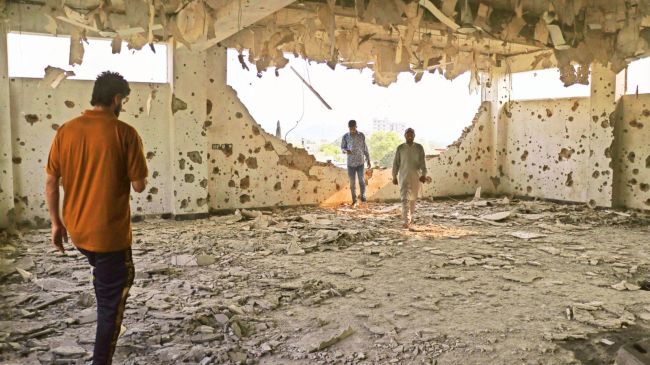 Members of media walks around a portion of mosque damaged by suspected Indian missile attack, in Kotli, Wednesday, May 7, 2025. (AP Photo)

Prime Minister Narendra Modi’s warning to Pakistan that the outcome of any future misadventure — “casting an evil eye towards India” — would lead to “destruction and total annihilation” must not be taken lightly by that country. The power asymmetry between the two countries has been established in this conflict, with India busting many illusions that the Pakistan army had entertained over decades, including its so-called “strategic depth” and nuclear blackmail.
When India decided to engage with the Taliban regime in Afghanistan after it took over in 2021, many eyebrows were raised. However, the strategic diplomacy that India developed with that regime resulted in Pakistan failing to capitalise on its old friendship. Indian and Afghan officials have been engaging with each other regularly for several months. In early 2021, India entered into a Memorandum of Understanding (MoU) with the erstwhile Ashraf Ghani government for the construction of the Shahtoot Dam on the Maidan River near Kabul, which would help provide clean drinking water to more than 2 million residents and irrigate millions of hectares of agricultural land. This was the second major dam project India was to undertake in the country after the Salma Dam in Herat province.

Ignoring Pakistan’s flimsy protestations, India and Afghanistan went ahead and even discussed additional projects on the Kabul and Kunar rivers. Regime change in Afghanistan pushed this agreement into temporary limbo. India is now discussing its revival with the new regime in Kabul.
The Pakistan army clandestinely supported the Taliban for many years and hoped that with the latter capturing power in Kabul, it would once again acquire the required strategic depth in dealing with India. But things did not go as expected. Far from becoming Pakistan’s backyard, the Taliban regime became a military challenge on the western front, with regular clashes taking place between the two sides. In the recent conflict with India, Afghanistan did not come to Pakistan’s rescue.
The loss of support from Afghanistan means Pakistan cannot go far beyond Islamabad to the West because the entire northwestern region, from Khyber Pakhtunkhwa to Balochistan, remains lawless and restive. Not a single week passes without the Pakistan army losing men in clashes with militants in the region. Far from securing strategic depth, Pakistan ended up with strategic shrinking. India conveyed this reality effectively by targeting the Nur Khan airbase located in Chaklala, some 350 km away from its border. Nur Khan airbase is Pakistan’s most strategic asset, housing several important air squadrons and also the entire management of its nuclear arsenal. It is less than 15 miles from Pakistan’s military headquarters and the prime minister’s office.
That brings us to Pakistan’s second delusion around nuclear deterrence. Unlike India’s “no first use” doctrine, Pakistan explicitly says that it follows a “first-use policy” against India when faced with any existential threat. The Pakistan military and political regimes relied on this blackmail for a long time, hoping to deter India. But PM Modi made it clear that “India will not tolerate any nuclear blackmail” and warned Pakistan that through Operation Sindoor, “a new line, new benchmark and a new normal has been drawn” against the terrorism it sponsors. What he meant was that India would not hesitate to attack deep inside Pakistan’s territory — a scenario that, according to its nuclear doctrine, allows it to use atomic weapons. By announcing that the Indus Waters Treaty would be kept in abeyance, India called Pakistan’s nuclear bluff, as cutting off the water lifeline by India was another clause in its doctrine for using nukes.
India is also a major nuclear power. Its doctrine categorically states that its retaliation to any nuclear misadventure against it will be “massive” and “designed to inflict unacceptable damage”. That eventuality notwithstanding, given the loose talk of the Pakistani leadership, it is time the world reviewed whether nuclear weapons are safe in the hands of Pakistani regimes.
In this conflict, India fought not just against Pakistan but the combined forces of Turkey and China. Pakistan extensively used technologies and weapons supplied by the two countries. Turkey’s role went beyond military support. As a founding member of the Organisation of Islamic Cooperation (OIC), it got the body to extend full support to the rogue acts of Pakistan. Turkish President Recep Tayyip Erdogan even questioned India’s decision on the Indus waters, forgetting that his own regime in Ankara denies the waters of the Tigris and the Euphrates to downstream countries like Syria and Iraq on the facetious argument that “neither Syria nor Iraq can lay claim to Turkey’s rivers any more than Ankara could claim their oil”.
For India, the involvement of China and Turkey in this conflict should serve as a warning. Turkey provided Pakistan with superior drone technologies, which were used extensively in this conflict. They are cheaper than than Polish, American and Israeli drones India uses. They are also well-tested: Since 2019, Turkish drones have been deployed in several conflicts including Syria, Libya, Nagorno-Karabakh, and recently, in Ukraine. This conflict also allowed China to test advanced defence technologies against sophisticated Indian and Western weapons systems. India responded effectively by deploying indigenously developed missile technologies like Akash and BrahMos besides Russian and Israeli technologies. While Make in India has proven its worth, accessing the best available technologies from all over the world for our defence forces, too, should be a priority.
An important lesson from this conflict is that the age of ground combat and aerial dogfights is over and the era of high-tech warfare with unmanned weapon systems has come knocking.
The writer, president, India Foundation, is with the BJP. Views are personal

 Share
Share


