
Opinion Putin may lose, but Putinism will survive
Pratap Bhanu Mehta writes: Putin may lose, but Putinism is ascendant as an ideology — now aligning itself with white supremacism, French chauvinism, Israeli right wing assertion, Ottoman dreams, Chinese aggression or Hindutva aggression.
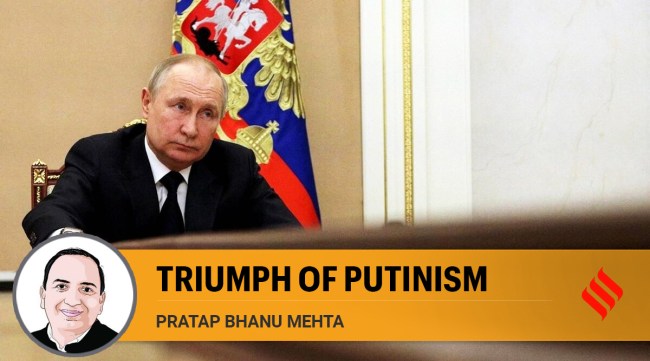 Russian President Vladimir Putin. (File Photo)


The biggest challenge to the world order is not the figure of Vladimir Putin. It is more a syndrome, a cluster of political tendencies that are congealing across the world that might be described as Putinism. At first sight, countries like India, France, Hungary, Israel, China, Turkey or even the United States seem like a motley bunch, each with a distinctive history. Yet powerful political forces in each of these countries are in the grip of a worldview that is not that far from Putinism. And the danger for the world is that Putinism may well survive the downfall of Putin.
The thread connecting these countries is not just admiration for the phenomenon of Putin. Donald Trump, Viktor Orban, and now the ascendant force in French politics, Marine Le Pen, have all been admirers of Putin. Turkey’s interests don’t align with Russia over Ukraine, but Recep Tayyip Erdogan used to admire Putin. The government of India’s position may carry a veneer of sophistication, but the outbreak of sympathy for Putin amongst India’s military, diplomatic and economic elites is as stunning as it is nauseating. Israeli politics’ rightward drift had something to do with immigration from Russia. The Chinese may be wary of the consequences of the Ukraine war, but they share Putin’s objectives enough to not want him to change his behaviour.

At first sight, Putinism might seem to be a peculiar Russian affliction: A product of a feeling of humiliation in the wake of the dissolution of the Soviet Union, fanned by an authoritarian regime. But its key tenets are widely shared. The most obvious is anti-Westernism, its avowed aim to displace Western hegemony. This might, in itself, not be a bad thing. But here, the West is not so much a geographical or even cultural idea, as much as an ideological one. In this construction, the West is a stand-in for “liberal.” It fuses anti-Westernism and anti-liberalism. If you are against the West, you oppose liberalism, and if you hate liberals you oppose the West. This explains, in a way, why Trump, Le Pen and Orban align with Putin. For they also want to rescue the West from its association with liberalism, and construct it as a more cultural or racial entity. It also explains the inner contradiction of Hindutva attitudes to the West. They strategically might court Western power, but they are also against Western hegemony — what they mean by that is simply the ascendant power of liberal ideas.

The association of the idea of the West with liberalism is one of the most potent mistakes in intellectual history. The West has only been intermittently liberal; and the strongest arguments for liberalism are not rooted in the Western cultural experience but in the demands of human freedom and dignity. But this fusion of the West and liberalism allows anti-liberals to wear the mantle of anti-colonialism and anti- Westernism. It allows them to trash liberalism while looking like national heroes. The West has a lot to answer for: Racism, imperialism, exploitation. But in this world view, anti-Westernism is simply a convenient dog whistle for being anti-liberal: It allows one to drape authoritarianism and ethnic supremacism in the mantle of virtue.
Second, there is an affinity in their attitudes to historical time. Putin might have the fantasy of creating Greater Russia that harkens back to Peter the Great. But these fantasies of undoing the past by erasing the present of other peoples or minorities is not unique. China fancies itself as recreating its position as the Middle Kingdom; India as terrorising its minorities to recreate the fantasy of an Indian history without a Muslim past; Turkey has always been fascinated by neo-Ottomanism, and references to a Greater Hungary, whose political boundaries are not the current moth-eaten product of the nation-state system, were aplenty in the Hungarian election. It is a fantasy world, but one that can license control and purification in its name.
But there is also a hostility to the recent past, an ambivalence about the post-1989 world. In Russia this hostility is, of course, apparent. But even countries that did well in that now much maligned neo-liberal phase of economic reform and globalisation, are ambivalent about that era in political terms. That economic reform came with, what is on this narrative, a political enfeeblement. This enfeeblement took two forms. The first is the reduction of the state to only quotidian goals like economic growth. The post- 1989 world was not just one of economic deregulation, but one in which the state becomes untethered from its higher purposes, or from fulfilling its nationalist purposes defined in ethnic terms. It also displays a fundamental political weakness: An unwillingness to assert control over culture, civil society and the economy, all in the name of some idea of freedom. It is not an accident that it is the political constellations that were ascendant immediately after 1989 that are getting decimated. In the French elections, Macron had already swerved right, but it is the decimation of the centre and the left that is striking. But the dissemination of the post-1989 “Liberal Left” in France, in Israel, in India, in Hungary, as if they were some kind of ancien regime that needed to be thrown out, is quite astonishing.
Third, there is a clear comfort with violence. Other ideologies have deployed violence as well. And there are differences in the institutional contexts that allow for the use of violence. But in Putinism, the threat of violence, internal or external, or its intermittent deployment, is itself the sign of success. It is useful for rallying nationalist sentiment, it is a raw assertion of ethnic privilege, and a sign of a masculine revenge of humiliation.
There is an obsession with demography, the ethnic composition of populations. There is an abiding suspicion of the foreign and the cosmopolitan. In a slightly odd phenomenon what unites these countries is that they all hate the figure of George Soros, emblematic now of the foreign hand. They envisage re-altering the relationship between civil society and the state, where civil society is expected to serve the purposes of the state rather than be autonomous in its own right. There is a discomfort with pluralism, a contempt for moderation, disdain for freedom, and mistaking of ruthlessness for achievement. Putin may lose, but Putinism is ascendant as an ideology — now aligning itself with white supremacism, French chauvinism, Israeli right wing assertion, Ottoman dreams, Chinese aggression or Hindutva aggression. They want to take down the West but what they really want to take down is liberalism.
This column first appeared in the print edition on April 14, 2022 under the title ‘Triumph of Putinism’. The writer is contributing editor, The Indian Express

 Share
Share


