
Opinion A doctor, a chief minister and an act of pulling down a niqab. Can questionable mental state be a justification?
Nitish Kumar Hijab Row: In India, where the journey of women into the professional sphere is already fraught, the implications of such an act are deeply corrosive
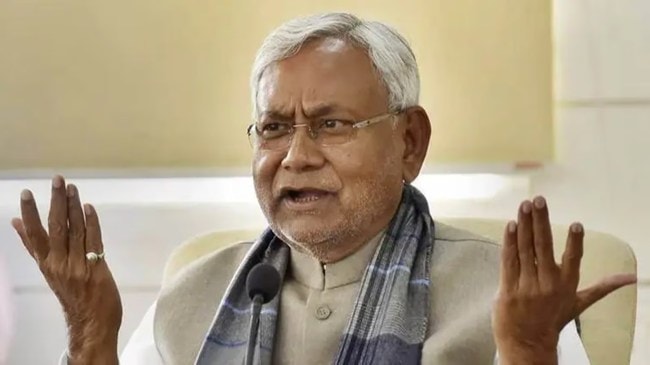 Bihar Chief Minister Nitish Kumar pulled down the hijab of a newly appointed AYUSH doctor. (Express File Photo)


Nitish Kumar Hijab Row: In a Patna hall, a government ceremony meant to celebrate professional achievement was transformed, through one thoughtless gesture, into a grotesque example of gendered power.
In a video, Bihar’s Chief Minister, Nitish Kumar, stands before Nusrat Parveen, a newly appointed doctor of AYUSH (Ayurveda, Yoga, Naturopathy, Unani, Siddha and Homoeopathy). She wears a traditional niqab as she accepts her appointment letter. The cameras obligingly flash to capture the moment. The CM gestures for her to lower the niqab (perhaps, for the photograph); then, abruptly, without awaiting a response, his hand darts out. He pulls the veil down from her face. A segment of the gathering laughs, sycophants who found nothing amiss in that act. The deputy Chief Minister, Samrat Choudhary, moves to intervene, a belated, futile flicker of propriety. The deed is done; no apology is issued. The video, which has been widely circulated, is brief, but the violence is palpable.

Some dismiss the humiliating incident as a clumsy accident by an elderly man, whose mental acuity has been in question for some time. However, it seemed to be a physical enactment of a particularly virulent paternalism. The aftermath followed a grimly predictable pattern. The victim internalised the trauma and the apparatus of power minimised it. Parveen, her family confirms, is now “too hurt” to take up the government post she earned. Her withdrawal seems to be a political statement. She refuses to serve a power that refuses to see her as sovereign.
‘A man after all’
Then came the chorus of justification and condemnation, which always reveals more than the act itself. Uttar Pradesh minister Sanjay Nishad, smirking, provided the definitive gloss. “He is a man after all,” Nishad shrugged, suggesting the fuss was overblown. “He just touched the veil … what if he had touched elsewhere?” Here, in its rawest form, is the ideology that enables such acts.
The belief that male entitlement exists on a spectrum, and women should be grateful for the degree of violation. This, unequivocally, is the grammar of rape culture. The subtext of his glib statement was that a woman’s bodily autonomy is never absolute. It is a negotiable space, and the negotiation is always on men’s terms.
The woman who sees without being seen
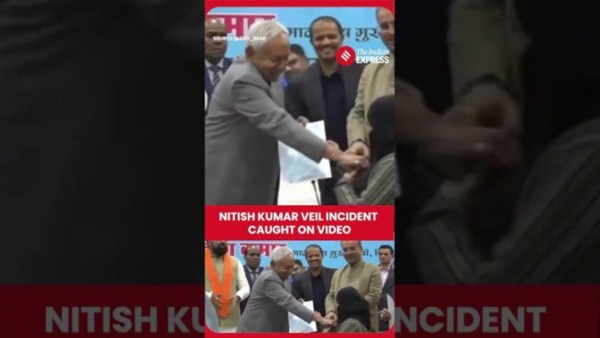 The CM gestured the AYUSH professional to lower the niqab, and then pulled it down himself. (Screenshot: The Indian Express)
This incident also crystallises a long-standing struggle, which is women’s right to opacity. The post-colonial theorist Frantz Fanon analysed the dehumanising, objectifying power of the colonial gaze. He famously wrote, “The woman who sees without being seen frustrates the coloniser.” The niqab (hijab or burkha), for the woman who chooses it, can be a radical assertion of control over that gaze. She sees, but is not fully seen. She participates in public life while retaining her privacy. This is unsettling for a paternalistic order, which conflates authority with the right to access.
In a country like India, where the journey of women into the professional sphere is already fraught, the ramifications of such an act are deeply corrosive. It signals that the government service is not a neutral arena of merit but a space where majoritarian comfort can be physically enforced upon minority identity.
This single gesture undermines years of fragile progress, validating the apprehensions of families who fear that public participation demands cultural erasure, and telling a diverse nation that the price of entry is not just competitive examination, but also the surrender to a dominant gaze that claims the right to unmask you.
Parveen’s potential absence from the public health system is a tangible loss for Bihar. But it is a symbolic loss for all societies that pay lip service to women’s empowerment while leaving the architecture of paternal power intact.
The empty chair that may now exist in an AYUSH clinic is a monument to this failure. It speaks of talent wasted and trust broken. It asks a harrowing question: How many women must be unmasked, metaphorically and literally, before we understand that true equality begins with the inviolable right to draw the boundaries of one’s own self? The silence from Kumar’s office is answer enough. Consent is the salient covenant of a civil society. The unspoken agreement that another’s body, faith, and autonomy are not ours to commandeer. For now, one can only mourn yet another woman professional stepping back from the state that reached out, not to lift her up, but to pull her down.
aishwarya.khosla@indianexpress.com

 Share
Share


