
Opinion The paradox of Manipur’s political crisis
The MLAs’ push for a government is, at one level, a procedural demand. Centre’s hesitation, in contrast, suggests that the crisis is far from contained
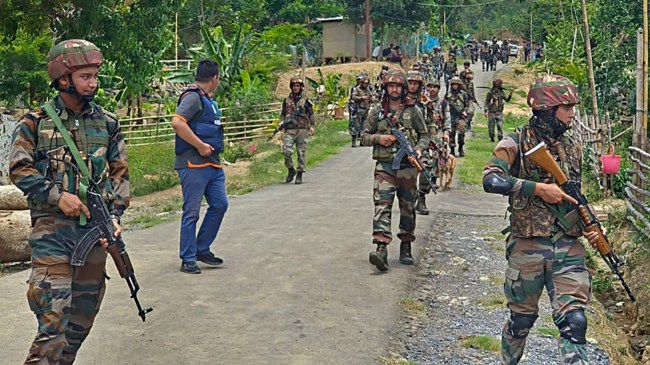 Manipur’s crisis is not about the absence of a government, but of a shared political imagination — one that sees governance as more than majoritarian arithmetic (Express File Photo)



On May 28, 10 NDA MLAs walked into the Raj Bhavan in Imphal, claiming the support of 44 legislators, and sought to form a “popular government” in Manipur. In another time, such a move would have been unremarkable — an expected feature of parliamentary life. However, in today’s Manipur, it looks less like a step toward democratic normalcy and more like a performance as the foundations of the political community are still fractured, and far from “normal”.
In Manipur, President’s rule has been in place since February, when Chief Minister N. Biren Singh resigned after months of escalating violence. The Centre’s stance has been cautious: No rush to restore a government, no appetite for political experiments. Expectedly, the BJP leadership dismissed the MLAs’ visit as a mere “courtesy call.”

What lies beneath, nevertheless, is a messier reality. The 44 MLAs’ claim, on the surface, suggests a consensus. But consensus in Manipur is a fragile word. Their claimed support excludes the 10 Kuki-Zomi MLAs (seven of whom won on BJP tickets) and the five from the Congress. Such arithmetic proposes a government that represents only one section of the society.
The protests that erupted over the past week expose the fault lines. A state-run bus carrying journalists to the Shirui Lily Festival was stopped at a checkpoint. Security forces reportedly asked the staff to cover the word “Manipur” on its windshield to allow safe passage through Kuki areas. The decision, in context, was pragmatic. The response in Imphal, however, was fury. To cover the state’s name was to erase its identity.
COCOMI, the Meitei civil society group, mobilised swiftly, demanding the Governor’s apology, the removal of top officials, and an end to what they see as a systematic undermining of Manipur’s sovereignty. While they have signalled a willingness to engage with MLAs, COCOMI’s stand is clear: Three months of President’s rule have failed to restore peace or hold anyone accountable, deepening mistrust in Manipur’s divided polity.
The protests also spilt over onto the streets. Human chains lined the roads; mothers and students carried placards demanding the Governor’s apology. In no uncertain terms, they made it clear that Manipur’s identity is non-negotiable. The Governor had to be airlifted to Raj Bhavan from the Airport — the leader is shielded from the very people he is meant to represent.
The Centre’s reluctance to end President’s rule is less a bureaucratic delay than a recognition of enduring instability. The looted weapons — estimated at 3,000 — remain largely unrecovered. The displaced remain in camps. The roadblocks, both literal and metaphorical, persist. The lines of control are found in the everyday geography of fear and formal orders. Without reckoning with these realities, a government formed now would not have the required legitimacy.
The MLAs’ push for a government is, at one level, a procedural demand. But it is also an admission of exhaustion. It reflects a desire to move on, to restore the machinery of governance, and to claim that the worst is over. The Centre’s hesitation, in contrast, suggests that the crisis is far from contained. A political arrangement that ignores the exclusions at its core will not heal — it will harden divisions.
What is missing from the debate is a reckoning with the nature of the political community in Manipur today. Can a state where the Valley sees the Hills as hostile territory, where the Hills view the Valley as a threat, and where the Naga districts increasingly assert their distinct identity, be governed as a single polity?
A popular government requires a shared sense of belonging, a basic agreement on political rules, and a willingness to coexist despite profound differences. Manipur, two years after its collapse into violence, lacks these foundations. The demand for a government, however procedurally correct, needs to take into account the challenges of rebuilding trust, recognising mutual legitimacy, and confronting the structural inequalities that fuelled the conflict in the first place. A popular government without a people is a contradiction in terms.
Manipur’s crisis is not about the absence of a government, but of a shared political imagination — one that sees governance as more than majoritarian arithmetic. Until that imagination is rebuilt around a lasting peace, any government will remain fragile, provisional, and unmoored from the realities on the ground.
The writer is a researcher and writer based in Manipur

 Share
Share


