
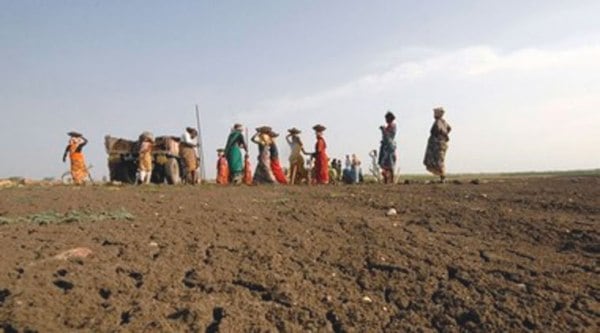
The MGNREGS stands out as one of the Indian government’s most ambitious social schemes, with far-reaching consequences throughout the economy. The only known recipe for poverty eradication is a combination of high growth and high development spending. Neither is sufficient. A recent study (Kapoor and Ahluwalia, 2012) has shown that post-liberalisation, one champion of poverty reduction in India is Andhra Pradesh. This reduction in poverty is widespread, as seen in all possible cross-cutting of the data: rural/ urban, Hindu/ Muslim, SC/ ST. The study shows that this was achieved through sustained high growth in the state, including growth in the agricultural sector, together with high social spending. The lesson, therefore, from the Andhra experience is that growth does trickle down, if managed properly.
Almost all research on the MGNREGS concludes that the demand for employment exceeds the state’s capacity to create jobs. In eight years, households on average got employment for less than 50 days, whereas the act guarantees at least 100 days of unskilled work. With complete disregard for the state’s low capacity at job creation, political pressures remain to raise the number of days under this scheme. The Rajasthan government succumbed to this temptation in 2013 under Ashok Gehlot, and raised the number of days to 150. A legal right that is impossible to fulfil is a bad idea. It fundamentally weakens the value of a right by making its violation acceptable.
Against this fact, one could argue that if India had a robust identification system and strong political will, the MGNREGS could be replaced by a direct cash transfer programme. In the absence of political will and accurate targeting capabilities, however, a workfare scheme like the MGNREGS is second-best for the rural sector, where the absence of productive employment opportunities in agriculture
is severe. The merit of a workfare programme as a means for direct transfers to the most needy is that it helps target beneficiaries, as the non-poor are less likely to accept low wages and heavy unskilled labour. It is time, however, to restructure the MGNREGS to raise its overall efficiency and gains to rural households.


Limiting the MGNREGS to the 100 days of summer when agricultural work is in short supply is a good point to start. This is a possible solution to the twin problems of the low job creation capacity of the state as well as distortions in the private rural labour market. In the first few years after the scheme was implemented, there was a strong seasonality to the demand and supply of work under the scheme. Over the years, this seasonality vanished as the above-market wages of MGNREGS made public works more lucrative and the incentive to seek outside employment decreased. Restricting the MGNREGS to the summer months will, therefore, reduce these pressures on rural labour markets and, at the same time, allow implementing authorities to specialise in the MGNREGS during those months. It is naïve to expect local government officials to possess the capacity to create mass employment at short notice, within a geographical proximity, repeatedly through the year.
Second, the emphasis must be shifted from employment to “productive” employment. In his budget speech, Arun Jaitley stated the need to link job creation under the MGNREGS to asset creation. Even ardent supporters of the scheme acknowledge that not enough assets are being created. Between 2007 and 2010, the number of assets created were 2.3 per 100 hectares of cropped land (ministry of rural development, 2012). Shifting the focus to asset creation has to start by expanding the scope
of permissible activities. This has been attempted by including work on private land, building individual household latrines, school toilet units and community sanitary complexes. While this is welcome, the selection of assets to be created has to be done with a long-term view on usage and productivity. At the same time, the creation of some of these assets might require a serious rethink of Section 1 of the MGNREGA, which limits expenditure on material and skilled labour costs to less than 40 per cent of the total project cost for each independent work.
Third, the scope of the work has to be expanded from purely unskilled to semi-skilled jobs. The provision of such jobs under the MGNREGS would lead to the skilling of agricultural workers and make them employable beyond unskilled work. Low-skilled food processing, manufacturing and handloom weaving are possible areas. Including such labour-intensive industries in the MGNREGS would be a win-win solution — these industries could grow and create jobs while rural workers would gain skills.
Finally, there is significant variation in the implementation of the MGNREGS across states. Lower-income states with limited organisational capacities tend to lag, while wealthier states like Andhra have been more successful. The Andhra government has extensively used technology in the MGNREGS, tying electronic transfers to biometric authentication to monitor leakage and track usage. If the MGNREGS is here to stay, there has to be an effort to create capacities in low-income states to successfully plan, organise and implement such large social schemes. Over time, states should have the flexibility to redesign the MGNREGS according to their own needs and potentially experiment with alternatives, such as direct cash transfers.
The writer is fellow, Brookings Institution, India Centre, and professor of economics, Indian School of Business


