
Opinion Vamsee Juluri writes: A lesson for Bharat in failure to tackle antisemitism on US campuses
Anyone invested in the ‘Bharat narrative’ should take the issue of the decay and crisis in Western academia seriously. They should also see it as an opportunity for a global intellectual revival that goes beyond trying to impress the West, as if we are just exhibits in museums built by them.
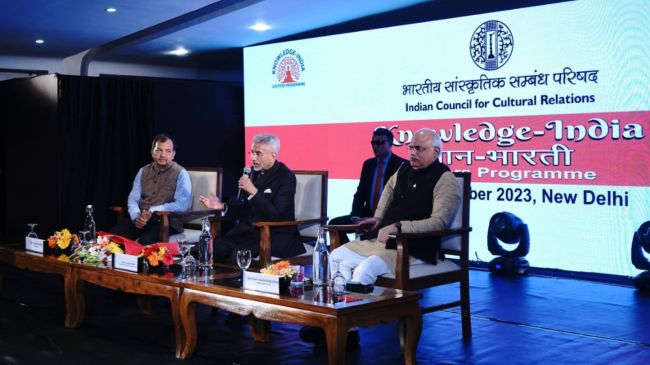 Minister of External Affairs S Jaishankar at the Indian Council for Cultural Research (ICCR)’s recent “Knowledge India Visitors Talk”. (X/@DrSJaishankar)


“How does one communicate to the world what is happening in India?” wondered Minister of External Affairs S Jaishankar at the Indian Council for Cultural Research (ICCR)’s recent “Knowledge India Visitors Talk”.
The question was perhaps rhetorical, for the MEA and ICCR already had an answer lined up in the form of the event itself. Along with its past “India Chair” memoranda and such, the ICCR perhaps conceived this event too with the belief that foreign scholars would visit, learn, and then go back to teach their countries about India and the “Bharat narrative”.

Spoke about Building a Bharat Narrative at @iccr_hq’s Knowledge India Visitors’ program.
Underlined the thinking which drives Atmanirbhar Bharat, creating an inclusive, just and fair society, assuming independent positions and expressing the persona of our society.
Bharat… pic.twitter.com/dhT6TWrkcr
— Dr. S. Jaishankar (@DrSJaishankar) December 4, 2023
From the perspective of New Delhi, the rest of the world’s universities perhaps look ready and eager to receive that narrative. But what exactly is the state of affairs in American universities today? To answer this question, let us consider another event involving academia and the government which just took place in America. Just a few days ago, the presidents of Harvard, MIT, and UPenn appeared before a Congressional Education Committee to answer questions from concerned Republicans about their inability to protect Jewish students from growing antisemitism on their campuses.
Reactions to their responses have been unsurprisingly polarised in the West. But to many Indian observers, it seemed the writing was on the wall. If university leaders could sound that cold and indifferent to the existential fears of Jewish students despite the long-standing global recognition of antisemitism as a form of bigotry, what chance would Hindu students ever have of being heard if they complained about Hinduphobia? Others put the situation more dramatically, calling the university officials’ prevarication the exact moment that American higher education’s glorious run came to an end. Some said that even if US STEM education remained strong, the social sciences and humanities were corrupt to the core. Calls to the Government of India to keep American universities, especially the liberal arts, out of India, echoed through social media.
Taken together, these two events give us a broad picture of where things stand in terms of India’s global knowledge efforts. On the one hand, we have an optimistic Indian political establishment which wants foreign experts to stop and listen to a particular story about India.
On the other hand, many Indian citizens are complaining that the same establishment has been ineffective in dealing with a foreign university system trafficking in outright hatred towards people deemed to be in possession of “oppressive” identities, be it “Zionist,” or “Hindutva,” which, in practice, often simply means, “Jewish” or “Hindu.”
For all purposes, the relationship between American higher education and India might be described as one-sided. India, or its government, says “MOU” while the other side signs off on them and profits from Indian consumers while actually saying under its breath, “We. Loathe. You.”
This is the harsh reality of the unequal landscape of knowledge exchanges between Bharat and foreign higher education today. If Hindu students are targeted for celebrating Holi, Dussehra, Diwali (and smear campaigns about some of these festivals have already happened on some US campuses), or threatened with slurs like “cow piss drinker” by fellow students, or singled out for Brahminical oppressiveness by professors, as was the case with some Jewish students being called Zionists recently, how much will the “Bharat Narrative”, being sung to foreign Indologists, come to protect not just our students, but the truth itself?
Having stressed this grim reality, I would like to return to what I found hopeful in Jaishankar’s observations. Critiquing his own field of international relations for its “unipolar” biases that denied the existence of traditions of statecraft in non-Western cultures, he rightly noted the need for “cultural rebalancing” alongside the political and the economic. Presumably, this was an admission that India’s growing GDP alone would not make for a rearrangement of our place in the world, that there would have to be a cultural vision to drive our journey.
It is on the question of what this cultural vision might be, that the scarcity of Indian social sciences, or at least their bearing on the political establishment and the trajectory of the country, is obvious. Dr. Jaishankar elegantly avoided the “Vishwaguru” slogans of recent years for a more egalitarian “Vishwamitra” label. Sure, India wishes to be a universal friend, and has walked the talk with vaccine-friendship and more, already. But what is India saying about the world? Do we have a story to explain to ourselves and others our own understanding of how the world got here, and where we might want to go from here?
All the major civilisations, to borrow from Samuel Huntington’s much criticised but still unignorable framework, have some kind of a story about modernisation, recovery from colonialism, and particularly the role of the West. But all we have is a Western Enlightenment template into which we plug in claims of our own “OG” (“Original Gangster”) liberal-claims. You didn’t bring us democracy, we already had it. You didn’t bring us reason and science, we already had it. To be fair, there is great interest in rediscovering “Indic” knowledge in India today, and it is commendable. But how, if at all, any of these great ancient systems of thought and practice are going to inform our story about the world, is still uncertain.
A “Bharat Narrative”, to put it plainly, has to be not about “Bharat” alone but also about the world in which Bharat hopes to play a prominent cultural role once again. What it needs is investment and development of not “Indology” but what scholars have sometimes called “Westology.” The seeds of this work do exist, but remain outside the notice of the political elite, as well as the academic establishment. The books of Ram Swarup and Sitaram Goel, and more recently, S N Balagangadhara and the Ghent School programme in the Comparative Science of Cultures, and in more popular circles, those of the most well-known Hindu critic of American academia, Rajiv Malhotra, all need to be studied if a different “cultural rebalancing” between Bharat and the unipolar world is to ever take place.
The “Bharat narrative” should be built on the recognition that there are very few countries or peoples today that have a continuous cultural memory that goes beyond a few dozen generations. A new Bharat, if it is to still be Bharat, will somehow have to stay true to memories of the very, very old one. For this to happen, the MEA, ICCR, and other concerned institutions should take the issue of the decay and crisis in Western academia seriously. They should also see it as an opportunity for a global intellectual revival that goes beyond trying to impress the West, as if we are just exhibits in museums built by them.
The writer is Professor of Media Studies, University of San Francisco

 Share
Share


