


Tags:


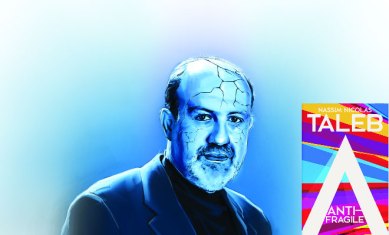
Book: Antifragile
Author: Nassim Nicholas Taleb

Publisher: Penguin Allen Lane
Price: Rs 899
Pages: 519
In the fictional universe of The Hitchhikers Guide to the Galaxy series,Douglas Adams introduced an infinite improbability drive to save the protagonists Arthur Dent and Ford Prefect from certain death by asphyxiation in deep space. The improbable odds against being rescued were,Douglas Adams wrote,2super276709 to one which was the telephone number of the Islington flat of Arthur Dents girlfriend. Nassim Nicholas Talebs book Antifragile reminds the reader of that device,using the mathematical notion of randomness to understand our world and the occurrence of rare events. Talebs first books,Fooled by Randomness and the much-acclaimed The Black Swan,dealt with the failure of Wall Street consultants to understand the direction of the stock market. This book is a more philosophical treatise on the world and its relation with randomness.
Using numbers and mathematics to explain the world around us is an activity as old as human civilisation. The Mesopotamian civilisation meticulously observed the positions of stars and planets to predict the future. This activity was so popular that much later,around 2,000 years ago,Indians borrowed these tables and calculations. Since the data arrived via Byzantine Rome,it was called the Romaka Siddhanta. Similar observations of the position of planets recorded by Kepler led Newton to formulate the celebrated inverse-square law,thereby establishing the theory of gravitation. In more recent times,in Political Order in Changing Societies 1968,Samuel Huntington,the guru of right-wing social theorists,used what the mathematician Serge Lang described as pseudomathematical hucksterism to prove that the apartheid South Africa of the 1960s was a very satisfied society.
The world according to Taleb is divided into three distinct segments the fragile,where human beings,societies,etc are risk-averse and conservative in their outlook,and thereby more vulnerable to external shocks; the robust or reticent where the society can withstand the shocks with less repercussions; and the antifragile,where shocks make the society stronger.
Written in advocacy of his thesis of antifragility,the idea is best showcased by the randomness of section titles Chapter 2,The cat and the washing machine has four consecutive sections with completely unrelated titles,Crimes against children,Punished by translation,Touristification and The secret thirst for chance. It is this thesis that is fragile. For Taleb,randomness is to be celebrated and,indeed,it is good for one a walk on uneven terrain does not expose us to chronic stress injury as compared to the randomness-free gym machine. Just go tell that to the ordinary Indian: that walking on roads with unexpected open manholes is more soothing to the nerves than the randomness-free footpaths of first world cities.
To build the thesis of antifragility,Taleb has to indulge in some painful verbal callisthenics. Thus the standard notion of variance,which every high school student studies in mathematics class,has to be called the hidden benefit of antifragility. Such new jargon is,of course,necessary because Taleb has to debunk academics and academicians as people indulging in lecturing birds how to fly. And how best to do it but to have an imaginary conversation between Fat Tony and Socrates? Once the notion of randomness is taken away from mathematicians and serious students of probability,Taleb finds that there is a titillating feeling associated with randomness. Clearly,the academics were concentrating on the game and forgot the importance of the sultry seductress who had sidled up to our hero,playing blackjack in the casino.
He also coins the new terms mediocristan and extremistan to describe the standard statistical concepts of the bell curve or normal Gaussian distribution and the skewed distribution. Examples in the Indian context are the percentage of students who get admission to the IITs from those appearing for the admission test from the metropoliton cities as against the percentage for those appearing from Kota. Talebs examples of extremistan are a small number of homeless people who cost the states a disproportionate share of the bills,the sickest 10 per cent consuming 64 per cent of the health care expenses. And his solution is: Just work on removing the pebble in your shoe.
The ideas in this 500-page tome are repetitive,and so are phrases like skin in the game and chickenst used at least 20 times. Taleb also makes generalisations a taxi driver is more antifragile than an academic and uses personal anecdotes to construct a philosophy in which disorder is what matters. Its a shame that despite all this new-fangled thinking,Talebs opinions never seem to rise beyond the banal and the conservative,in which the old is superior to the new.
Since The Hitchhikers Guide to the Galaxy,we have known that 42 is the Answer to the Ultimate Question of Life,the Universe,and Everything,as calculated by an enormous supercomputer over a period of 7.5 million years. Unfortunately,no one remembers the question after that span of time,so a special computer the size of a small planet has to be created to rediscover it. It is named Earth. This fantasy is what Taleb should take serious instruction from the stuff of philosophy is the questions that we ask,not the answers that we arrive at. It would have been so much better if Taleb could have just asked the right ones.
Rahul Roy is a Professor at the Indian Statistical Institute,Delhi,and a fellow of the Indian Acadmy of Sciences


