

Journalism of Courage

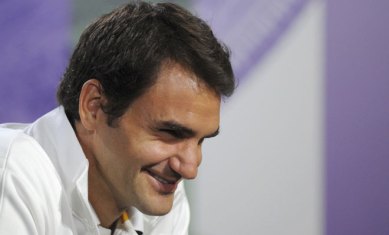
A decade on from his debut grand slam success,Roger Federer will begin 8216;Mega Monday8217; at Wimbledon as the defending champion,the holder of a record 17 grand slam titles and in pursuit of an unprecedented eighth trophy at the All England Club.
What was clear from the reaction of the public on Sunday was that 10 years on from lifting the gilded,pineapple-topped Challenge Cup for the first time,Federer has not lost any of the magic that makes him a fan favourite no matter where he plays.


REUTERS: In all your years at Wimbledon,this is the first time that you will have to potentially beat three top-five players to win since Rafael Nadal and Andy Murray are both in your half of the draw. Would you rate this as the most difficult draw you8217;ve had during your decade-long success at Wimbledon?
FEDERER: 8220;You can see it in different ways. Is it harder to have a tough draw later in the tournament or is it harder to have a tough draw early in the tournament? I remember when I played Richard Gasquet in the first round in 2006,he came off just winning Nottingham on grass and then to play Tim Henman or Robin Soderling in the second round. That to me is terrible. That to me is a terrible draw.
8220;The draw plays itself out eventually and then you just deal with it. For that reason I look at it8230;I wouldn8217;t say a normal draw this year because Rafa8217;s not a normal player. He8217;s achieved too much,he8217;s got a great record against me. He8217;s been successful here in the past,I mean he8217;s a former Wimbledon champ.
8220;I8217;m just really focused early on,then we8217;ll see how it goes and I8217;ll prepare as well as I can for the Rafa match. But I think it8217;s the early rounds that sometimes you cannot control,which makes things really complicated and dangerous and that8217;s where always my focus has to lie. But looking at it from the start of the tournament,I don8217;t see this as a worse draw than the one I was just telling you about.8221;
REUTERS: It8217;s the 10th anniversary of your first slam win here at Wimbledon,does it worry you that you will probably not be able to relive or experience such a long sequence of highs again?
FEDERER: 8220;I really,really enjoyed those incredible years of dominance,where I was winning 90 matches a year and losing three or four. Going on a 40-match winning streak,for me those were incredible times. Clearly I would like to relive them again,I8217;ll try my best and that8217;s why I train hard.
8220;I cannot go into a season or tournament with a mindset that it8217;s impossible it8217;s ever going to happen again. I feel like I8217;m strong enough as a player,and physically that it should be possible. That8217;s the mindset,that I8217;m going to beat everyone I possibly can,everywhere around the world and not just at the slams.
8220;Some people say I8217;m less interested in the smaller tournaments and that8217;s totally untrue. For me every tournament counts and I8217;m still enjoying what I8217;m doing. Clearly everything has changed in my life. The players have changed among those coming up. There are less teenagers actually than we used to have,which allows our generation also to be more successful in the process.8221;
REUTERS: You opted to miss a Masters 1000 event for reasons other than injury earlier this year. Are you likely to cut back on more and more non-slam tournaments in order to prolong your career?
FEDERER: 8220;For me it always depends where you are in your career,and in your year. I8217;ve never really overplayed. Last year I almost did because I won so many matches in a short period of time. Sometimes it8217;s unexpected.
8220;Sometimes it8217;s nice to be playing tired but extremely confident. I see it as an overall decision making process and took the decision to take a rest because of the last busy couple of years because of the Davis Cup and Olympics.
8220;Because of the break I took,it8217;s going to give me the flexibility moving forward for the rest of this year and also for next year that I can play more.8221;
REUTERS: There has been a lot of negative sports stories around in 2013,like Lance Armstrong8217;s drug confession,Oscar Pistorius8217; trial,match-fixing in soccer,the drugs trial. Do you feel all these stories have only harmed the sports concerned or are all sports paying a price?
FEDERER: 8220;It8217;s not cool,I don8217;t like to hear those stories because in some ways sport is a family. So when something happens in other sports,it echoes over to other sports and we get asked. I don8217;t enjoy talking about them or about cases that have not been positive for sports. Unfortunately it8217;s part of the whole situation and you follow it more closely than other stories in the world just maybe because you feel you may be asked. You want to know about it because now you are intrigued. I wish we would highlight the good things more than the scandals but it is the way it is.8221;
8220;SO PROUD8221;
REUTERS: You had a scary moment in the 2009 French Open when a man jumped in from the stands and approached you on court during the final against Soderling. During this month8217;s Roland Garros final there was another such incident with the flare-waving protester who jumped on court while Nadal and David Ferrer were playing. Do you think tournaments are doing enough to safeguard the players on court or do you feel vulnerable each time you go on court?
FEDERER: 8220;I feel safe,which is most important. That feeling,that when you are serving you don8217;t feel like something8217;s going to happen to you. But clearly it8217;s a lot of people in the same space and it8217;s hard to control everything. You don8217;t like to see it.
8220;It8217;s maybe happened to me maybe three times,people running out. I think it8217;s always very unfortunate and not so cool when it happens. Everybody comes to enjoy something and athletes are trying to achieve something and you don8217;t want that to be taken away. The tournament can only try their very best to try to prevent that.8221;
REUTERS: Would you ever be in favour of a perspex screen to be put up in front of the stands to prevent such on-court invasions?
FEDERER shaking his head emphatically: 8220;No,that would not be cool. No.8221;
REUTERS: You were very emotional when you reached the Olympic final here last year. If you had a choice,would you have cared to swap last year8217;s Wimbledon triumph with an Olympic singles gold?
FEDERER: 8220;No,because I walked away from the Olympics with a medal. And if you walk away from Wimbledon in a semi-finals or final,you don8217;t walk away with much8230; other than respect and a great result.
8220;But in the Olympics you do walk away with a prize if you are in the top three. So for me it was a huge deal walking away with the silver. I already have a doubles gold from the Beijing Olympics which makes me so proud.
8220;I wouldn8217;t say the silver makes me equally proud but it was a big moment for Switzerland and I wish I could have had more success in the final and done a bit better. But Andy Murray played great and I have to accept the fact. But for me I guess,now looking back,the final for me was almost the one against Juan Martin Del Potro in the 3-6 7-65 19-17 Olympic semi-final and that8217;s why I was very proud of the result.8221;
REUTERS: I know you were keen to meet Nelson Mandela during your charity trip to South Africa earlier this year with your mother,who hails from the country. What does he mean to you?
FEDERER: 8220;I heard it wasn8217;t possible to meet him because he wasn8217;t around,which was totally understandable. He8217;s been very important for the entire country,an inspiration to many people8230; you know that the impossible is possible. He was such an influential person in South Africa when things were difficult. I follow his state of health very closely and I wish him all the best. I8217;m thankful he exists.8221;


