6 min read

Journalism of Courage



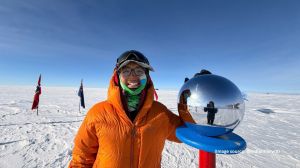
One recent morning at the bottom of the world,Kim Bernard spotted two humpback whales gorging in the Southern Ocean not far offshore. Bernard,a biological oceanographer,was spending the austral summer at Palmer Station,the US research outpost on an outcropping off the western Antarctic Peninsula.
Bernard and her team,known at Palmer as The Psycho Krillers,are studying the feeding patterns of Antarctic krill,the small,bug-eyed shrimplike crustaceans that are the central diet for whales,penguins,seals and seabirds. She is one of a growing number of scientists concerned about the effects of a kind of gold rush,as fishing companies race to the Southern Ocean to catch krill and turn it into animal feed and lucrative omega-3 dietary supplements. The former Soviet Union began fishing krill in the ocean in the 1960s,but it was not until the 1990s that Luc Rainville,a graduate student at the University of Victoria in British Columbia,discovered that the omega-3 fatty acids in Antarctic krill were readily absorbed by the human body. In 2002 he helped found a company,Neptune Biotechnologies and Bioresources,to bring krill oil to the market as a supplement. The annual krill harvest is still well within the limits set by the Convention on the Conservation of Antarctic Marine Living Resources,which regulates fishing in the Southern Ocean. But fishing is not the only threat to the krill population. The creatures,feed on algae that live on the underside of sea icewhich is retreating as the climate warms.
Scientists and environmental groups fear that as more companies deploy more vessels,fishing and climate change could prove a double blow to krill and the delicate Antarctic food web that depends on them. Im not worried at current levels of the fishing effort, said Deborah K. Steinberg,a biological oceanographer at the Virginia Institute of Marine Science in Gloucester Point who oversees Bernards krill research at Palmer Station. But I do worry about the future if the industry really starts to take off. The western Antarctic Peninsula is warming faster than most of the rest of the earth. Winter temperatures have shot up roughly 11 degrees Fahrenheit over the past 60 years,reducing sea ice cover. Those and other effects of climate change have caused Antarctic krill populations to plummet 40 to 80 per cent in the last three decades around the South Shetland Islands near the tip of the peninsula,according to research published last May in The Proceedings of the National Academy of Sciences.
The research,led by Wayne Z. Trivelpiece of the National Oceanic and Atmospheric Administration,also showed that populations of Adelie and chinstrap penguins,which rely heavily on krill,declined more than 50 per cent in the northern peninsula,where krill fishing vessels concentrate. Marine scientists are working to make sure the Antarctic krill fishery does not collapse as many others,like Atlantic cod,have. New krill-harvesting technology introduced by Aker BioMarine of Norway,the largest krill fishing company in the South Atlantic,has made it economically feasible to send vessels to the icy waters at the bottom of the world. These factory ships continuously vacuum up krill Aker calls it eco-harvesting and process it immediately on the ship.
Last year Aker,which started harvesting krill in 2006,bought a second factory ship.Many major retailers sell krill oil capsules along with other omega-3 supplements. Most come from krill oil processed by Aker BioMarine and its main rival,Neptune. Aker has gained two important allies. Its krill oil was approved by the Marine Stewardship Council,a global programme that issues labels certifying seafood products as sustainable,despite objections from some scientists and environmental organisations. And Aker has joined forces with WWF-Norway,an arm of the international environmental organisation WWF,paying it an undisclosed amount to help Aker make its fishing practices more sustainable. Aker also provides data on krill populations to WWF-Norway and scientists studying krill and its predators. Krill is one of the more sustainable fisheries today, said Matts Johansen,head of marketing at Aker BioMarine. Compared with fish oil its very sustainable. And it comes from the cleanest waters on earth,with no pollutants. Wael Massrieh,vice president of scientific affairs at Neptune,said the company was also applying for eco-certification and was awaiting regulatory approval in the US for a drug based on krill oil. Because krill is at the bottom of the food chain, he said,it doesnt accumulate as many heavy metals as fish-based oils.
Vegetarian alternatives,particularly algae-based omega-3 oil made by the Netherlands company Royal DSM NV,are also gaining ground. The claimed benefits include improving heart,brain and vision health. Back at the bottom of the world,Bernard was thinking much more about krill health than human health on a recent morning as she plunged an echo sounder from her rubber Zodiac boat into the Southern Ocean,its water just 31 degrees Fahrenheit.
The reading looked good. There was a massive influx! she wrote by email. I had never seen so much krill on the echogram before. She collected nearly 1,000 krill in a plankton net. Bernard attributed the abundance to a healthy buildup of sea ice last winter. But the long-term trend is less certain,she said,and that does not bode well for krill or the larger creatures that depend on them. On a good day just a year earlier,she noted,she had caught a mere 10 lonely krill.