


Tags:


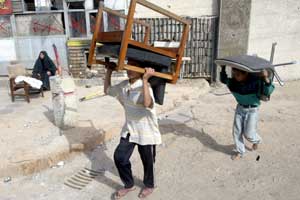
Iraqis who lived through the US-led invasion that toppled Saddam Hussein see eery similarities in the scenes of Libyans parading through Tripoli ripping up posters of Moammar Gaddafi. But Iraqis also saw looting,bloodshed and bombings in the days and years since.
8220;A lot of people think that freedom means doing whatever you want to do,8221; said Saad Abbas,who witnessed the jubilant cheering when a statue of Saddam Hussein was torn down by American troops steps from Baghdad8217;s Palestine Hotel.

Libyans 8220;are going to have revenge,stealing from the shops. A lot of problems will happen,8221; Abbas said in an interview at the hotel,which he manages.
Skirmishing,some intense,continues in Tripoli. But Gaddafi8217;s regime seems all but finished,with his leading opponents who had established their interim administration,the National Transitional Council,in eastern Libya earlier now moving into Tripoli.
The Iraq conflict provides a sober lesson: Winning the peace is often harder than winning the war.
Libya8217;s rebel military chief Abdel-Hakim Belhaj seems aware of the challenge,telling Al-Jazeera television Tuesday: 8220;We ask God to bless our country with stability.8221;
Belhaj also called on Libyans to act responsibly.
8220;We need security for our people,justice and prosperity,8221; he said.
There are of course key differences between Iraq eight years ago and Libya today. Although Libyan rebels have had NATO support,the battle to overthrow Gaddafi was an internal uprising galvanized by domestic dissent and propelled by Libyan ground forces. The presence of U.S. troops on Iraqi soil almost immediately became a rallying cry for both Sunni resistance groups and later Shiite militant groups,said Habib.
The lessons of Iraq,as well as Afghanistan,were on the minds of many in the West who feared another drawn-out conflict should the U.S. or NATO send troops into Libya.
Libya8217;s neighborhood also differs from Iraq8217;s. Tunisia and Egypt,on Libya8217;s borders,are themselves going through democratic transitions that can serve as a model for Libya.
Iraq,nestled between Sunni powerhouse Saudi Arabia and Shiite dominated Iran,essentially became a battleground for the two meddling neighbors,said Michael Hanna of The Century Foundation .
Libya does not have the stark sectarian and religious differences that drove violence to such horrific levels in Iraq. But Libya does have tribal divisions that could prove deadly if those with ties to Gaddafi feel excluded.
In Libya now,the short-term challenge is securing the capital. The undermanned American forces,with little plan for securing the country,never did that in Iraq,where the National Museum was among the sites looted.
Paul Bremer,the head of the American-backed Coalition Provisional Authority who essentially ruled Iraq during the first year of Saddam8217;s ouster,disbanded the Iraqi Army,leading to tens of thousands of angry Iraqis on the streets and fueling the insurgency.
Hanna of The Century Foundation said the rebels8217; governmental body,the National Transitional Council,has been eager to show that it is securing Tripoli.
8220;The security vacuum that opened up right after the fall of Baghdad and the looting,that was seared into people8217;s minds,8221; he said.
The long-term challenges may be tougher. The building blocks of democracy and freedom parliaments,parties and credible elections won8217;t just fall into place.
Jabir Habib,professor of political science at Baghdad University,said Libya should move faster than Iraq on important issues. Iraq8217;s first elections weren8217;t held until January 2005,nearly two years after the invasion,and the constitution wasn8217;t approved by voters until October 2005 when Iraq was almost into full-scale civil war.
Iraq also set an early policy of revenge and not reconciliation. Under a process called de-Baathification started by the Coalition Provisional Authority,Iraqis with ties to Saddam8217;s ruling Baath Party lost their jobs.
8220;Many of the qualified or good people,some of them were the wealth of Iraq,were excluded from their positions,8221; said Iraqi human rights activist Hana Adwar. 8220;If Libyans do this,I fear that will be chaos for the state.8221;
Mahmoud Jibril,the head of Libya8217;s opposition government,told reporters in Paris on Wednesday that his plan for the transition to democracy started with the formation of a national congress to which all Libyan cities would send delegates,and which would select a committee to write a constitution. He said parliamentary elections would follow the constitution within four months,and the parliament speaker will be the interim president. Next will be presidential elections.
Already in Libya,former Gaddafi loyalists have taken key roles in the opposition. Jibril promised 8220;no more alienation.8221;
What may be the most lasting lesson of the Iraq conflict may be how difficult it is to maintain unity once the celebrations over a dictator8217;s ouster is gone. Right now,Libyan rebels are united in their desire to oust Gaddafi and his regime. But so were Iraqi leaders and now the government is beset by infighting.
8220;They were together because their enemy was one: Saddam and the Baathists,8221; said Abbas. 8220;Over there in Libya,they have one enemy: Gaddafi and his family,his tribe. When they leave,the differences between them will appear.8221;


