Every morning, 63-year-old homemaker Aruna Divakaran’s laptop screen in Palakkad, Kerala, fractures into a mosaic of a hundred small squares. Each one holds a face, some looking askew into the camera. Almost all are over 60, logging in from across Kerala, Bengaluru and the United States, for Aruna’s sessions on the Bhagavad Gita, Narayaneeyam and the Bhagavatam.
Twice every day, including weekends, Aruna logs in for the spiritual discourse on Zoom. She mutes the gathering to block out the familiar sounds of their daily lives: clattering vessels, ceiling fans, the occasional passing autorickshaw, the conversation in a distant living room. Many in the gathering fumble with their newly acquired skills — logging into Zoom, staying on “mute”, keeping the video on.
Her son, an engineer, once spoke of being “in a meeting”. Now, Aruna says with quiet pride, “we also have this meeting”.
The sessions had started as physical meetings, but Aruna switched to the virtual mode during the pandemic. “I don’t know anything about technology,” she says, though her ease on the screen suggests otherwise. “There are so many old people. They have nothing else to do once their children have gone off to work and the grandchildren to school. Some among the elderly even doze off mid-session, but they turn up unfailingly. This keeps us together.”
Older adults, long assumed to be on the margins of digital life, are becoming some of its most active participants. Smartphones shape their days and their emotional worlds. Many elders now live alone while younger relatives move to cities for work. Into this solitude the smartphone has arrived as a companion, entertainer and conduit for connection.
With India’s senior population projected to reach 230 million by 2036, according to the Ministry of Social Justice and Empowerment, and the country’s cellphone use growing steadily — about 85% households have at least one smartphone (2025 figures of the Ministry of Statistics & Programme Implementation) — many more of them will be on a smartphone.
Which is why, the government’s now aborted attempt to pre-install the Sanchar Saathi app carried an added layer of privacy concern. It comes at a moment when this demographic of the elderly is heavily dependent on phones for UPI transactions, banking, pensions, and family contact, but are not equipped to navigate opaque system apps or terms of use.
Story continues below this ad
Glued to their phones
Dr Pratima Murthy, Director, NIMHANS, says that while there is “no immediate data” on the extent of digital dependence or addiction among the elderly, they are a vulnerable group, particularly in the context of shrinking family sizes. “Substance use disorders are observed in this population — for instance, the use of sleeping pills or alcohol often increases as they become more isolated and lonely. Behavioural and digital addictions are likely to follow a similar pattern,” she says.
A 2025 HelpAge India report captures this transformation in the digital space. Forty-one per cent of the elderly who participated in the survey own smartphones, two-thirds say digital tools are confusing, more than half fear making mistakes, yet nearly three-quarters believe technology has brought them closer to younger generations. For many, the device becomes the unofficial architecture of their day.
Yet, the smartphone that connects them also sucks them in.
 Sheela Goel, a homemaker, and her husband Brij Mohan Goel immersed in their phones. (Courtesy: Srishti Goel)
In west Delhi, content creator and youth climate leader Srishti Goel, 27, has watched her parents sink deeper into their screens. Her father, real estate agent Brij Mohan Goel, 58, spends long hours watching political commentary and news explainers on YouTube. Her mother, Sheela, 53, flits from bhajans to cooking videos and health advice while managing household chores. Evenings in their living room can be strangely silent.
“Sometimes we are all sitting together and nobody is talking,” Srishti says. “I have to shout, papa or mummy, will you reply?’” She has seen changes too. “My father’s attention span is affected. We repeat ourselves several times.”
Story continues below this ad
If the device interrupts family time, it deepens bonds elsewhere. Her mother is now in constant touch with her siblings. Her father’s WhatsApp groups, even ones filled mostly with greetings, give him a sense of community. Technology, Srishti says, has widened her parents’ world even as it narrows their shared space.
In West Bengal, scriptwriter Pradipta Mandal, 23, has watched similar patterns unfold. His mother, Chameli, listens to religious kathas for hours. His father, Manoranjan, toggles between political debates and science explainers. Once, Pradipta found his mother scrolling videos at 2 am. Another time she showed him an AI-generated clip of an orca attacking a girl, insisting it was real. His father speaks with growing certainty about politics — “the belief that he is better informed than the people who appear on debates”, Pradipta says.
smartphone addiction: The signs of excessive screen time among the elderly.
Clinical psychologist Dr Jasmine Arora, who works extensively with clients over 50, says older adults often experience digital content as emotionally real. “The trust they had in traditional broadcast media transfers directly to YouTube and WhatsApp,” she says.
This creates what she calls a porous boundary between digital content and emotional reality. Misleading information becomes entrenched belief. Autoplay and recommendations turn the phone into a steady companion. “For many older adults who spend long hours alone, this quickly becomes routine.”
This dependence cuts across geographies and urban-rural divides.
Story continues below this ad
Bengaluru-based archival researcher Sachin Arya has seen his parents’ immersion grow. Back home in Chandausi, in Uttar Pradesh’s Sambhal district, his father, Sompal, 71, a retired government employee, and his mother, Kanchan, 65, a homemaker, now spend hours on YouTube, WhatsApp and Google. Kanchan writes emails; Sompal uses voice search for songs. Their new skills empower them, but Arya worries too. “They believe everything on social media is true. I have to teach them about scams,” he says.
When Amritsar-based writer Rameshinder Sandhu travels home to Khasa, a village near the Indo-Pak border, he sees his aunt, uncle and father — all in their 60s— “glued to their phones”. His aunt watches Pakistani dramas, his uncle science videos, and his father’s long viewing sessions have reduced physical activity. Their WhatsApp group also offers companionship, full of jokes, old photographs and new videos. The soundtrack to this scene, he adds with wry humour, is the constant, headphone-less blare of multiple devices.
Across households, families describe the same mix of concern and acceptance. Smartphones fill the silence that once belonged to neighbours, letters, evening walks and television. They provide devotional content, family updates, recipes and medical advice. But they also disrupt sleep, attention and emotional balance.
Dr Prasun Chatterjee, chief of geriatric medicine and longevity science at Artemis Hospitals, Gurgaon, says his research on rising dementia in the 70+ demographic showed that though social isolation, empty-nesting, disconnect from peers and lack of physical activity were triggers for mental illnesses, most among those affected had built their lives around excessive screen-time.
Story continues below this ad
His OPD numbers attest to that reality. “Digital addiction among this age group was not this apparent five years ago. Of course, there is no data, but today if I see 25 persons with sleep problems, at least 10 of them are because of mobile scrolling,” says Dr Chatterjee, who is a member of the World Health Organization’s technical advisory group for healthy ageing.
Screen-time engagement that goes up to four hours is a cause for worry, he says. “That’s definitely detrimental to the human brain, particularly memory. For example, a person may be watching a reel on Bhakti sangeet. A series of reels pops up on their device by the time they are done watching the first feed. Then they click on the next, and another, often not even finishing the 30-second limit that each has. Your brain can only process this much at one go. If you are distracted and jump from one visual engagement to another, you miss key details to record a strong memory in the brain,” he says.
Given that digital apps are idiot-proof, largely involving copy-paste prompts, the capacity to learn new things and doing them manually gets affected, says Dr Chatterjee. “Earlier, the elderly would know their bank account number by heart. On a digital app, you don’t even need to remember. Besides, the blue light and the strong audio-visual imprints from your device can keep your brain agitated, leading to headaches, glaucoma and dry eyes. Then there is massive sleep debt. You would often find the elderly waking up at odd hours and scrolling, saying they can’t sleep,” he says.
Dr Chatterjee sees some of that playing out at home.
Story continues below this ad
“When I introduced my parents in Bolpur (West Bengal) to virtual media, it was intended to help them communicate with me and my family, so that they could see us, not feel the distance or be lonely. I remember my dad asking what use would platforms like Facebook be to him. Today he is busy chatting in a WhatsApp group of school friends. My mother is on her device and they are in their own isolated world, alienated from their immediate reality,” he says.
Gerontologist Dr Meenal Thakral, MD Geriatric Medicine (AIIMS), who works at a leading Delhi hospital, sees a pattern in mobile dependence among the elderly. “Most of them begin with basic calling and messaging. They are cautious at first, because the digital world feels unfamiliar,” she says.
She describes this as selective digital adoption. “They use what feels immediately useful such as video calls, teleconsults, and avoid what feels risky, especially net banking. They don’t feel confident.”
Dr Thakral says much of this stress is preventable — if technology were designed differently. “Most interfaces are not built with seniors in mind. They need larger fonts, simple icons, adjustable volume and reliable voice control,” she says.
Story continues below this ad
A new anxious generation?
For many seniors, however, the deepest fear is not about fatigue or isolation, but of being conned. Across homes and cities, older adults describe the same, persistent fear: that they might tap the wrong link, or answer a call that isn’t what it seems. They have heard of neighbours losing money to electricity-bill scams, courier frauds, cloned ATM cards or the increasingly common “digital arrest”. Many now hesitate to pick up a call from an unfamiliar number. The fear of being deceived lingers behind every notification, and every message.
How to keep the elderly safe from scamsters.
Vinit Kumar, IPS, Deputy Commissioner of Police (IFSO, Cyber Crime), Delhi Police, says the fear is justified. “Cybercriminals target all age groups, but seniors tend to lose more because they usually have more savings and often live alone.”
Most scams begin by manufacturing panic. “The first thing criminals create is fear and urgency. They want the victim to react before they can think. Digital arrest overwhelms older adults very quickly. The fear and the official tone make them believe it is real,” he says.
Many of these frauds are just a tap away. “It usually starts with a simple .apk link. The moment you install it, the criminal has access to your phone. Older users rarely recognise the danger because the link looks routine,” he says.
Kumar believes prevention must start with education. “There is no getting away from learning how to handle your phone correctly. Digital hygiene is essential now, because technology is no longer optional,” he says, adding that something as small as a 2-step authentication on WhatsApp is a useful intervention.
Story continues below this ad
Life outside of phones
Dr Chatterjee believes it is not too difficult to shed the dependence, given that the elderly are a disciplined generation, who like their routines, be it their morning walks or yoga sessions.
He suggests developing a hobby, something that worked for his mother. “She loves music and beats and realised that in the small, impromptu soirees she attends, there is no tabla player. So she learnt the tabla, now she wants to learn the piano. Learning something new challenges their brain,” he says.
He also suggests “developing a sense of purpose”. Instead of cutting down on screen time, he says, fragment it to half-hour spells so that the elderly do not feel punished. “Set a routine for reading, gardening, solving puzzles, chit-chatting with friends and fixed time for mobiles in between. Watch films and TV shows on smart TV instead of on your device. Do not take mobiles on a morning walk and stop reel-watching at least an hour before bedtime,” advises Dr Chatterjee.
In Mayur Vihar Extension, a group of men in their 80s are learning that the hard way. Only days ago, one of them lost nearly Rs 1 lakh after tapping a link claiming his electricity would be cut.
“We do not want to learn,” says V K Gohil, 85. “Our memory is weak. Cards get cloned. Computers had just entered offices when we retired.” Others have adapted. S P Aggarwal, 88, a retired telecom engineer, makes calls, uses WhatsApp and listens to old songs but avoids online payments.
Sudarshan, 72, a former bank employee, does the opposite. He uses net banking, Paytm, online shopping and experiments with AI tools. He has received scam calls and “digital arrest” threats but stays alert. “My children ask me to get off Facebook. They think I am addicted. I am trying to read more to cut down on screen time,” he says.


 13 min read




 Sheela Goel, a homemaker, and her husband Brij Mohan Goel immersed in their phones. (Courtesy: Srishti Goel)
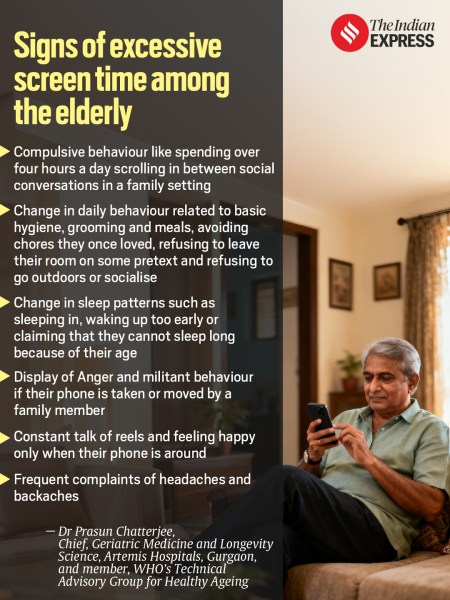 smartphone addiction: The signs of excessive screen time among the elderly.
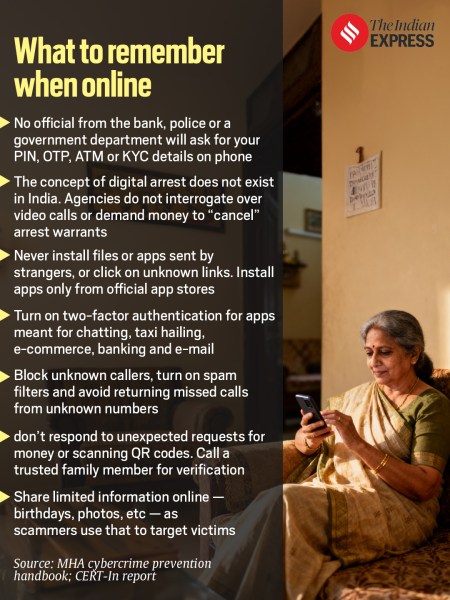 How to keep the elderly safe from scamsters.