


© The Indian Express Pvt Ltd
Tags:


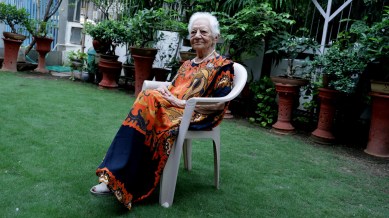
Every Saturday, 95-year-old Dr Sneh Bhargava, professor emeritus at All India Institute of Medical Sciences (AIIMS) and its only woman director ever, reviews films of the latest scientific breakthroughs — and AI, her latest obsession. “As a radiologist, I still want to learn with AI and see the inside of a human body better. AI certainly improves your diagnosis but without your patient’s history, it can’t help you. That’s why you still need to listen to your patient closely,” says the veteran who taught doctors to “humanise” technology.
Living by herself at her New Friends Colony home, tending to her bonsai in the garden and wearing her pearl strings and brooch, Dr Bhargava doesn’t mind learning new skills. Just three years ago, she took to writing for the first time. Her autobiography, The Woman Who Ran AIIMS, is out now. And thanks to it, she has also learnt to do Zoom calls with help from her secretary. In fact, she is already writing her second book on the history of radiology, her mind sharp, her memory elephantine. “I write in longhand and my secretary feeds it into a computer,” says Dr Bhargava who has marked many other firsts in her life.


Which is why she still gets the chills that the woman who would silently assess her work on the floors, and make her the first woman director of AIIMS, would lie bloodied on a gurney on October 31, 1984. Indira Gandhi was assassinated on Dr Bhargava’s first day at the job. “Everybody remembers the charade of trying to revive her when she was gone. The bullets that had punctured her organs kept coming out as doctors tried to stop the bleeding. We couldn’t even infuse the embalming liquid. But what I remember most is Mrs Gandhi’s family in shock, grief and disarray, trying to hold themselves together before the public eye when they didn’t know how,” says Dr Bhargava.
She took the lead in protecting the Sikh staff from the riots that followed, opening her home and organising OPDs at Delhi government schools where Sikh families sought refuge. “I had seen the horrors of Partition and I didn’t like what I saw,” she says.
Growing up in a liberal family in Lahore, with her father giving equal opportunity to sons and daughters, Dr Bhargava had practical wisdom. “I played doctor with my dolls but when it came to me choosing radiology, I did a SWOT analysis. By exclusion, I chose radiology because up until then, you couldn’t see inside a human body. Also doctors and specialists only focused on specific organs, and I wanted to know all about the human body, from head to toe. Besides, nobody wanted to do radiology, thinking it was just a photographer’s job, so the field was open to develop and grow with,” she says.
Dr Bhargava became the first to detect and analyse vertical B lines in an X-ray, which was the gold standard back then to detect inflammation and fluid build-up. “Tuberculosis was very rampant in India then, it still is, but at that time it was worse. So I learnt a lot of what a chest X-ray can tell you about the lungs and their complications,” she says. Gradually, she used imaging to help doctors understand problems of the heart as well.
Unlike most radiologists who submit reports, Dr Bhargava insisted on doctors giving her the patient history, correlating it with her image and then guiding the diagnosis. This symbiotic relationship helped her find acceptance over 24 years. “So if the doctor tells me the symptoms show heart disease, then the increased level of fluid in the lymphatics can help both of us assess how serious it is. If my scan shows a lung collapse, history-taking can tell me if it is due to a tumour or an infection. If the patient loses weight drastically, then it could be an abnormal tumour,” she says. Sometimes she would suggest slides from different angles for a sharper diagnosis.
It was this integrative approach that helped her lobby for a CT scan machine at AIIMS after she was introduced to it during a training session at the Massachusetts General Hospital in Boston, US. But funding was a challenge. “We got it in 1978. I spoke to cardiac surgeons and neurosurgeons, saying they would benefit the most. We sought help from our bureaucrat patients, who were posted in different ministries. That’s how we got a grant from the Swedish International Development Agency, SIDA, with help from the MEA. There were 13 projects in the race but our cardiac and neuro surgeons put up a data-backed presentation on how the scanner could help speed up surgeries and save people from going abroad to access superior healthcare,” says Dr Bhargava.
She still had an uphill task to get the ultrasound, which she managed, arguing it was safer for pregnant mothers than X-rays. “There is always initial resistance and naysayers who say whether a poor country can afford technology. But that technology has revolutionised healthcare today. With a shortage of radiologists in the country, AI can further last mile connectivity,” she says.
Dr Bhargava never thought much about gender bias. “Beyond a point, your knowledge and expertise get respected,” she says. But during her tenure at the helm, from 1984 to 1990, she did push for doctors’ quarters in the AIIMS premises. “It helped both men and women doctors manage their families and be on call for their patients. It was just a five-minute walk and I could always check on my daughter and son,” she says.
Why then are women not making a headway in STEM or becoming medical directors at AIIMS? “In my time, we promoted women doctors and researchers who were meritorious. Their numbers have increased but so has the power of political lobbying. Maybe, that’s what’s holding them back,” says Dr Bhargava.
She even worries that public health infrastructure continues to crumble despite technology. “AIIMS is a research institution but its corridors are spilling over. We must broadbase a preventive healthcare network to arrest diseases. We need to increase the allocation for public health in the budget. Till it goes up to 9 per cent of our GDP, there is no hope,” she says.
As she rings a brass bell to call her domestic staff for tea, she stretches her upper limbs. “On good days, I can still do yoga. My tummy is problematic now but I have broken each of my meals into two smaller parts,” she says. She shares another privilege she had as a student in the UK. “The India House had got students to meet Roger Moore, and I saw the handsome man before he became James Bond to you all,” she adds, laughing with a twinkle in her eye.i


