


📣 For more lifestyle news, click here to join our WhatsApp Channel and also follow us on Instagram
© IE Online Media Services Pvt Ltd
Tags:


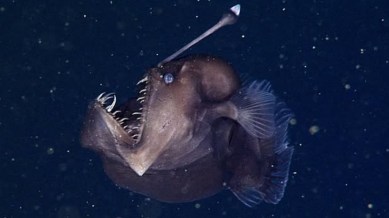
In the vast darkness of the deep sea, where finding a mate can be as challenging as surviving the crushing pressure, anglerfishes have evolved one of nature’s most extraordinary reproductive strategies: sexual parasitism.
Known for their terrifying appearance and signature fishing-rod-like appendage with a bioluminescent lure (the esca or illicium) to catch other fish, this remarkable adaptation ensures that once a male finds his much larger female counterpart in the midnight depths, they remain together — sometimes permanently.


As described by researchers at Yale University in a recent study published in the journal Current Biology, this bizarre reproductive strategy involves tiny males attaching themselves to females that may be up to 40 times their size. In some species, this attachment is temporary, with males biting the females and releasing once mating is complete. In others, the relationship becomes permanent through a process called obligate parasitism.
“Sexual parasitism is thought to be advantageous to inhabiting the deep sea, which is Earth’s largest and most homogenous habitat,” explains Chase D Brownstein, a graduate student at Yale’s Department of Ecology and Evolutionary Biology and co-lead author of the study.
When a male anglerfish finds his mate in the pitch-black expanse of the deep sea, he uses his sharp teeth to latch onto her side. What happens next is extraordinary – his head begins to dissolve into her body, their circulatory systems merge, and the male essentially transforms into a permanent sperm-producing sexual organ.
According to the Natural History Museum, the male “becomes a permanent parasite on the female, his small body left simply trailing along in the water beside hers. Slowly he fuses to her, becoming an irremovable appendage.” The male no longer needs eyes or digestive organs, as he receives all his nutrition directly from the female’s bloodstream.
In return for this all-inclusive accommodation, the male provides the female with “a constant supply of sperm. This ensures that the female can produce fertile eggs for the rest of her life, making him vital to species survival,” as explained by the Natural History Museum.
Brownstein and his colleagues emphasise that sexual parasitism doesn’t exist in isolation but works in concert with other adaptations that help anglerfishes thrive in the deep sea. Female anglerfishes possess the iconic fishing-rod-like appendage with a bioluminescent lure at its tip — a feature that gives the fish its name and helps it attract prey in the darkness.
Males, lacking this luring apparatus, compensate with “an impeccable sense of smell that he uses to sniff out his future mate in the pitch-black expanse of the deep sea,” according to the Natural History Museum.
It is important to note that this extreme form of sexual parasitism is not universal among anglerfishes. The Natural History Museum points out that “there are over 300 species of anglerfish living at various ocean depths. Parasitic behaviour and extreme sexual dimorphism… is only evident in deep-sea anglerfish species.”
In shallower-dwelling species, males and females are more similar in size, and males encounter females only to mate before returning to their solitary lives.


