‘State can’t act in violation of its policy’: Supreme Court rejects Rajasthan department decision to names villages after persons
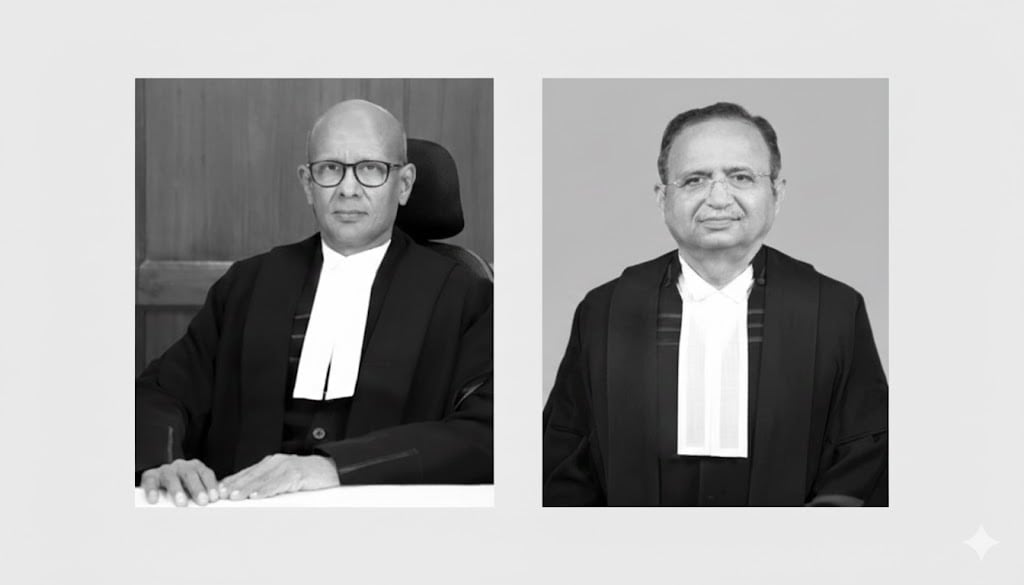
Supreme Court Rajasthan government policy: Justices Sanjay Kumar and Alok Aradhe referred to a 2009 state circular which bars naming of revenue villages after “individuals, religion, caste, or sub-caste”.
Rajasthan Land Revenue Act naming rule: The Supreme Court allowed an appeal filed by the residents of Barmer district of Rajasthan against the state’s decision to name revenue villages after “individuals”. (This image is enhanced using AI)
Rajasthan High Court village naming case: The Supreme Court recently allowed an appeal filed by the residents of Barmer district of Rajasthan against the state’s decision to name villages after “individuals”, observing it was in contravention of the state policy.
A bench of Justices Sanjay Kumar and Alok Aradhe was hearing the plea filed by Barmer district residents who challenged the Rajasthan High Court’s July order, which allowed the use of the names of individuals for revenue villages.
You’ve Read Your Free Stories For Now
Sign up and keep reading more stories that matter to you.
A revenue village is a small administrative region with defined borders. One revenue village may contain many hamlets. A village administrative officer is the head officer of a revenue village.
The apex court noted that through its 2020 notification, the state named several revenue villages, including “Amargarh” and “Sagatsar”, and found that these names were derived from the names of individual persons, namely “Amarram” and “Sagat Singh”, thereby contravening the policy framed by the state, which binds it.
The court said, “It is well settled in law that a policy decision though executive in nature binds the government, and the government cannot act contrary thereto, unless the policy is lawfully amended or withdrawn”.
The apex court noted that the Section 16 of the Rajasthan Land Revenue Act, 1956 empowers state government to “create, abolish or alter” division and also referred to a circular issued by the state revenue department in 2009 which laid down criteria for “declaring a new revenue village”.
“Clause 4 of the circular mandates that the name of a revenue village shall not be based on any person, religion, caste or sub-caste, and the same shall be proposed with the general consensus,” the court observed.
Story continues below this ad
The apex court found the said circular was in the nature of a policy decision, incorporated with an object to “maintain communal harmony” and emphasised that this policy decision binds the government.
Observing that no “legal sanctity” can be attached to the 2020 notification pertaining to the naming of two revenue villages, namely “Amargarh” and “Sagatsar”, the bench said on December 19, “The state government cannot be permitted to act in contravention of the policy framed by it, which binds it”.
Case
It was placed on record that the state issued a notification in December 2020 and created several new revenue villages exercising its powers under the Rajasthan Land Revenue Act, 1956.
The residents moved the Rajasthan High Court challenging the validity of the concerned notification particularly in the creation of revenue villages, namely “Amargarh and Sagatsar”.
Story continues below this ad
The single bench, in its July 2025 order, noted that the names of revenue villages were derived from the names of individuals, namely “Amarram and Sagat Singh”, who had also agreed to donate the land.
Therefore, the single bench ordered to quash the notification and granted liberty to rename the revenue villages in accordance with law.
This order was challenged before the division bench which set aside it and allowed the appeal which came to consideration before the top court.
The apex court quashed the division bench’s order and restored the single judge’s decision.
Story continues below this ad
Arguments
The residents contended that the division bench erred in overlooking the fact that the names of the said revenue villages were clearly based on the “names of individual” and was in direct violation of the 2009 circular issued by the state government.
On the contrary, the state urged to not open settled issues and argued that the statutory procedure prescribed for the creation of revenue villages were followed and stated that the 2009 circular was merely “directory”.
It was also argued that the residents lack “locus standi” since the 2020 notification does not cause any “legal injury” to them.
Richa Sahay is a Legal Correspondent for The Indian Express, where she focuses on simplifying the complexities of the Indian judicial system. A law postgraduate, she leverages her advanced legal education to bridge the gap between technical court rulings and public understanding, ensuring that readers stay informed about the rapidly evolving legal landscape.
Expertise
Advanced Legal Education: As a law postgraduate, Richa possesses the academic depth required to interpret intricate statutes and constitutional nuances. Her background allows her to provide more than just summaries; she offers context-driven analysis of how legal changes impact the average citizen.
Specialized Beat: She operates at the intersection of law and public policy, focusing on:
Judicial Updates: Providing timely reports on orders from the Supreme Court of India and various High Courts.
Legal Simplification: Translating dense "legalese" into accessible, engaging narratives without sacrificing factual accuracy.
Legislative Changes: Monitoring new bills, amendments, and regulatory shifts that shape Indian society. ... Read More